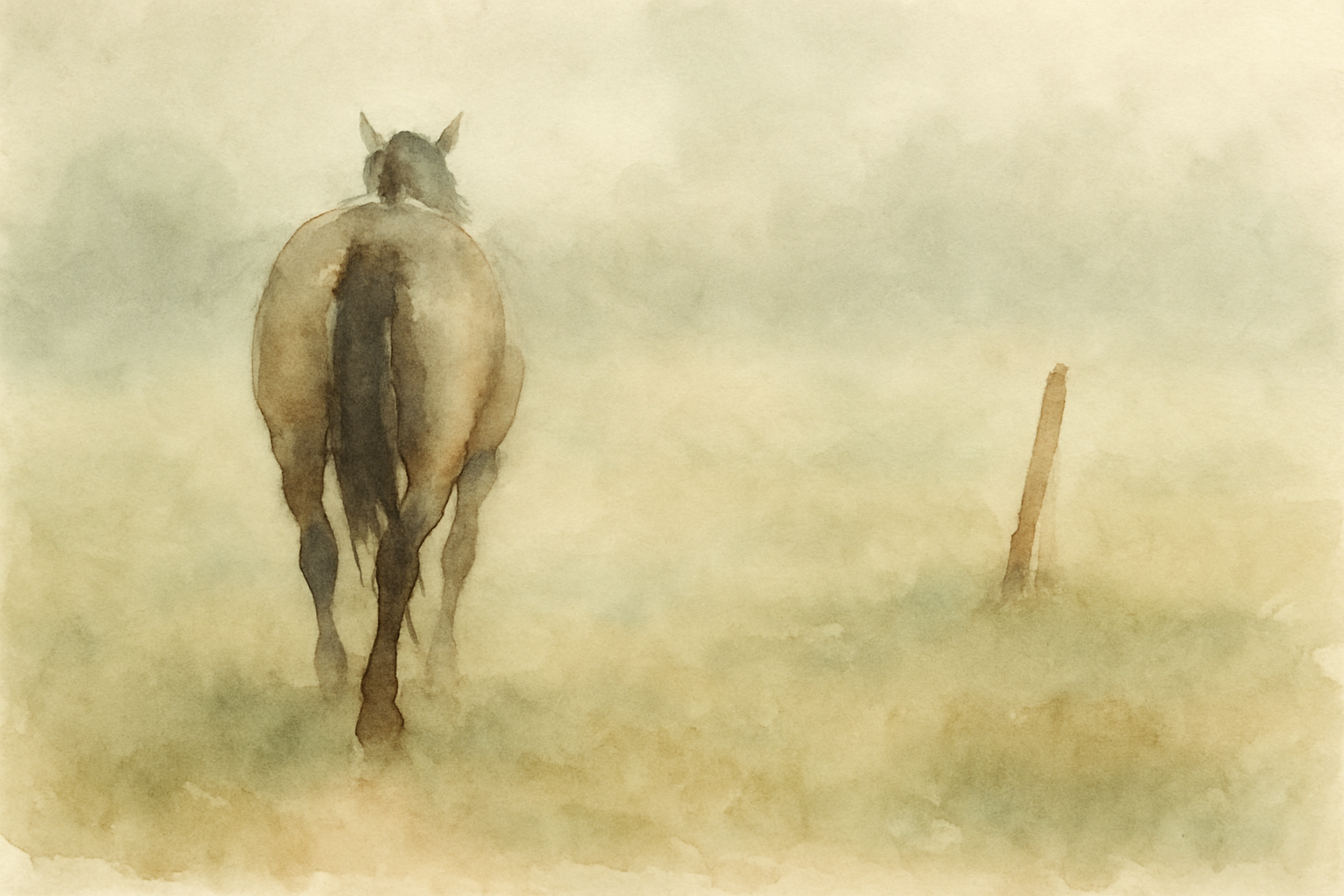
The Farmer's Horse
El Caballo del Granjero
A student reflects on the compulsion to identify problems and fix them, especially in parenting, and how the humility of not-knowing opened a new way of moving through life.
The Farmer's Horse
A student reflects on the compulsion to identify problems and fix them, especially in parenting, and how the humility of not-knowing opened a new way of moving through life.
I resonate with so much of what everyone shares in this group. Although sometimes I'm very quiet for long periods, I find a lot of value in what others bring, and I get a lot out of it.
I wanted to share some things that have been happening for me recently. A lot of what has been pointed to for all of us, in our different worlds and different concerns, keeps coming back. There's this recurring theme for me: there's a problem, and I have to solve this problem. The illusion that I know what the problem is, that I'm going to do all this research and fix it, and that after this problem is fixed I'm going to arrive somewhere. It took me so long to learn that maybe there is no problem. Maybe my idea that it's a problem is the problem. It's just so humbling to see that I'm creating so much chaos in my own life.
What comes up for me is the story about the farmer and the horse.
That's from Zen Buddhism. The farmer has a son and a horse. The son falls off the horse and breaks his leg, and the townspeople say, "Oh, your son broke his leg, how unfortunate." The farmer says, "Whether this is good or bad, I don't know." Then the kingdom goes to war and all the young men are conscripted, but the son can't go because of his broken leg. Everyone says, "You're so lucky your son doesn't have to go to war." The farmer says, "Whether this is good or bad, I don't know." And then because the son didn't go to war, something else happens. There's this constant reframing: what seems so good balances out, what seems so bad balances out, and at every point the farmer says, "Whether this is good or bad, I don't know."
Yes. "I don't know." That's exactly it. This idea of me knowing, but in reality I don't know.
I feel like my son is a unique individual who doesn't really fit within the norm of what a lot of other families experience, and it's been so hard trying to figure out how to be a good parent for him. I spent hours researching on the internet, thinking I was going to be the best parent. It was really hard to just follow his lead and arrive at a place of, "Maybe I don't know. Maybe there is no problem. Maybe this is exactly what he needs, and he knows what he needs."
The habit of problem-solving
I kept hammering down on activities, thinking we needed to spend more time at home, get used to routines, focus on this or that. It was all me trying to problem-solve, trying to figure things out. What I actually needed was to let all of that go. I reached out to people, tried different parenting groups, followed things that popped up, drove halfway across the city to listen to people talk about these special kids. It took me so long to realize that I can't do this alone, and that I need to be curious and talk to others. I finally said, "This isn't working. I have to try something different." And that has helped me so much.
When you talk about being in a place of curiosity rather than knowing, that resonates deeply.
Knowing is the end of curiosity
Knowing is the end of curiosity. It's also the beginning of madness, because we really don't know.
I would get so neurotic. "We need to try this, this, this, and this." It took so much of me just to stop.
What you're describing points to a better way: not knowing whether anything is good or bad. You still have to act and make decisions, but you do so from a place of exploring and going with your deepest insight in the moment, knowing that you don't know. The moment you are convinced you know, humans will start acting more poorly, because that knowing only comes from believing something we cannot really verify as true.
I would look for things to validate my ideas.
Of course. That's going to be theories, people, all kinds of confirmation bias and validation. That's how humanity operates. People don't want to be around those who show them how mistaken they are and how false their beliefs are. It's not fun. We open up to that only when things really stop working and we arrive at a place of humility: "I don't know what I'm doing. This is not working."
Being curious and trying new things and talking to different people has completely turned things around for me. So now I have this other idea of what I should be doing.
Acting without certainty
Just remember that you have a tendency to become convinced something is a problem, and that you can and will have to solve it, and then you convince yourself of a solution. If you can see that pattern, you can hold it differently: "Whether this is good or bad, I don't know. But I'm interested in this direction. I have a feeling it might be better, but I don't know. So I explore, and I'm open to seeing what happens, and I'm open to being wrong."
There is a risk when we dismantle all this conviction of knowing. The risk is becoming paralyzed and overwhelmed, stopping altogether: no acting, no moving, no exploring. So the combination is acting, moving, and exploring, while knowing that we don't know.