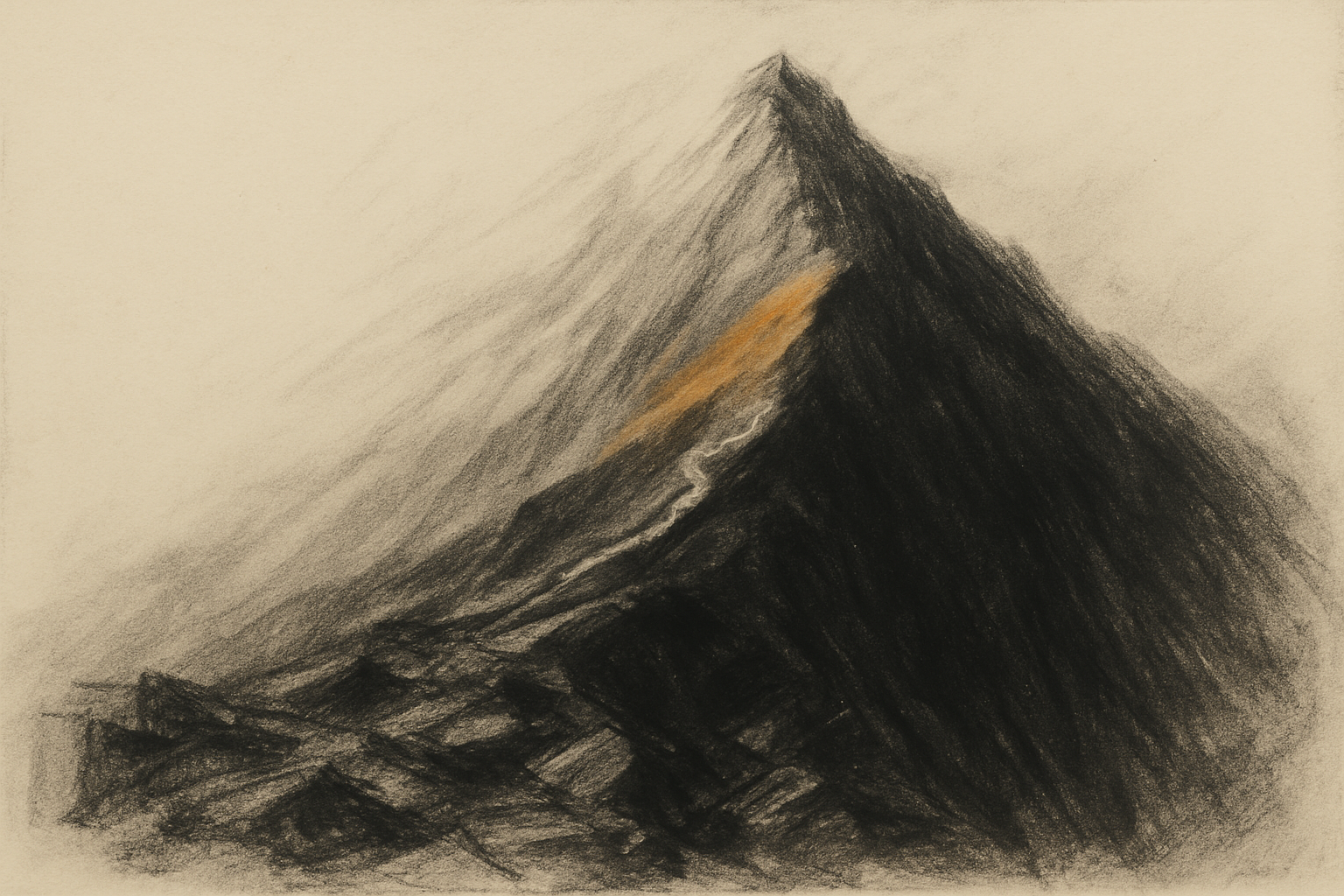
Needs, Wants, and Your Everest
Necesidades, deseos y tu Everest
This meditation invites you to notice where fear holds you back and to orient your life around what you genuinely love and want most.
Needs, Wants, and Your Everest
If I need something in order to survive, because if I don't have it I'm in extreme malnutrition and I'm going to die, well, I need it in order to survive.
But is it actually a need?
It starts to become more like a lot of it is just what you want.
In that case, all of it.
Where we draw the line
We draw the line of needs a lot higher than it is.
Then it's really about what do you want, how you want to live.
Also, if I'm hungry and there's no food around the corner, it's going to be hours till I eat something, and I have an attitude that I need to eat in order to be okay, I'm going to have a really rough time.
But if I drop that and just see I'm fine because I'm eating in a few hours,
I'm just going to be hungry,
then that's a good day compared to the other one.
I could have a great day, just a hungry one.
Then the priorities can be set straight.
What do you really want?
What do I really want?
What's the thing I love the most for this day,
for this day,
for this week, for this year,
for this life,
for this minute,
for this hour?
It's always an open question.
It's interesting to think also about what gets in the way.
Yeah, it's mostly just beliefs,
because even when I say, what do you love the most,
it's not personal.
There's an interpretation that there's a thing here that is what loves.
Your Everest
There's that documentary about the woman who summited Everest, what, 20 times?
A great example of answering this question of what do you want.
It is quite specific in that.
She was living in Connecticut, had two daughters, had a safe life.
She was a receptionist, she worked in a safe way.
She was safe.
She was comfortable.
She had become American, but her life and her daughters were a mess.
Only when she risked her life over and over again and brought her daughters did they all heal and have a good life,
because she was following the calling,
the longing, the dream, the love that she had for that mountain.
And it's a documentary. It's not even science fiction.
It's really amazing.
So you could think, yeah, what is that?
Your Everest might not be hard like an Everest in that sense. It might be hard in different ways.
Yes, you could say it's your Everest.
That which we think is too much, too big, too hard,
but actually staying in Connecticut is harder, metaphorically.
Living from love or from fear
It's almost like the Everest is an orienting factor to have you question:
am I living from love or from fear?
It's a good metaphor because it's that grand of a vision that is possible.
And I say grand intentionally in the sense that it's really, what's the thing you love or want the most?
I might change that and use the word love more.
But I like thinking of it as a desire, a want.
It's what you love the most.
What is it, really?
And it could be just to be a father.
That's an Everest.
That's huge.
And then the question becomes how, and in what ways, or what kind of father,
so that the fathering becomes the Everest.
How high can you get?
Don't settle for less than the most beautiful, loving vision of a father that you can conceive of.
There's no limit to how much we can develop, grow and learn and be better.
There's no limit.
So it's like an infinite Everest, yeah.
One that never ends, always going for what you love.
Through relationship
There's a paradox in there where, as we were describing earlier, it's cultivated through relationship.
But through that cultivation it can expand.
It's still about the relationship.
It doesn't cease to be about that relationship, even if it sort of spills over to other areas or to other Everests.
Through the relationship, we can see what is real, if we approach it with openness and love.
And the more you see what is real, what is true, what is present,
then what is there is prior to the relationship.
It's what sustains relationship.
The love is prior to the relationship.
It can be discovered through the relationship.
And then it can be celebrated and expressed and lived and learned through the relationship.
Through relationships.