The Free Fall Beneath Identification
La Caída Libre Bajo la Identificación
A student describes a deepening recognition that what she sees "out there" is not separate from herself, and the teacher explores how the mind pulls us into identification as a way to avoid the deeper, more mysterious feeling of free fall.
The Free Fall Beneath Identification
A student describes a deepening recognition that what she sees "out there" is not separate from herself, and the teacher explores how the mind pulls us into identification as a way to avoid the deeper, more mysterious feeling of free fall.
What I've been experiencing these days is a kind of progression. First I figured out that resistance is not so helpful. Then I saw that resistance itself is the problem. And then it went further: not just embracing, but seeing that it's all part of the whole thing. What I've been feeling recently is that I allow myself to be swallowed by the fire. That's what it feels like.
That deep feeling is the path, is the door.
The more I'm rooted in the reality of it, the more it unfolds. At first it's like receiving a great teaching. Then it becomes, "I can use this teaching." And then it becomes, "I am this teaching." The more I realize that, the more deeply things come up. And it's hard, because I can't look on the outside and say, "Isn't this world terrible?" It's me. There's no difference. It's just me that I'm looking at.
So it cuts both ways. The more I realize that when I listen to you, I'm listening to me, the more I get that on a deeper and deeper level. But then the more I realize it's me, the more excruciating it all becomes, because the others are me too.
It's you and it's not you. It's both.
The pull to take a position
That's the trick, I think. Who the hell am I? That's what's up for me. It feels like me, but then I find I'm looking at it, and I can't say, "This happened to me in my childhood," or "I've got this shtick going on." I'm watching the shtick happen. I'm seeing it, but I haven't dropped it. Conditioning is conditioning. I see that, but I haven't dropped it.
Just notice: there is a really deep tendency, and it gets more subtle. There is an attachment to a position. There is going to be a temptation, and I don't mean that in a metaphysical way; I mean it in an energetic way. The temptation is a kind of magnetic pull to take a position, and it's going to involve the mind and an interpretation. The position is, "That is me," or, "That is not me."
That's why I said it's both. If I say it's both, then it confuses the mind so that you aren't able to so easily identify. When you notice you're taking one side, you'll be able to see, "I'm taking a side. But if I'm both, what am I?" That's the way to address the tendency of this pull to take a position.
So, not allowing the mind to say, "That's me," or, "That isn't me." Is that what you're saying?
It's not about you not allowing that. It's about seeing it.
The mind as instrument
Right. What I mean is, the mind can confuse me and make the identification feel real?
It's the other way around. We use the mind. The mind is not the culprit. It's the relationship to thought. The mind becomes the instrument of illusion, the aid in illusion. I can construct a position and then take a position.
For example: "What is bad in the world is me." That's a position. So then, it's both me and not me. "What is bad in the world is not me." Where does that leave me? At the level of thought, it doesn't work. I can't resolve that. I can't rationally be both that and not that. And so that creates a kind of koan, so that a deeper disidentification can happen.
But part of the process is this: if I'm always identified with "what is bad is out there and not in me," that position needs to be shaken. But then if it gets reverted and resolved into the opposite, as in, "What is bad in the world is actually me and only me," that's another position, an opposite illusion.
I don't see it as only me.
I understand, but this is the kind of thing the mind is going to do.
In other words, it wants to define or label, and it's just none of the above and all of the above. Is that what I hear you saying?
Ultimately, it's what we do in the freedom to buy into any illusion we want. The mind becomes the instrument for playing in that illusion. It's a free play, but it's the kind of game that will bring suffering.
When I'm not so pained by what I'm seeing around me, when it's just a regular, "Okay, this is happening, that's happening," what seems to show up is simply seeing. Just seeing.
Yes.
Identification as a way to avoid deeper feeling
Is that what you're describing? Or is that already too much?
No, it's fine. Because ultimately you went to a place of very deep feeling, and that is a doorway. All of that magnetic pull into identification is a way to not feel.
To not feel what, even?
What we don't want to feel. Especially if it feels horrible.
But I feel horrible. So maybe the identification is that I don't want to feel good? It goes either way?
More likely, what happens is this: when we feel horrible because of identification, it's a more manageable horrible. It's a more manageable horribleness than the deeper feeling.
The deeper feeling feels like free fall. That's what I feel sometimes. It's like being on a roller coaster I did not pay to get on.
The choice between contraction and free fall
Exactly. The sense is free fall. And because it's more mysterious, it's going to be unknown. There is a sense of possibly an impending doom, a feeling that it's going to be the end of me. Ultimately, a sense of death.
Now, with that comes an option: identify, create a mental map of what reality is and what I am within that reality, and contract into it. What this does is avoid the free fall, avoid the deeper feeling. It feels horrible, it's suffering, but consider the alternative: free fall into the unknown, with potential disappearance into nothingness. That is what one option feels like. The other option is contracting into the manageable known. It is suffering, but I'm used to it, so I'd rather stay here.
That's the choice. And what this teaching does is say: try the other one. Try it out. Go through it, because there is a coming out on the other side.
Yeah.
But the journey is free falling into the unknown, with possibly the end of me. And it is, in a sense, the end of me.
What happens is we're always dancing between these two. The contraction and the suffering get to be too much. We tiptoe into the free fall. There's a bit of relief, a bit of fright. We go back to the contraction. It's that dance: contracting, expanding, contracting. Until something really shifts. And it is, ultimately, a deep choice, when we just don't want this contraction anymore and we're willing to taste this journey all the way.
There is no rush for any of this to unravel. That's why I was saying this contraction into identification is a play, in the sense that there's a part of us that is having fun with it. Until it's not fun.
The mind offers branches
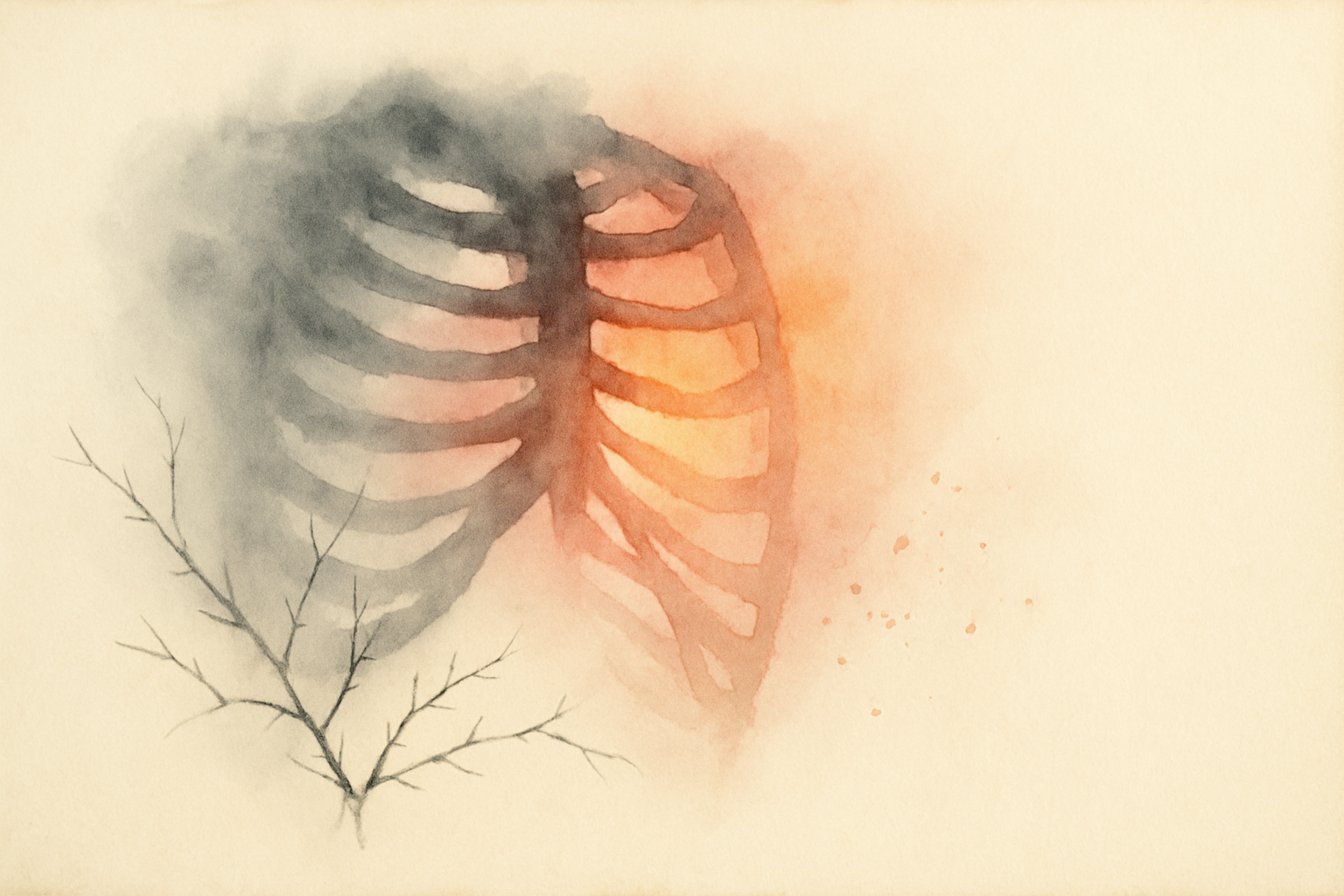
So notice: when you're coming close to that free fall, the mind is going to kick in to give you all the worlds of possibilities for identification. Here are all the ropes you can hang on to. Here's a rope, here's a branch, here's a stick, here's a ledge.
In that free fall, you're going to go to the mind and say, "Give me a branch, I'm falling!" And the mind is going to say, "Oh yes, the world is like this, and you are a part of it in this way, and this is what you are." That starts to create an idea of what I am. That's the branch I hold on to. That's the identification.
The free falling is the disidentification.