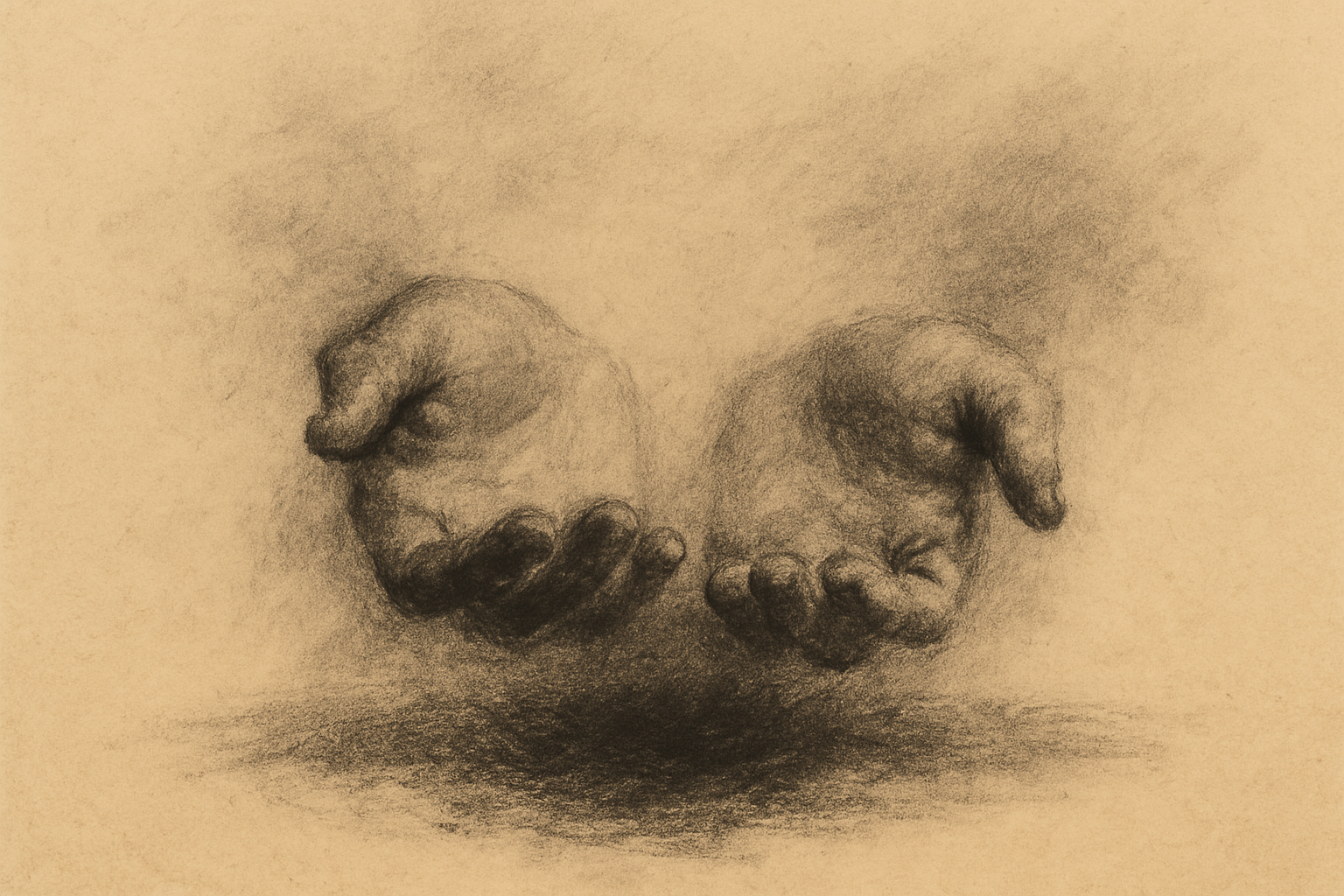
The Humility of Not Knowing What to Do
La humildad de no saber qué hacer
A therapist asks about the painful contraction that arises when sitting with distressed clients, and the pull into a sense of being a doer who must fix or help.
The Humility of Not Knowing What to Do
A therapist asks about the painful contraction that arises when sitting with distressed clients, and the pull into a sense of being a doer who must fix or help.
Things are softening, and I'm getting more moments where separation isn't noticed here. There's just this moment and being a part of it. What I notice now is the ways in which I create separation. They're like neon lights: I can see them so clearly, they stick out, and they're very painful.
I wanted to ask you about one in particular. I've noticed that when I'm with my therapy clients, there's this feeling, arising out of just being there in presence, of not wanting to disappoint them. I want to help them. I want to know what to do. Especially when there's a lot of distress in the client I'm sitting with, it's really noticeable because it pulls me into a sense of a doer, a sense of "I need to do something."
I was sitting with it in meditation and I noticed there was a kind of sweetness and innocence to it, a sense of just wanting to be helpful with somebody I care about. There's love there. But I also know there's something I'm not seeing, something I'm trying to push. Could you comment on that at all?
What comes up has to do with the frame through which you operate in your work, and how you imagine or conceive that you help. I know that's a rabbit hole of a question, and I'm not sure where to go in answering it because it's really a conversation for many sessions. But I think that's where the crux will be.
In a sense, an antidote will always be matching that with the understanding that you can't help, not in an absolute way, but as a balance. It's really not up to you, and there's nothing you can do, and it's neither one nor the other. Holding both of those will keep the process of how you can help somewhat in check, so that it doesn't become too important or too self-involved.
It doesn't feel like it's about me needing to have success or anything like that. It feels like I'm responding to something, and that response pulls me into a doing mode. It doesn't feel like I need to be the savior. It feels more like an unconscious response to distress, or to a sense of watching the client struggle. It's more like "I need to know what to do here."
The implication of doing
Yes, but it implies that there's something you can do. That's why I'm saying: bring into your awareness the notion that there's nothing you can do. Hold that as a partial truth, like the yin and the yang, so that it balances all of the energies of you being there to do something.
So you're saying it's both. I tend to go either/or with it: either I can't do anything, or I'm doing everything.
The mind will want to pick a side, and then that will be the solution, the strategy, the fix.
It feels very visceral, very uncomfortable. There's a sense of contraction in the body, a pulling into a self. It only happens with a few people, but the ones it happens with either have a lot of distress or I'm worried they might lose faith in therapy. And there's a visceral thing where their body and my body are reacting to each other. There's just this reaction of distress meeting distress. It's almost below any level of thought. The bodies are connecting in a way that is below whatever my conscious intent is. There's just the body responding to my client's bodily distress.
Conditioning and the mechanism of selfing
All of that is just the conditioning. All of the discomfort, all of those movements, the body, the energetics: that has to do with body, mind, and conditioning. It has to be included; you can't just push it away. But keep that in the balance where it's really not up to you, and it's not either one or the other. Because it's all the mechanism of selfing, which you described.
And notice how you will tend to keep referring back to "but there's something else, but there's also this, there's also this." That's the mind looking for some other path, some other thing to address, some other dynamic that's happening with the client. It's pulling you away from just presence. There is room and a necessity for you to engage, to speak, to do the art and the practice that you do. But anything that starts to move you away from the complementary reality (not the absolutely true reality) that it's not up to you and you can't do anything, that's where the identification takes hold.
Or I'm not even doing anything. It's so clear, and yet there's still this pull.
You can't do anything, and it's not up to you. But that's just half of it. In the yin and yang, that's one side. If you drop one side and the other becomes more prevalent, you're getting pulled into a mind identification, a mind-body strategy.
Stepping into a role without becoming it
That's what feels so difficult: it is the yin and the yang. Part of it is that I am a psychotherapist working with clients, so that's where it's hard to blend those.
You're stepping into that role. But there's a difference. You're not that.
Right. But I'm saying in that moment, I am in that role.
I understand. In normal speaking, you would say "I'm a psychotherapist." But in this moment, I think it's important to be precise. During the session, you are in only one way stepping into the role. But if you then become that, it's identification, and all of the aspects you're describing will become more activated and more in the way. Ultimately, all you can do is be in presence. If there's no presence, no matter what you do, nothing will work. And what is presence? It's not identification.
But how do you be in the role, and this goes for all roles maybe, when the role implies certain techniques or certain behaviors, and yet you're not identified and you're in presence? Is it that the behaviors of the role just happen naturally when they do? Is that how you see it?
I would say that's for you to explore. What I'm suggesting is to keep in mind, in some place in your attention when that's happening, just the directive, the pointer: "There's nothing I can do. It's not up to me." That acts as a short circuit to part of the process that's happening. It's going to push you into a constant balancing.
I can see that. I get it.
A seventh of your attention
If we keep talking about what it would look like and how to do it, we fall into the side of strategy and technique. So instead, keep this pointer. One way to think of it: keep a seventh of your attention in God. This comes from the idea of Sunday being the day for God in Christianity, using one day of the week to pay attention to God and then forgetting about Him the rest of the days. But the suggestion is to keep a seventh of your attention in God at all times. It's a metaphor, a pointer.
In a similar sense, keep in your awareness during the session this pointing: there's nothing you can do, it's not up to you. You have no power to help, fix, or change anything, and you don't need to have it, because it's not up to you.
That's only half.
Right.
Because that itself can become an identification. So that's why it's like keeping a seventh of your attention. In what? What is God? It's mystery. It's what I cannot comprehend. It's what's beyond me. It's what's not up to me. It's the power that I do not have.
Because my attention is in presence. I feel that all the time, even in session. But that's different. You're saying it's about something else.
It has to do with how you operate, at the level of navigating how to relate, what to say, and also what's happening in your body and your energetics. To a degree you're already doing this, I'm sure of it. It's just a deepening because of what's been happening, what you've been sharing.
The best times in therapy are when something comes out of thin air, something I say that I haven't even tried to produce. It just comes out. That's coming from a different place. I recognize that.
So that's really helpful: to keep in mind that there's nothing I can do and I don't have the power to change anything. Just keep reminding myself of that during the sessions.
Humility and the middle way
And also: you can never fully know or understand what is needed.
That's really true. So in a way, it's a bit of humility.
Absolutely. And it's also not just humility; this is the movement towards freedom. Freedom from the belief that it's up to you and you can do it.
But I want to clarify: it's freedom from that because that's what's pulling you. For the next person, the freedom might be from "there's nothing I can do, it's not up to me." Because from that freedom, you can move, you can do a lot, and a lot is up to you. The mind is very tricky. The ways in which we identify are multiple and complementary.
This is the middle way in Buddhism. They talk about views, meaning what perspective I'm stepping into. If I have the view that it's up to me and I have to do it, that perspective can become an identification. If I hold the view that it's not up to me, there's nothing I can do, that too can become an identification. Now, what's the middle path? Both are true, both are false. Yin and yang. At some moment, in some situation, more of one is appropriate; at another moment, more of the other is appropriate.
Right. They're both views. They both pull you into a view. Either one colors everything. Thank you so much. I appreciate it.