The Ocean and the Waves
El océano y las olas
A student describes their practice of holding attention in awareness and asks whether a more open, allowing approach pointed to during meditation is a different or better practice.
The Ocean and the Waves
A student describes their practice of holding attention in awareness and asks whether a more open, allowing approach pointed to during meditation is a different or better practice.
I've been spending a lot of time in this practice of self-remembering, trying to hold my awareness in the sense of awareness. I've been doing a lot of meditation, a lot of guided meditation, and just taking it easy in my human life, going on walks. I feel like I don't really know what to do human-wise, so I'm putting a lot of energy into just being in the self. But in today's meditation, you gave a different pointing, and I've heard this before when I was in India. It felt different. You said something like, "Don't try to force your attention. Allow the thoughts. Just observe the happenings of the body and sensations." It felt different because I had been so focused on harnessing my attention in the sense of presence. Is one better than the other, or is it the same thing?
Concentration versus freedom
The practice of observing thought and staying connected to the breath, for example, is a very common meditation practice. It won't go very deep, but it is valuable. It's going to strengthen an aspect of the mind. You can use a kind of willpower, pushing against the temptation and the movement into thought, staying connected to the breath. That is valuable. It's like harnessing and strengthening an aspect of the mind, and it's going to create positive changes in the body-mind. But it's not the same as freedom from.
The freedom from will come from seeing what's happening, seeing what's pulling you into the mind and away from sensation. That requires a different kind of looking.
Sorry to interrupt, but which one is the one I've been doing?
I'm using the example of paying attention to the breath as an illustration of the type of thing I think you're doing. Does that resonate?
Well, it's like awareness, so it's not an object. It's the sense of being.
Okay, so you're, so to speak, putting awareness in awareness, noticing what you called the self. What happens when you do that? Do you feel that you're efforting there?
Yes, because the mind wants to wander and it wants to have opinions about the experience I'm in. It doesn't feel natural to be in that space completely.
How is thought not awareness?
So in a sense it's the same. How is the mind not awareness? If there's an efforting away from thought and into awareness, that is separating thought from awareness. So I'm asking you: how is thought not awareness?
Well, thought is inside awareness.
How is it separate? I could have water inside of a glass, and the water is not the glass.
I'm not sure I understand your question.
You're moving your attention or your awareness away from thought and into awareness. Where is thought, and where is awareness? How are they two?
Well, I am aware of the thoughts for sure, because the thoughts will come in and I recognize them. I'm in the body, I'm sensing the sounds, I'm trying to just be present with the experience while maintaining the awareness of awareness. This is how I was introduced to non-duality ten years ago.
Every pointer has its limits
That's fine. These practices, these pointers, are all useful, valuable, some extremely valuable, but they're always context-dependent. Every pointing, every technique is going to take you so far and then have limitations. What you're describing is a very valid, valuable practice, as is paying attention to the breath and sitting with breath awareness for hours. It's very valuable, but it's not going to take you to the end, to absolute freedom.
The practice of putting your attention or awareness in awareness needs to be refined. It could actually go very far, but it needs to be refined. What is awareness? That's why I'm pointing to subtleties around the objectification of awareness. When you place your awareness in awareness, where is it going?
That's the problem. I definitely use the visual field when my eyes are closed, and I notice that there's something looking at the darkness. Then sometimes I feel like I'm not focused on the visual field, and something expands, and I'm just in awareness. I know I'm in awareness mentally, I guess. That's the experience for me.
The knowing that never stops
You're describing shifts in perception and attention, state shifts. Through all of that, there is a knowing of what's happening. Whatever is happening, even if you're totally immersed in thought, there's a knowing of thought. That cannot stop. Even through all the shifts of the mind, the expansion, the contraction, the darkness, the visual field, whatever is present, the knowing of it is there as well. That is what I would call awareness or consciousness.
But also, when they say "thoughts appear in awareness" or "in consciousness," that can create an interpretation in the mind: that there's a thing called awareness, and then there are things that appear inside of awareness. They're not separate, but they're two different things. There's a subtle separation there, a subtle distinction. Sure, they're in the same thing, so they're not separate, but they're actually two different things. I can say this laptop is in the same room, in the same space as the table, but they're two separate things. That's a subtle mental map around what awareness is.
If you know consciousness, you cannot move away from it or towards it, because it is what you are. When thoughts are appearing, the movement away from thoughts to awareness is a fiction. It's a valid practice up to a point, but eventually you start hitting this fictional distinction between thought and awareness, even if thought is understood to be appearing in awareness.
The taste of allowing
I think what you were describing in the meditation, when I gave some direction around not doing anything, around allowing, is that you may have had some taste of: "Oh, there are thoughts, and I can be with thoughts, and there's no problem." Is that what you were referring to?
Yeah, it was more of an open, allowing, observing energy, as opposed to a focused one.
Versus focusing, pushing, pulling. Yes. And that's what you're coming up against. In a sense, the practice you've been doing has reached its end. You can always refer back to it when you're really getting pulled into the illusions of thought. But when you're more stable in that awareness, and thoughts are over there, and you're noticing some bit of efforting or pushing, pulling, focusing, that's where I recommend you explore the allowing. Because the wakefulness is in the thoughts as well. It is possible to have a really big activation of thought, a lot of thoughts happening, and you're completely in awareness in the middle of thoughts. Not by pushing away. It's all there. It's just a thought soup, and all the thought is awareness.
So I focus on observing.
Less focus, more allowing. But also: what's this distinction between thought and awareness? Look for that distinction. There's a subtle interpretation, a subtle object of what awareness is, different from thoughts.
Right. Because the thoughts are actually appearing as me for a moment, just like the sensations and the sounds.
The ocean and the waves
That's appearing, yes, but let's focus on thought. When thoughts are appearing and the mind is activated, or the body and emotions are activated, you might then refer to awareness as a way to find some center. You used the word "self" in the beginning, and I think what you call "self" and what you call "awareness" are the same; you're using two words for the same thing. How is that separate from or different from thought?
Well, it's not coming and going.
But it's in the nature of what thought is that it is indistinguishable from awareness.
In the nature of what?
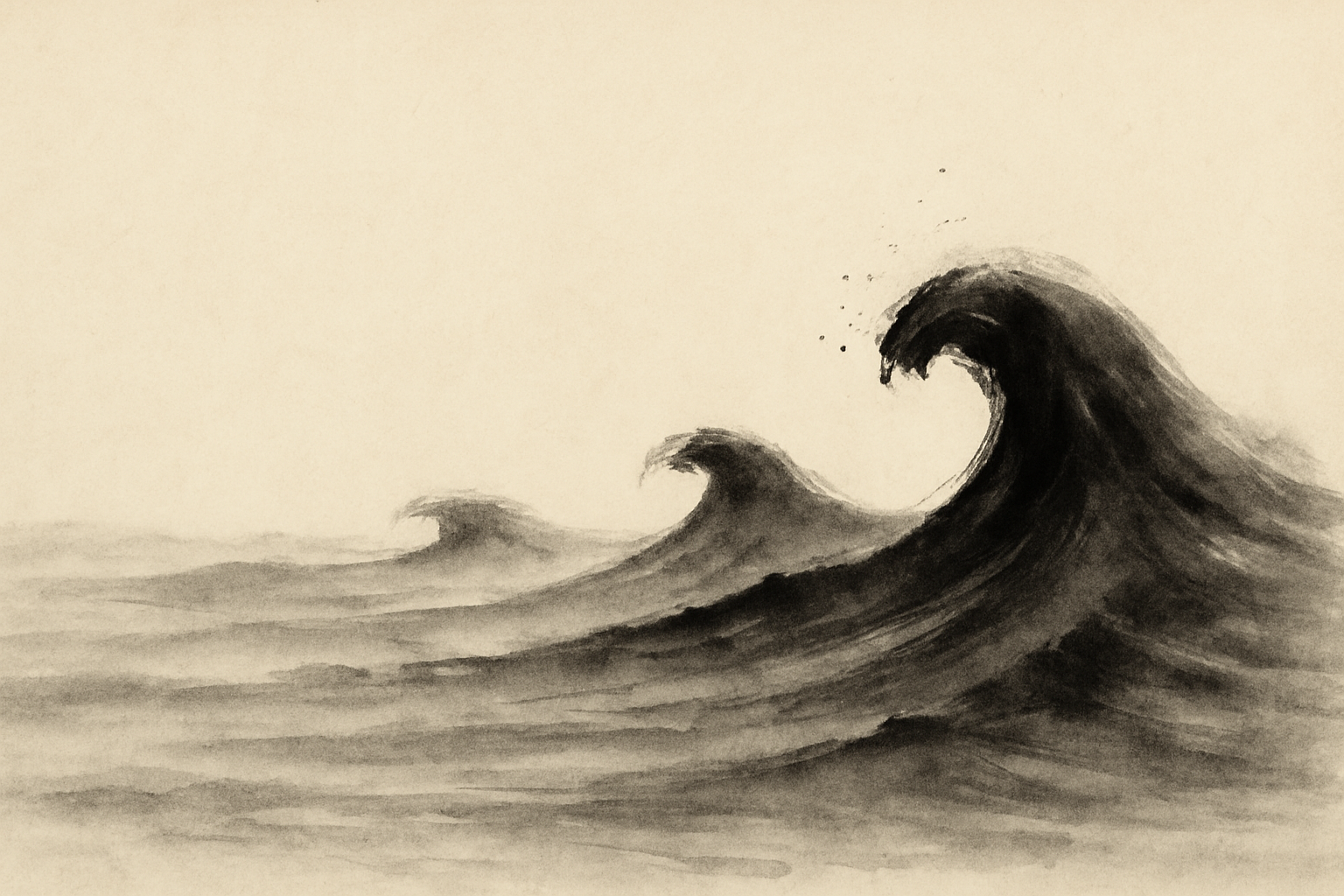
I'll use a metaphor: the ocean and the waves. You are using effort to push away from the waves in order to be connected to the ocean, but you are recognizing the ocean as the stillness underneath. I'm asking you: how are the waves not the ocean? Or, what's the difference? You're saying, "Well, if I go underneath, it's quiet and still. On the surface it's very busy and choppy." But if you're moving towards awareness in the metaphor of the ocean, why is surfing or swimming on the surface not the same?
This is for you to explore in your experience. When you're noticing this focusing, this pushing or pulling away from thought, there's some kind of division, some distinction that says, "That's not awareness; this is awareness."
But isn't there something special that happens when you put your focus on the awareness and it starts to expand, and that's all you have to do?
Yes, but if I go with that, I'd say: it's all you have to do, because then you will see what I'm pointing at, as part of that.
Right. So I can still be in the awareness.
So in my day-to-day life, if I'm going for a walk or talking to someone, the practice is to still be in the awareness, I'm assuming, but not pushing away the thought.
I'm asking something more general. You're saying you go for a walk with a friend. How is the friend not awareness? How is the walk not awareness? How is all of that not awareness?
Well, it is, but I get focused on the person and I start operating in the old way. I forget the awareness.
You think the thoughts about the person are not awareness.
So I guess what I'm hearing is that instead of focusing on being in the awareness, it's better to just be in the observer. Is that the new thing?
Not the observer either
No, because how do you distinguish awareness from the observer? The observer is a position. I'm asking you, in a sense, what are you calling the observer?
The one that's not trying to maintain a focused mode of operating from the awareness, but more just noticing what the thoughts and the body are doing. I noticed that distinction in the meditation today. Otherwise, I'm not sure what the practice is.
In a sense, what I'm pointing to is not a practice, but it can shift your practice. It's a seeing of the nature of what is appearing: what is thought, what is sensation, what is perception, sight, sounds, and the knowing of all that.
When you say you move away from thought into awareness, which is a valid practice, I'm asking you to look at and explore what that distinction between thoughts and awareness actually is. There is an illusion there that has to do with a subtle interpretation of what awareness is, one that turns it into something you can refer to, something you can go towards and away from. When you're in thought, you're away from awareness. When you're in awareness, you've arrived. This is a valid practice, but to a degree, at another level, it's reinforcing an illusion.
Recognizing it's all water
The metaphor is the ocean and the waves. All we know is the waves. All we know is the surface. We have never gone into the depth. So the practice is: swim down, and you will know stillness. But then you can stay stuck in this movement, always away from the surface because it's too choppy, into stillness, and you run out of breath, go back up, run out of air, go back up. You're stuck in this back and forth. What I'm saying is: just be with the ocean. Notice it's all ocean. Once you are able to swim into the depth, then you can start to recognize that it's all water. When I'm walking, I'm with my friends, I'm thinking, the same nature of what was down there in that stillness, which I called awareness, is right here in the waves.
I'm presenting that more as a question so that you look and find it in yourself. I'm describing the answer in words and using a metaphor. But that movement down and back up, getting pulled up, going back down, all of that will start to appear as: what am I moving away from? What am I moving towards? Because actually the same depth in the depth of the ocean is present in the waves.
The same depth of awareness, the same freedom, is in the thoughts, is in the body sensations, in perceptions.
I hear you. And lately, in certain moments when I catch myself in a thought, I've had the reflection: where is this thought coming from? It doesn't feel like it's coming from my head. Is it coming from the field? It doesn't have that same story that it's appearing from my brain and is inside me. It just feels like it's appearing in me, but I don't really know why or where it came from. It's so interesting.
Yes, it is.
So is the question "Who am I?" still a valid practice?
Who am I can go all the way
Yes, it's valid, because "Who am I?" will point to: thoughts come and go, images of yourself come and go, sensations come and go, thoughts come and go. Everything is coming and going, and I'm still here. So I cannot be thoughts; I cannot be sensations. That clarification is one initial clarification that can be deepened, because there are always deeper, more subtle thoughts that I identify with. But that only goes halfway.
In the metaphor: you're a surfer, surfing on the waves, and you think you are the surfer. I'm saying, no, you're the ocean. But when you ask "Who am I?" you realize you don't even identify with the surfer; you identify with a wave. You think you're this wave. Then you realize the waves are coming and going, constantly shifting. There is no such thing as a single wave, and when that wave disappears, I'm still here. I'm still aware of these waves. These are the thoughts, the sensations. You start to notice: I'm actually this deep thing, awareness, from where I look at the waves.
I am that. But then I'm saying that's only halfway, because now you're in a sense identifying with the opposition from thoughts. That's great, that's a good practice, you've gone into depth. You see the waves, all the thoughts you thought were true, the sensations, the body, the mind, and you realize: all of that's coming and going. One day the ocean is totally flat, there are no waves, and I'm still here. So I can't be the movement of the waves, that which I thought I was. But then I'm saying: when the waves are there, how are you not the waves? You're the ocean.
"Who am I?" can take you all the way. Because: I am not the waves. And I am not not the waves.