When the Waves Are the Ocean
Cuando las Olas Son el Océano
A student explores the distinction between awareness and thought, and the teacher questions whether that distinction is as real as it seems.
When the Waves Are the Ocean
A student explores the distinction between awareness and thought, and the teacher questions whether that distinction is as real as it seems.
In meditation today, I noticed it was more of an open, allowing, observing energy, as opposed to a focused one.
Versus focusing, pushing, pulling. Yes. And that is what you are coming up against: in a sense, the practice you have been doing has reached its end. You can always refer back to it when you are getting really pulled into the illusions of thought. But when you are more stable in awareness, and thoughts are over there, and you notice some bit of efforting, pushing, pulling, or focusing, that is where I recommend you explore the allowing. Because the wakefulness is in the thoughts as well.
It is possible to have a really big activation of thought, a lot of thoughts happening, and to be completely in awareness in the middle of those thoughts. Not by pushing them away. It is all there. It is just a thought soup, and all the thought is awareness.
So I focus on observing?
Less focus, more allowing. But also: what is this distinction between thought and awareness? Look for that distinction. There is a subtle interpretation, a subtle object of what awareness is, as if it were something different from thoughts.
The nature of thought and awareness
The thoughts are actually appearing as me for a moment, just like the sensations and the sounds.
Yes, that is appearing. But let us focus on thought. When thoughts are appearing and the mind is activated, or perhaps the body and emotions are stirred up, you might then refer to awareness as a way to find some center. You used the word "self" earlier, and so that which you call self, which you call awareness (and I think you are using two words for the same thing): how is that separate from, or different from, thought?
Well, it is not coming and going.
But it is in the nature of what thought is, that which is indistinguishable from awareness.
In the nature of what?
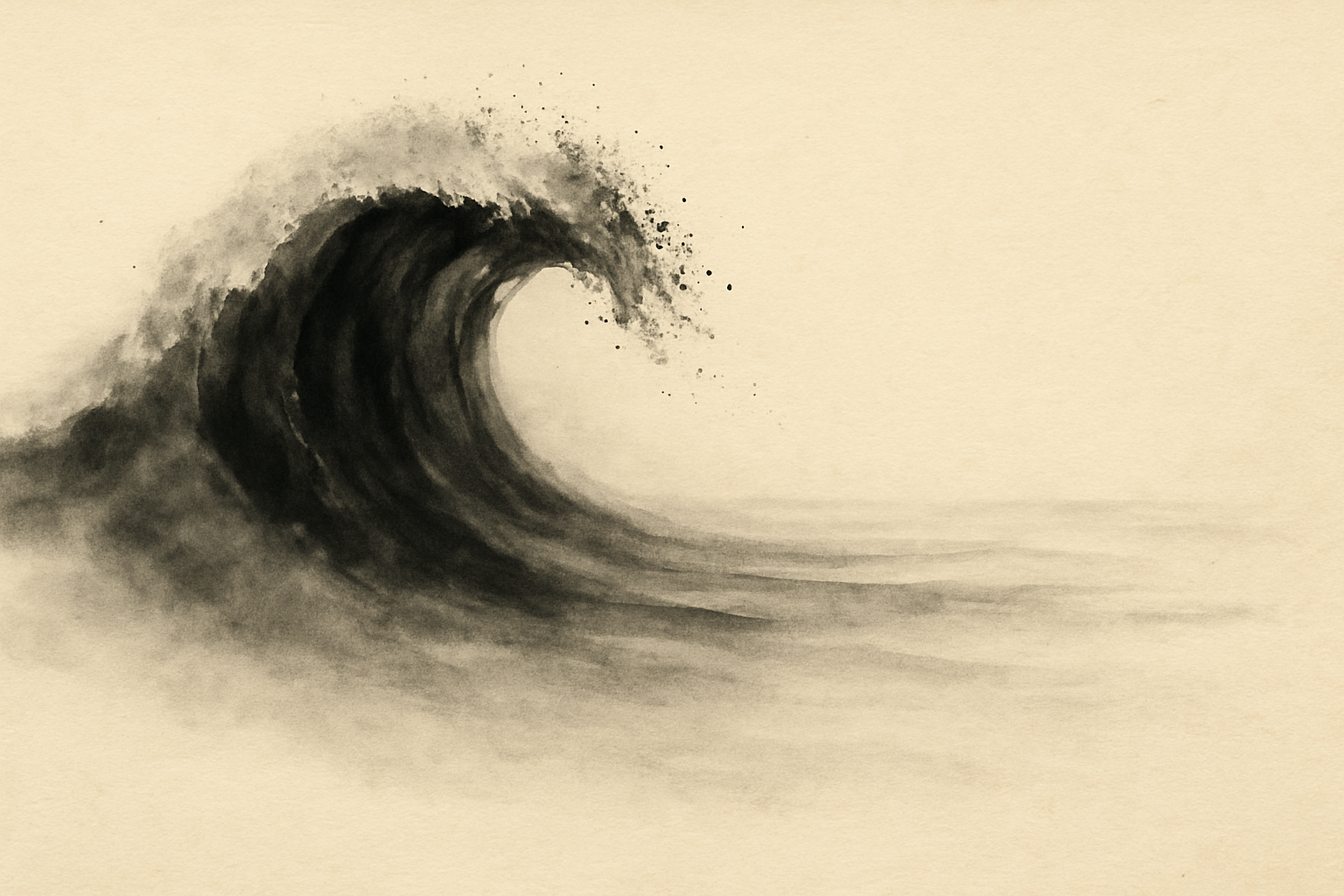
The ocean and the waves
I will use a metaphor: the ocean and the waves. You are using effort to push away from the waves in order to be connected to the ocean, but you are recognizing the ocean as the stillness underneath. And I am asking you: how are the waves not the ocean? What is the difference?
And you are saying, "Well, if I go underneath, it is quiet and still. On the surface, it is very busy and choppy." But I am asking: if you are moving toward awareness (in the metaphor, the ocean), why is surfing or swimming on the surface not the same?
This is for you to explore in your experience. When you notice this kind of focusing, pushing, or pulling away from thought, there is some kind of division, a distinction that says, "That is not awareness; this is awareness."
But isn't there something special that happens when you put your focus on awareness and it starts to expand, and that is all you have to do?
Yes, but if I go with that, then I say it is all you have to do, because then you will see what I am pointing at, as part of that.
So I can still be in the awareness?
The practice in daily life
In my day-to-day life, if I am going for a walk or talking to someone, the practice is to still be in the awareness, I am assuming. But not pushing away the thought.
I am asking something more general. For example, you go for a walk with a friend. How is the friend, how is the walk, how is all of that not awareness?
Well, it is, but I get focused on the person and start operating in this old way. I forget the awareness.
You think the thoughts about the person are not awareness.
So I guess what I am hearing is that instead of focusing on being in the awareness, it is better to just be in the observer. Is that the new thing?
No, because how do you distinguish awareness from the observer? The observer is a position. I am asking you: what are you calling the observer?
The one that is not trying to maintain a focused mode of operating from awareness, but is more just noticing what the thoughts are, what the body is doing. I noticed that distinction in the meditation today. Otherwise, I am not sure what the practice is.
Not a practice, but a seeing
In a sense, what I am pointing to is not a practice, but it can shift your practice. It is a seeing of the nature of what is appearing: what is thought, what is sensation, what is perception, sight, sounds, and the knowing of all that.
When you say you move away from thought into awareness, that is a valid practice. But I am asking you to look at, to explore, what that distinction between thought and awareness actually is. There is an illusion there, having to do with a subtle interpretation of what awareness is, that turns it into something you can refer to, something you can move toward and away from. When you are in thought, you feel you are away from awareness. When you are in awareness, you feel you have arrived. This is a valid practice, but to a degree it is reinforcing, at another level, an illusion.
The metaphor is the ocean and the waves. When all we know is the waves, all we know is the surface, and we have never gone into the depth, then the practice is: swim down and you will know stillness. But then you can get stuck in this movement away from the choppy surface into the stillness. You run out of breath, you go back up. You are stuck in this oscillation.
What I am saying is: just be with the ocean. Notice it is all ocean. Once you are able to swim into the depth, you can start to recognize that it is all water. When I am walking with friends, when I am thinking, the same nature that was down there in the stillness, which I called awareness, is right here in the waves.
I am presenting this more as a question so that you look and find it in yourself. But that movement, down and back up, getting pulled up, going back down, will eventually prompt the question: what am I moving away from? What am I moving towards? Because actually the same depth of the ocean is present in the waves. The same depth of awareness, the same freedom, is in the thoughts, in the body sensations, in the perceptions.
Emptiness and the unnameable
I hear you. Something like love or truth is substantial. Is that right?
Yes. And try to turn love or truth into something ponderable, an object you can put in a book or do commerce with. The more you conceive of it as that, the more it is not what it is. That is not what love is. That is not what truth is. If you put truth and love in a rule book, it is not truth and love.
Is it the same with emptiness and form, or what some traditions call spirit and the manifest world?
What we call spirit, anything that you can name, is not the unnameable. Even something you call spirit, or essence, or substance.
But the emptiness is not a name for the unnameable?
You could say "unnameable" is the name for the unnameable, but it is not what it is.
But those words are not referring to something altogether other than that?
It all has to do with the appropriate tool for the appropriate illusion. "Emptiness" is a word that, when used in the context of "emptiness as form," is a tool pointing to something. It is not true or valuable in itself. When I use the word emptiness, I might be pointing to something in the context of what we are discussing. But that which it points to, once it is known, reveals that the word is just a word, far from what it points to.
There still does seem to be a little bit of an apparent duality in my experience, and I am trying to find the right question.
I hear you. Emptiness has been used extensively in Buddhism to refer to that which appears to be a self, that which appears to be an object. The more something appears to have its own objective essence, an essence that belongs to itself (like the self, the body-mind, the objects in the world), the more that appears to be something with its own source, that is actually insubstantial. Substantiality refers to what is essentially real.
The pull toward a separate self
Do you think it is a better investigation to just look at what makes me want to create a separate self?
Yes. What you have been exploring is valuable too, but I think that is a really interesting exploration: to see what is the pull. Why am I tempted? What is the gain?
That was part of the meditation earlier. Instead of trying to push away from thought and come into presence, and then noticing you have been taken by thought, just let that happen and notice what is going on. Why is it so tempting? What is the pull into thought, into identification, into stories? What is that helping with? Not as a philosophical exploration, but in the actual experience of the sensations. Is it a discomfort? A pain? An anxiety? A restlessness? An emptiness that thought helps to resolve?
The knower and the known
Should I try to experience the world as myself?
It really depends on what you refer to as "myself," but I would say yes, with a qualification. The world, therefore thoughts, therefore sensations, appearances, what you see, what you taste, what you smell, what you hear: how is any of it different from that which knows it, meaning yourself?
I am being precise about the "myself" part, because "myself" might mean a particular body-mind, and it is not that. That would be like saying the laptop is the table; it is a futile experiment. But if it is the knowing, that which knows, how is it different from what is known?
Consciousness can be defined as that which is hearing the words I am speaking right now. More precisely: the reality that is hearing them. That which knows what is happening, that which knows these words, is what is real. How is it separate or different from what is known? That is how I would frame what you described as seeing that you are the world.
So to hold both?
No, it is not both. It is exactly not both.
So it is to see that the knower and the known are the same.
Yes.
I got it. Thank you.
You are welcome.