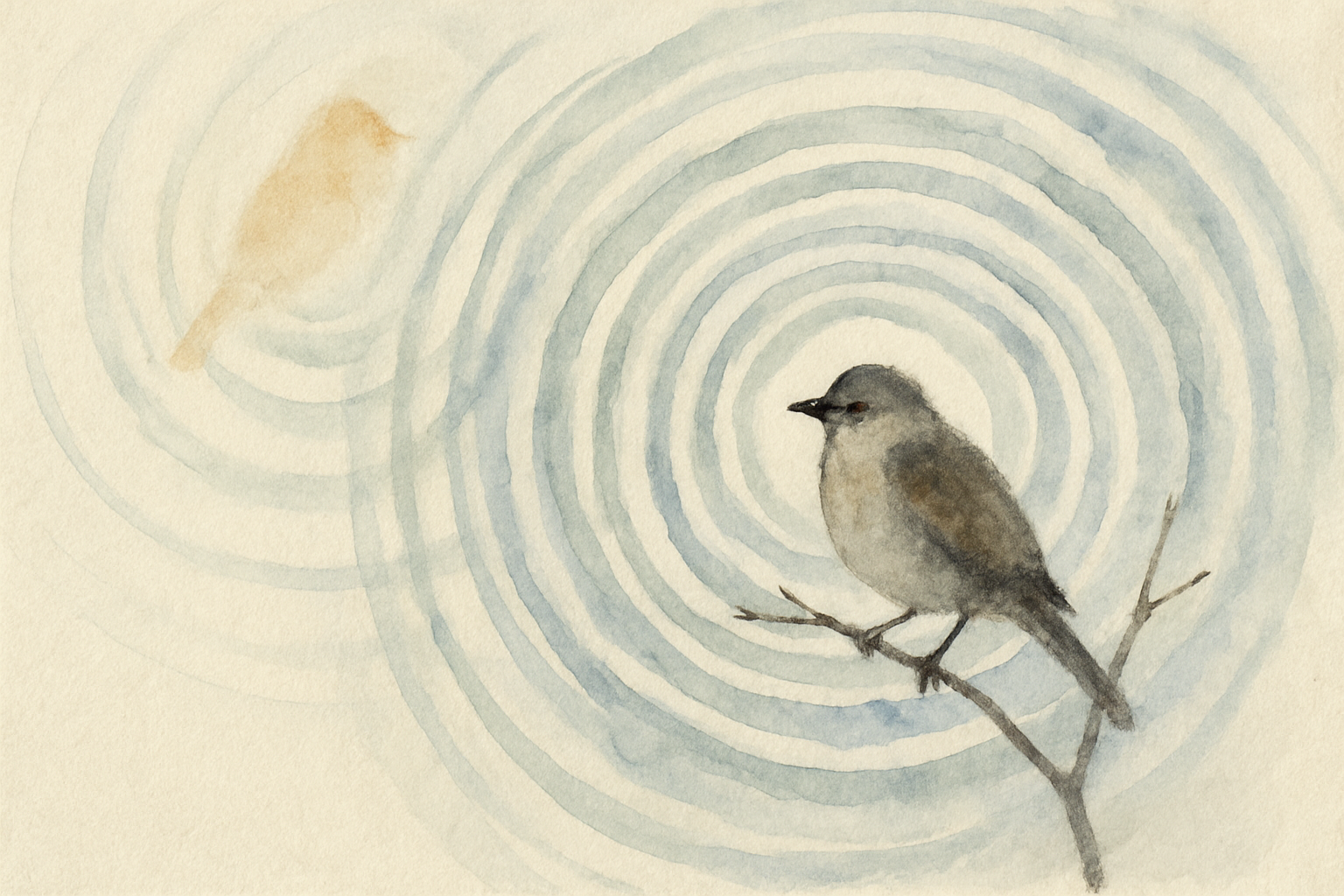
The Sound and the Bird
El Sonido y el Pájaro
A student who has long struggled with the distinction between direct experience and interpretation discovers a subtle but crucial shift: instead of trying to stop interpreting, simply notice that interpretation is happening.
The Sound and the Bird
A student who has long struggled with the distinction between direct experience and interpretation discovers a subtle but crucial shift: instead of trying to stop interpreting, simply notice that interpretation is happening.
I was watching a video where you were talking with someone about direct experience versus interpretation. I've been hearing people talk about this for ten years, and I just don't get it. Frankly, it's not the end of the world if I don't get it. But I do have curiosity about it, even though I resist that curiosity.
Do you resist having curiosity?
I hate curiosity. It irritates me. And what it brings up, to be perfectly honest, is that it feels like you're saying I'm blind, like my eyes have been gouged out. You're leading a meditation saying, "Look around and see all the splendid colors," and I feel like I just can't see.
So the first question really is the difference between direct experience and interpretation. It's very simple, but it's very elusive, because from a very young age, after so many decades, we instantly name things. There is an experience and, immediately, there is a thought. If you hear a bird sing, when the sound happens, you experience "a bird is singing." There's the sound, and then it's wrapped in the thought "bird singing." You instantly recognize it. A car drives by, and the sound gets recognized as the sound of a vehicle, some form of engine. The direct experience is the sound itself.
I know the theory. I just have no idea how to detect the difference.
The texture of perception
That's for you to explore. If you have curiosity for it, you could sit with the experience of sound, or even with sight. But sound is a better place to start because with sight it's very hard to separate the interpretation. With sound, both aspects are more abstract. The experience will be that, instantly, there is an interpretation. There's the sound of a car, the sound of a bird, the sound of whatever is happening, and the knowing that it's a bird, it's a car. All you need to know is that the bird-like nature of the sound of the bird singing is a thought.
What is "bird-like" about a bird singing?
It's just the sound. It's not the bird. I'm calling it "texture" to point to the abstract nature of a sound. When a bird sings, there is a texture in the perception of sound, and then there is the imagination: "bird." All you need to recognize is that there are two aspects. There's the texture of sound, and then there's the imagined bird.
I see what you're saying. Like attributing something. I think the penny just dropped.
You could take that and then struggle with it, trying not to interpret the bird sound as a bird. But that's not the point. The point is to notice the difference.
Noticing, not stopping
I notice that the interpreting is so deeply ingrained that I don't even notice I'm doing it. Maybe it's like so many other things that have helped me: just notice that I'm interpreting, instead of trying not to interpret. I think that's where I've been tripped up, thinking, "Don't interpret." But how can I not do what I'm already doing?
Exactly. Trying not to interpret is a never-ending struggle. The interpretation will dissipate on its own. The more you recognize the difference, it dissolves as an aftereffect. It's just about noticing the difference, seeing what really is. There's a texture of perception, which we call sound. And there is the imagination, the label. The same applies to sensations in your toes: there's the texture of sensation, the tingling, and then there's the image of feet, toes.
It makes me wonder why this has tripped me up for so long. I get the theory. I think it's this one almost imperceptible pivot, which is actually a huge pivot: I've been looking for the direct experience, instead of simply noticing the labeling.
The direct experience is always present. And having thoughts that label is not the problem. The problem is when the label becomes the real object. When you hear the sound of a bird, the central experience becomes the imagined bird, and the actual sound recedes into the background.
What's really helpful for me is something that also makes me want to cry. Talking about these things, I feel so alienated. It feels cold and foreign, like I don't belong, like I can't go there, like I'm not made for it. I've been listening to these dialogues, and many of them have me sitting at the edge of my seat, but I have such a strong reaction to the ones that feel overly analytical. For me, the way in is to just embrace the experience. It has a whole different texture.
I'm glad I spoke up, because I wanted to explore both the topic and my personal reaction to this kind of discussion.
---
I really enjoyed the meditation. You touched on very vulnerable, very sensitive spots. I'm having a hard time with resistance lately. I'm in a place in my life where I'm trying to do new things, and as much as I take on new challenges and celebrate them, there's always somewhere I can't quite go, something I can't quite bring myself to hold. It's very difficult for me, and I'm also very hard on myself about it. It could be something as simple as making a phone call to ask someone basic questions. It's not so much the act itself, but also the aftermath. If I don't do it, I'm hit with this reality check: "I just don't have it in me. I don't have what it takes." It's almost like an identity I put on myself.
What I found useful in the meditation was this sense of knowing the experience for what it is, relating to it differently. I was able to feel into the pain and all the thoughts and the turmoil, and allow it to exist without putting a label on it, without coloring it. Or even though it's already colored, experiencing it in a new way.
You're putting it well. Even if there is a label, even if what's appearing is self-criticism, all of that can also be seen. What matters is that you see it for what it is, which is what you describe: "This is a label. This is an identification." That is the doorway to seeing things as they are.
Being with the difficult labels
It was a very sensitive and intimate experience to be with the difficult labels, to be with the difficult fears and doubts. I was trying to open up to all these sensations, to all of "what does this say about you?" I was trying to melt into that rather than control the fact that it was happening.
Melt into it, and recognize it for what it is. Especially: what is sensation, what is perception, what is thought, what is emotion. Rather than trying to change what is, recognize: this is sensation, and here is the intimate direct experience of it. This is thought. This is a sense of contraction. This is a sense of resistance, the taste of resistance, the taste of self-critical thoughts appearing. And recognize them as imagination. This is mind stuff. It's not true. It's not reality. It's mind. It's thought.
At the start, I didn't know how to relate to the meditation. I was just floating around in my body. For me, it's important to have an anchor, and my breath is usually useful. But then what you said about letting whatever is happening take you where it needs to go, I felt that deeply in relation to my own fears. Letting myself experience the pure horror of the experience, in a way, shifted it into something I could allow to be there.
And that allowing invites a tasting of love. In a sense, it's being able to love the horror, not in the sense of wanting it to be what it is, but in the wisdom that it's worse to reject it, and that the doorway is in the allowing.
The worry about losing the opening
I'm worried that I won't be as gentle or as allowing after this session. It's a very sensitive thing. I'm still afraid.
I understand. It's delicate. And what is the direct, intimate experience of that, right now? There are thoughts, worries, thoughts about the future, thoughts about things being a certain way you'd rather them not be, negative consequences. Those are all thoughts, which create emotions we call fear, which you're experiencing in some form.
But there are things in my life I want to confront, things I want to do. And it feels like such a powerful force, the avoidance. It doesn't even believe I could go there.
That's the fear.
It's like not seeing what's on the other side of a wall. Not wanting to go there, but knowing that most likely there's a whole different picture on the other side.
The deeper want and the avoidance
And you cannot know. Part of the beauty is that everything is always mysterious, surprising, and new. Even when things appear to repeat, nothing really ever repeats. You're touching upon something important. There's a life force, a human aspect that has its own value: to live fully. You called it a powerful force of wanting, and I'm not against that. I'm fully in favor of it. This work in no sense goes against that, not in the way I know it. In fact, it frees you to live the deeper life force fully. There's a true, deep life force that is fully alive and in line with wakefulness. And then there's the wanting and desiring that is problematic, that comes from fear, from the mechanisms we use to avoid what we really want. Those are two forces pulling in opposite directions.
What is it that I really want?
That's an exploration. It's a deeper and deeper unfolding: allowing, exploring. It clarifies the more you are able to see through illusions. The temptation to keep an illusion as something real is the avoidance. To make it more practical: take the example of calling a friend. There's a desire for connection. What you really want is to connect with this person. But the mind can imagine all the ways it could go wrong, all forms of rejection, all forms of shame, all kinds of negative outcomes.
Because the mind activates fear and all these possibilities, there's going to be a temptation toward something else, something that isn't the deeper want. So there's the wanting of connection with the friend, which, hypothetically, is the deeper want. And then something else arises: "Actually, all I really want is to watch something on Netflix." Or just go to sleep. Whatever feels like, "No, actually, what I really want is this other thing."
But if you taste and look deeply, more and more you'll start to recognize the flavor of something that's more real and the flavor of something that's fear-based.
You're saying it's always worth following what's more real?
Yes. It's freer, more loving, more beautiful.
Some people are very good at just facing things straight on. I'm not like that.
That's a good way to classify yourself as "not in that camp," so why should you bother? You're not made for it. That's not for you. That's the "go to sleep" direction.
Identity as avoidance
I guess that's where I'm stuck. For a long time, my identity has been this avoidant person.
That's what identity is. All the work on identification is exactly that. That's what it is for everybody: a form of avoidance and self-categorization. You categorize yourself as the person who is not able to go left, and what you really want to do is go left, so you create a life of going right. That is suffering. At the heart of it is "I know what I am: the one who goes right and doesn't go left." That creates a sense of security, a sense of control, but at its source is suffering and its motive is avoidance.
The peeling away happens only through going toward it. And there are many complementary ways for that to happen. It's nearly impossible to know what you're really avoiding without first doing some disidentification. Without seeing through the illusions of thought, it's almost impossible to recognize what you really want. So with the meditation, just accessing some of that intimacy, you can taste: "Oh, this is more than avoidance. This is more of what I really want."
Otherwise, how can you convince a drug addict that what they really want isn't the drugs? Their experience says, "That's all I want. I want nothing other than the drug." Some work needs to be done to recognize that the drug is an avoidance, that they want something else. And there needs to be a willingness to see the truth. Seeing the truth means letting illusions dissolve, letting yourself see that what you think is real is not. There's a humility in that, even a humiliation. "I'm wrong. I've been attached to something false, something that has been working against me." That has an aspect of pain. It could be an actual substance, or it could be a form of behaving. It's always some addiction to a form of control through thought and emotion.
That's very fitting, because I did struggle with that for a while: what I think I want versus what I really want in the bigger picture.
What we really want and what we most fear
What we really want starts to become very similar to what we're most afraid of. Back to the example: calling a friend versus going to sleep. Which is scarier?
They're both quite scary. But I think going to sleep is scarier, because I know it's coming from avoidance.
I was hoping you'd say that, because you're aware of the self-betrayal in it. And that's really good, because it means, in a sense, you're screwed. You can't be fully taken by illusion. "Screwed" in a good sense, because there's an aspect to it of not being able to go into denial anymore. To love truth more than illusion really starts taking us to a place of surrender. And surrender, by definition, is not what we think we want. At a deeper level, yes. But we would like to be free without having to surrender. It will always include the fear of the unknown. But once you are able to taste the fear of the unknown to a point where you can sit with it and savor it, you're free. Free from the need to avoid.
That's beautiful. I think I touched on that a little during the meditation. This intimacy with the unknown feels like a very beautiful way of putting it.
When we no longer need to make the unknown known, we stop going into illusion. The unknowable is, by definition, what cannot be known. When we make it known, we go into illusion. So when we can be with the unknown and savor it, we are free from the need to live in illusion. And that savoring is an acquired taste. It takes a bit of time. It's like giving the finest wine to a five-year-old: he's going to spit it out.