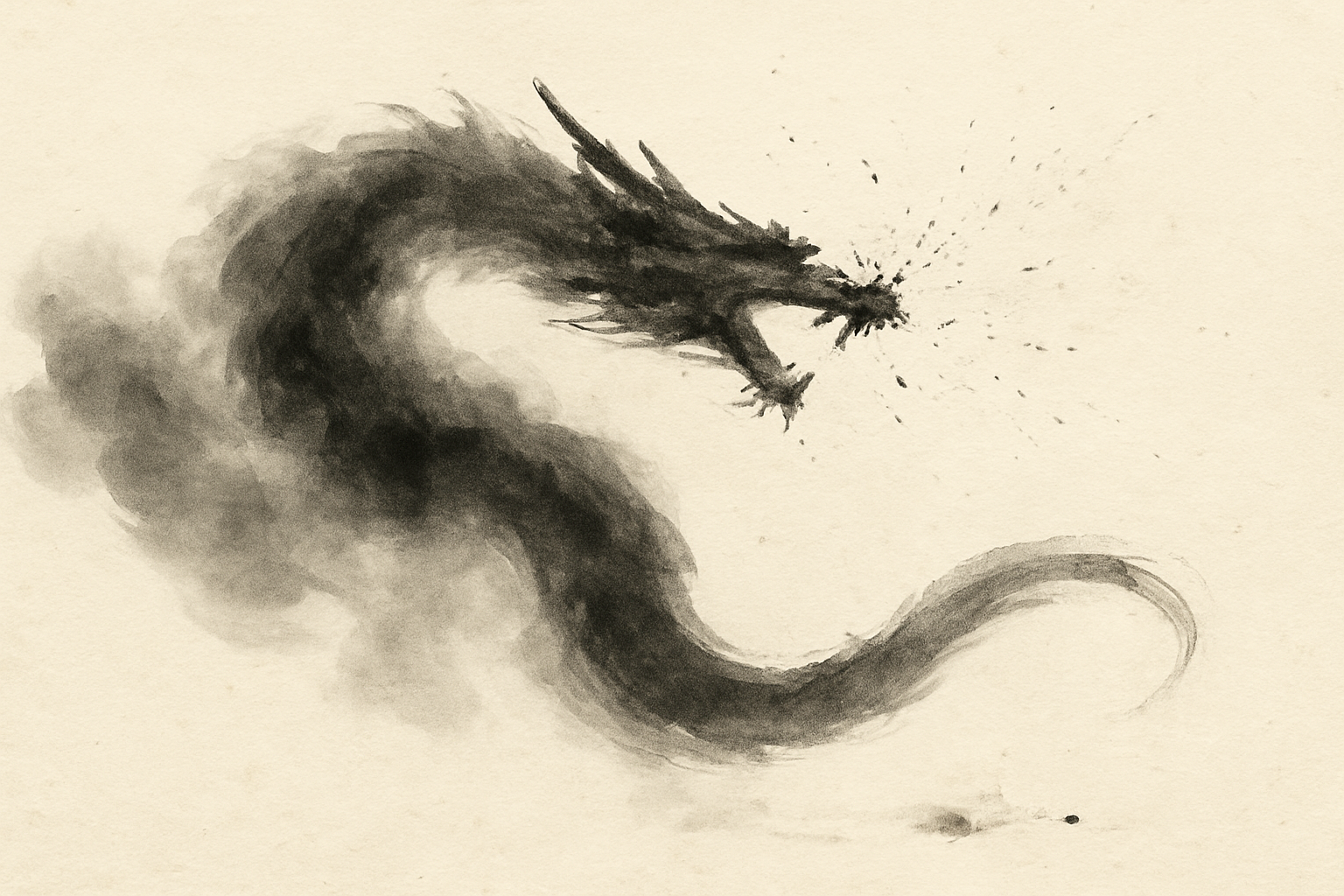
The Dragon That Was Never There
El dragón que nunca estuvo ahí
A student describes a period of intense mental activity following a significant opening, and asks how to handle what feels like a new identification with being "the one who is not identified." The teacher points to the illusory nature of identification itself.
The Dragon That Was Never There
A student describes a period of intense mental activity following a significant opening, and asks how to handle what feels like a new identification with being "the one who is not identified." The teacher points to the illusory nature of identification itself.
I had a big opening some weeks ago, and then there was this effortlessness, a deeper sense of just being. But it unleashed all kinds of stuff: things with people, changes in my behavior, insights. It's still extremely dynamic. The meditating was extremely helpful during that period, particularly the "I am" meditation. But it seems like what happened is that I took on a new identification, which was the one who isn't identified. Now the thoughts are racing, and it feels like Frankenstein. The thoughts are beautiful and expansive, and I wanted to say, "Shut up. I heard you. I don't need to hear that again." So I sit and meditate, and there they are, and I can feel my heart pounding. Part of me says, "Well, that's what's showing up," and I think that's what you were alluding to, but I don't think I've really embodied the surrender. I can feel there's an entity that wants to hold on to the reins. When I was listening just now, simply watching the breath and coming back to that was helpful. Originally I was thinking, "Could you just tell me what to do?" I love the simplicity of that. But I can see the limitations of it. So I'm just open to hearing whatever you have to say.
The key where you are is: just keep seeing.
Surrendering and its limits
The practice of surrendering, accepting, is valuable to a point. Then there comes a place where that which can surrender isn't real. But to hear that it's not real before reaching that edge might not work or be useful, because there is a kind of clearing that happens when we do a certain practice of accepting, surrendering, seeing, observing.
What is needed is more clarity, and it's not a clarity of the mind. It's the clear seeing, the clear knowing of what is appearing.
What is resistance made of?
For example, when you have a sense of something, you said there's an entity that's resisting or pulling. If you go to your experience, something that you feel is pulling away, that's the experience of resisting appearing. There are thoughts. The thoughts create emotion. There are sensations that are uncomfortable. There's fear, imaginations, all of that.
But what can be seen is this: there's an uncomfortable sensation, and think of that as a sound appearing. It's just appearing. When a sound appears, there is absolutely no way it could be resisted. Sound appears, and sound appears. You can get distracted, but the sound will still appear. There is no amount of effort, of focusing, of thinking, of going into imagination that will prevent the sound from appearing.
There is a kind of delusion in the belief structure that says, "I could just pull into this thought space and stop the appearance of something."
There is a very, very fine line, like a thin hair, between the perspective of "I'm resisting, I need to surrender, I need to accept" and the recognition that there is absolutely no resisting possible. You cannot resist the appearance of the sound. You can create a lot of thought, engage with a lot of thought while the sound appears, but it does absolutely nothing. It just creates thought. It's just engaging with thought. A sensation is appearing. I can engage with thought, but it will do nothing to the sensation appearing, and in fact will probably create more sensation.
Seeing what the entity is made of
In a sense, it's about seeing: when you experience "there's some kind of entity pulling, resisting," see what that's made of. Because there has been a seeing that this entity is not real, but when it shows up, you relate to it as real. You haven't seen through it completely. There is still this temptation of engaging with it as if it had some form of non-thought-like existence. But any kind of entity that is experienced is imagined.
There's usefulness to that too?
The imagination of an entity has a usefulness, for example, in communication. But there is a very big difference between communicating as if that entity is real and is what I am, versus using it as a tool for communication, a vehicle. A rough metaphor: it's like driving a car but believing you are the car, versus knowing that it's just a vehicle you're moving with.
When the imagination of an entity is, to any small degree, granted a reality of "what I am," then the struggle begins. When it is known and seen as "not I" (neti neti), there is freedom, and then there is a more harmonic existing, a more harmonic movement.
Thought appearing only when useful
It's just seeing more and more clearly. I can go into thought, and then thought becomes, to some degree, more than thought. Or I can live in, engage with sensation and perception, and then thought appears and can be useful, appearing more and more only when it's useful, in the ways that it's useful, rather than as a way to not engage with sensation and perception. Even the language "engaging with sensation and perception" is faulty, because there isn't a something that engages with. It's just the intimacy with the appearance of sensation.
Is that hitting the spot?
I think so. What came up as I was listening is, first of all, it's always about seeing and nothing more. There might be all kinds of different things on the side, but ultimately that's all there is. And the other thing that came up is: I think I just discovered that I felt like I was committing the ultimate sin in non-duality, which is identifying with thought, or being taken over by thought. Like, "I thought I was over that." I didn't notice the judgment going on. "What the hell? There's something wrong." As opposed to, "Oh, this is showing up, just another thing showing up." And obviously it's a great opportunity to see: this is another chunk of identification. That's all.
And notice, when you catch yourself in what you call identification, what's really there. Because ultimately there isn't even that.
There isn't identification?
It's an illusion.
That's so crazy. It totally caught me off guard. What else could it be? And here I am in the midst of it, fighting the dragon that I've created. Who created it? There's no "I." There's no dragon. There's nothing.
Life has now become the ultimate task: "Let's get this identification problem fixed."
Right, I've got to graduate, get a certificate. It feels so linear. But the way you talk about it, you've got me totally off guard.
It was never there in the first place.
Much ado about nothing. I can feel the investment, the years, millennia probably. My body is trembling. What an anticlimax. It's crazy.
The humility of seeing nothing was ever wrong
All of that trouble about nothing. That's humility. "At least I thought I knew what the problem was really about. I figured it out. It's all about identification. I got it."
It's always the same. There's nowhere to go. It's always the same. How can I be so dumb is what I want to say.
"The son of man has nowhere to rest his head." Nowhere to rest her head. Not even the problem of identification. You focus, and that's the challenge.
It lies so easy, you know what I mean? It's like, "I got somewhere." It's so simple. "Go there." But there's nowhere to go. It's always what it is.
I love the simple, and this is more simple than simple. That's the problem. It's even more simple than that. I mean, it's not a problem, but I want to make it a problem.
Concepts feeding more illusion
The tricky thing with this is that the words I'm saying, the concept of "there is no identification," can then be co-opted to feed more illusion.
It's all the same. It's just production, production, production. That's what it is. And it's infinite. It will produce anything out of nothing.
That's the power of the mind. To imagine anything. It's infinite.
I feel like, I don't know exactly how to put it, but: "Huh?" That's how I feel right now, which is probably a good place, because the mind can't deal with it. It feels like a Zen koan. I was hoping to feel "Ah," and instead I'm in the middle of "Huh?"
The subtlety of deepening clarity
Progressing on the de-identification path. It's very anticlimactic, I have to say. There are a lot of climaxes in the beginning, because there's somebody on a journey and there are all these intense ups and downs. Then as the clarification goes deeper, it's more and more subtle, and the shifts are more subtle, and the climaxes are evened out.
But there is, at least there was for me, something really big at the end. Not big in the kind of climactic experience. It wasn't a lot of experience. It was big in the liberation, the freedom. But at the same time, it was the most subtle thing.
That's very helpful to hear, because it's almost like there's a pivot, but there's not even a pivot. It's the nothing. It's the all. It just falls away. Anyway, thank you.
You're welcome.