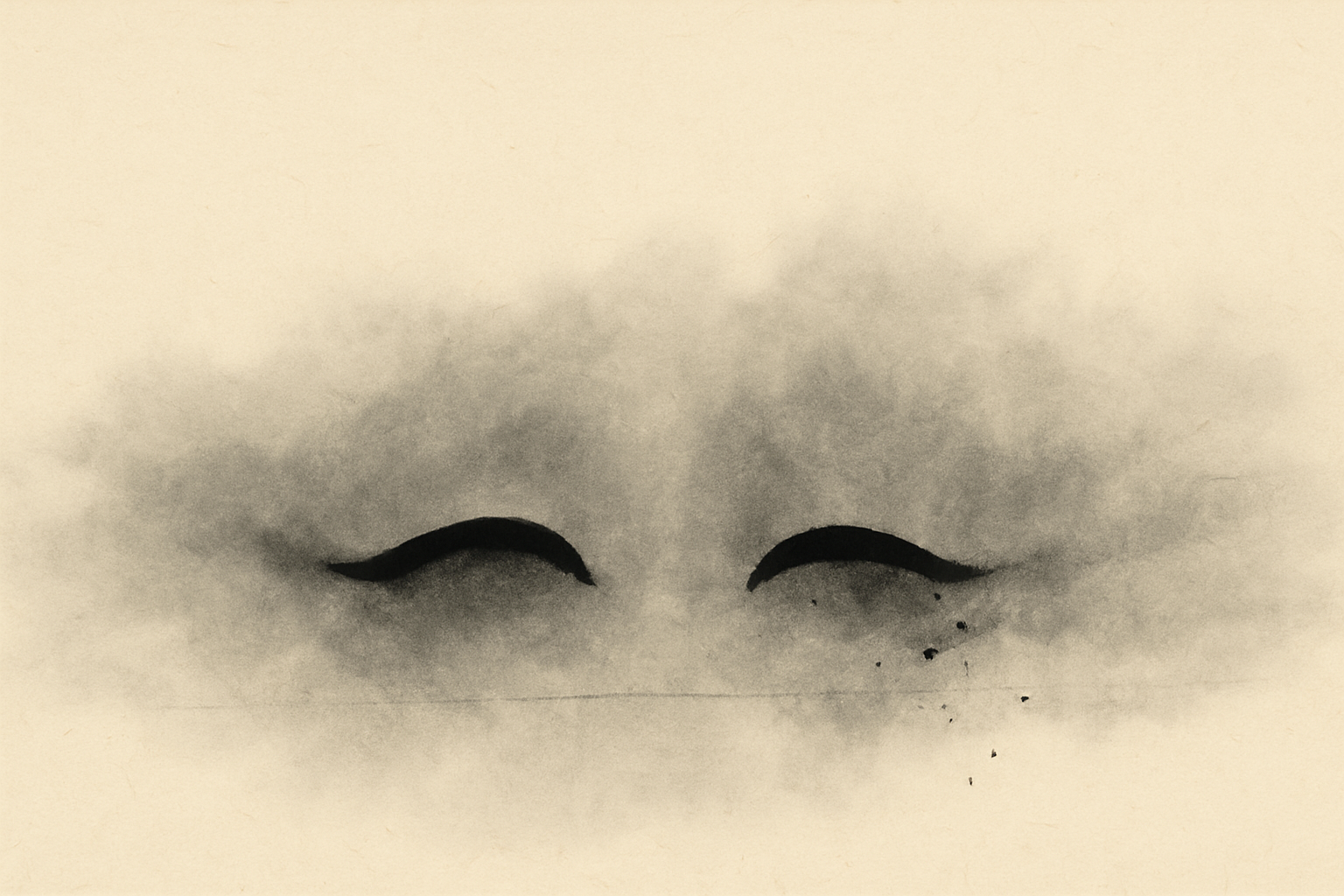
The Whirlpool and the Space It Moves In
El Remolino y el Espacio en el que se Mueve
A student describes their strong preference for meditating with eyes closed, which opens into an exploration of how we split experience, maintain identity through habitual sensations, and mistake the whirlpool of thought for what we are.
The Whirlpool and the Space It Moves In
A student describes their strong preference for meditating with eyes closed, which opens into an exploration of how we split experience, maintain identity through habitual sensations, and mistake the whirlpool of thought for what we are.
For the first time, I took your suggestion and kept my eyes open. I've been resisting that. I so much prefer to keep my eyes closed. I was noticing that big preference, and then I saw the stories connected to why. I could prove to you with my stories why it's better. I'm good at that.
I'm sure I'll believe them.
You get extra points if you start nodding your head. Bring as many people on as possible. That's part of the satisfaction. Anyway, it's pretty obvious. It's all about conditioning. Well, not only about that. It's about noticing the conditioning, the deconditioning. And then I noticed I had a certain threshold. How much deconditioning can I take?
How much are you willing to give up?
Say more about that.
The line between value and identification
If there's something you're not willing to give up (it doesn't mean you have to give it up if you're not willing to), that is a form of identification. But you probably won't experience it as a story. Once you recognize something as a story, you're halfway there. So instead, it will feel like something very important, something you're going to fight for. To go from there to "this is a story" is something else entirely.
There's also the matter of discernment: What is it that I'm attached to because I'm identified, and what is it that is simply a value I hold? You said "I will fight for it." There is an aspect of what is right, what is loving, what is goodness. And then there is what we rationalize as valuable and good but is actually self-involved.
That speaks to me. It didn't occur to me because being visual feels superficial. I'm not comfortable there. I'd rather be inside. There's a value added, like it's not just conditioning, but it's also better to be inside.
Where does the visual field appear?
But I ask you: where does the visual field appear?
Oh. There. Yeah, you caught me. That's beautiful.
You're splitting experience and pushing something to the other side of some arbitrary line. Well, it's not entirely arbitrary; it's functional. But when it becomes so absolute and we lose the reality that all is appearing in the same place, then the illusion begins.
This is different from, for example, two cups of coffee both appearing in the same place. I can work with them separately because at that level they are two. There is a distinction between the two cups, but I know they're in the same space, the same dimension. What I see, what I hear, what I think, what I sense: all of it appears in the same space. I can distinguish what I see as functionally useful for navigating in a way that is appropriate (the body is here, other things are there), but if that separation is the foundation of my reality, if it's an absolute separation, then look at your actual experience. That's not what it is. Your experience is that it's all appearing in the same place. Not just the body and the rest, but also sounds, sensations. Where is the line between the sound and the visual experience? Where is the line between seeing and sensing? Really look for it, and see if any doubt remains.
When that's seen, you could still operate with the distinctions. There is still a use for what I often call a mind map. But if we don't see that the mind map is a mind map, it becomes reality.
I can see how this has the potential to take me very deep into meditation, because I can't depend on habit.
Depth is not a state you work into
Even there, there is a place where "deep in meditation" and what is happening right now, at any time, are not so different. That difference in depth isn't as real as it seems.
This is not a state you can work yourself into. It's a recognition of what already is. Being completely immersed in thought and being in a deep meditative state are, at the fundamental level, the same. They are just experiencing. And seeing that frees you from the pushing and pulling of experience.
That which knows you are immersed in thought, lost in confusion and contraction, and that which knows the deep state of meditation: it is unchanged. It's just the kaleidoscope turning.
When I say "that which knows," it's experience knowing itself. But here language fails, because it always implies a twoness that isn't there. It's just appearance, appearance, appearance. Contraction: appearance. Deep state: appearance. Freely moving, changing, nowhere to get to. It's just the river flowing.
The preference for eyes closed
Back to your sense that eyes closed is deeper and eyes open is not. That contrast you can explore. For there to be a fundamental difference, you have to be looking from a perspective, a point of view within the mind, where one is better than the other. But that which knows those two is deeper, deeper as in more real. From there: eyes open, eyes closed.
The non-attachment to experience works like this: there are certain sensations that happen when eyes are closed in a meditative habit, and there are sensations when the eyes are open. Why is one better than the other? How do you know? And that "knowing," that certainty that one is better, is the identification. That is the narrative. As opposed to simply: "I don't know. They are just different in flavor. I prefer one, but I'm curious about the other."
How identity sustains itself
There's a certain continuity of identity that is more easily preserved by maintaining certain kinds of sensations that are familiar. That's what narratives do. If I have a narrative that the world is out to get me, that this is dangerous and scary, that's going to create an emotional tone that is preserved. And the continuation of that emotional tone becomes "I." I am that which is in this.
If everything is allowed to move and shift and change as it does, then there is no continuity of "I" in the experience. The only continuity is that knowingness, that beingness, the consciousness of experience. But that's not in the experience, so you cannot call it "I." You can only call "I" something that is appearing.
Say more about that, please.
That knowingness I'm describing is prior to thought. It's prior to the mind. So the mind can only label a construct of it and then call that "I." That seeing is empty. The minute you call it "I," you're creating an image of it. That's a contraction, or rather, an apparent contraction. There is no real contraction. It's still there. Just space, playing.
That is it, for me at this moment at least.
Just taste it. Don't worry about it.
Now I'm thinking I want to say something, and I'm wondering: is that coming from the old conditioning? I'm going to just be quiet.
Sounds good.
The whirlpool
It's all trying to keep those habitual sensations and thoughts that you call "I" going, to keep them activated. It's like a cognitive system running. The mind activates certain parts that keep certain images and sensations ongoing. That's the whirlpool. Keep it going, keep it going. And its only interest is to keep the whirlpool going.
There's a path that involves becoming more and more proficient at whirlpooling. And there's another, which is to see through the illusion that you are the whirlpool. This is not something you can explore only through thought, because thought is the whirlpool.
So my thoughts are trying to make sense of my experiences and keeping me in the whirlpool, and thus my identity: the thoughts, the doing, the avoidance.
Something like that. You're so attached to the sense of being the whirlpool that you can't even conceive of something else. You stand from the perspective of the whirlpool, looking at the rest of your experience. And everything then becomes something to manage, something to fight, something to understand.
There are habits, types of habits. Some people tend to do this through more emotional means and others through more intellectual means, through a rational thought process of understanding the world.
That's me. I'm trying to intellectualize everything. Study, learn, categorize.
There's a value and a usefulness to that. But it becomes a crutch when it's done in service of an illusion.
Keeping me in the whirlpool.
Keeping you as the whirlpool.