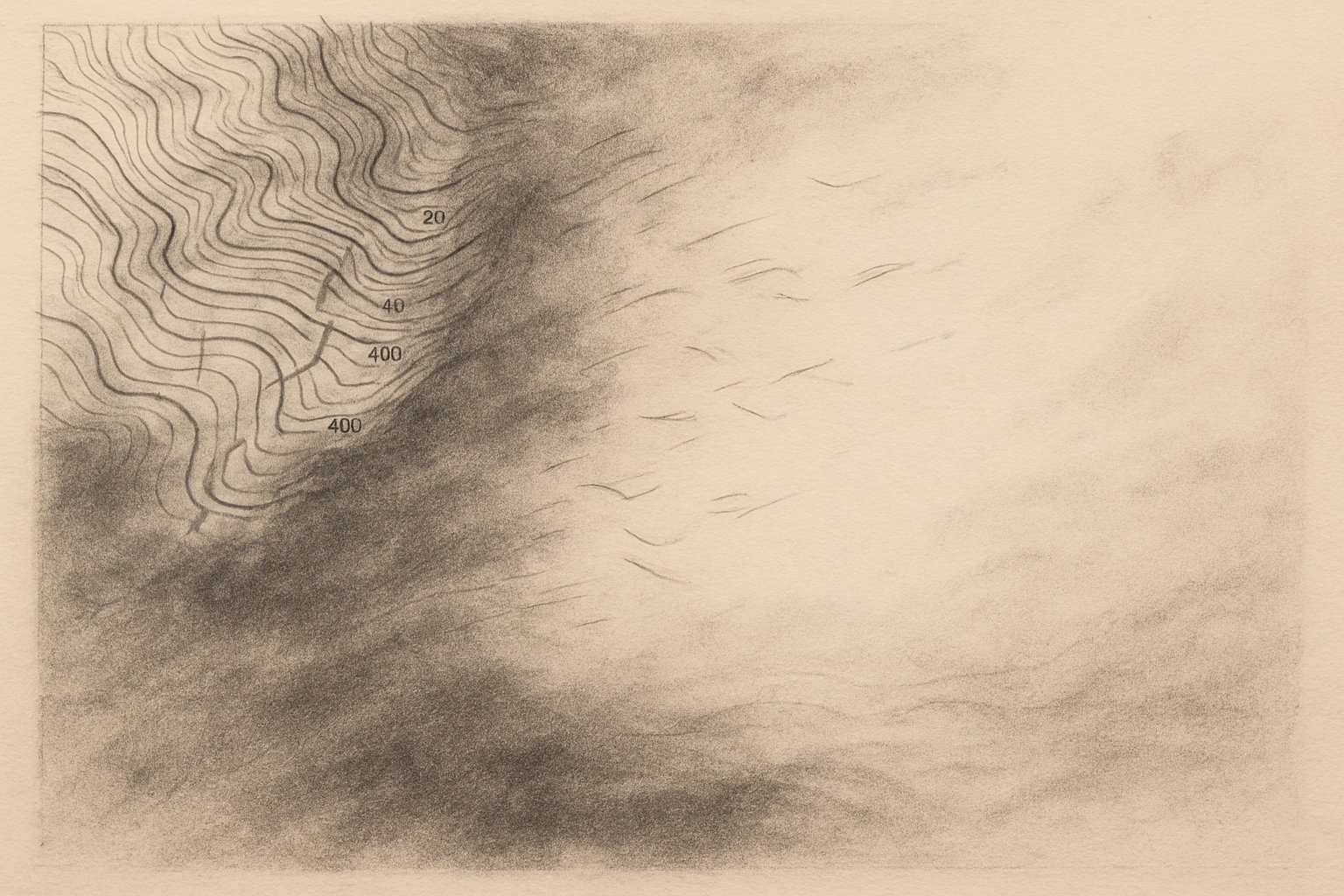
When the Map Dissolves
Cuando el mapa se disuelve
A student shares the unsettling experience of seeing through the process and progress they had relied on, and the teacher explores what remains when subjectivity, hope, and the promise of future attainment are recognized as illusory.
When the Map Dissolves
A student shares the unsettling experience of seeing through the process and progress they had relied on, and the teacher explores what remains when subjectivity, hope, and the promise of future attainment are recognized as illusory.
A couple of weeks ago in satsang, something stayed with me about process, and about mapping with a process. As I reflect back on your pointings, this has actually come up a number of times, but I could only hear it incrementally. There was still attachment to the idea that there is a process and there is progress. Of course there is in a relative sense, but I'm talking about attachment to process in terms of seeing clearly, seeing the natural way things are.
Something from two weeks ago stayed with me: seeing that a map is a map, and how unraveling that map creates a sense of feeling lost. For me, I noticed I hadn't wanted to see that. Then, as it was seen, there was a lot of agitation, almost a wanting to come back, and also something like depression around losing it. I'm not actually depressed, but there was grief, a moodiness.
Then today, during the meditation and even before that, something else stayed with me from a previous conversation where someone asked, "What is that restlessness, that sense of subjectivity? What is that?" And it was just: poof. You didn't say anything, and that stayed with me too. Exploring what that subjectivity is, it's becoming clear that there's nothing you can actually land on with it at all.
I guess this is more of a sharing, because there's no question about it. It relates to the circle analogy you gave in the last two meditations: try to imagine a circle, and you see it, but you can't hold on to it. That sense of subjectivity is the same thing. You try to find where it is and it's nowhere. And it's also becoming clearer and clearer how much it actually comes and goes.
The assumed reality of subjectivity
One thing comes up. The key to what I'm pointing to is that the sense of subjectivity is assumed to be fundamentally true, fundamentally real, as if it's part of existence itself. Then it can be seen that it's a point of view, a mechanism, a way of functioning. And as you describe, it can be seen that it comes and goes. When it's seen to come and go, it no longer holds as fundamentally true or real.
In Sanskrit, the Indian concept of reality and illusion is different from the Western one. It's just a matter of semantics, but when they say something is "real," they mean it doesn't change. A chair is considered an illusion because it has a beginning and an end. If it has a beginning and an end, what is its nature? The nature of the chair can't be the chair, because the chair aspect comes and goes. So what is its essence? That's the approach: inquiring into what is the essence of reality, what is really real, versus what appears to be something that is actually something else appearing in some form.
Subjectivity has a reality. It is real. But its essence isn't subjectivity. The reality of it is not subjective. The subjectivity comes and goes.
I'm not sure what you could say is real. I think if something is real, you can't really say what it is at all. What comes to mind is what Francis Lucille says: there's something rather than nothing. I think that's it.
There is something rather than nothing
That's a very fundamental point. In fact, there are only about two things you can say about reality that can be put in words and are logically true, or seen as factually true. That's one: there is something rather than nothing. That's irrefutable.
In contrast to that, I would add from the Tao Te Ching. Let's say there's something we're talking about, something rather than nothing. There is something; let's call it reality. That exists. That is real. The terminology around it can get tricky, but that somethingness rather than nothing is absolute.
Now, the Tao Te Ching says, in one translation (the more popular one that I don't prefer): "The Tao that is spoken is not the true Tao." Think of the Tao as reality. Anything said about reality is not reality. The translation I prefer is more direct: "Tao called Tao is not Tao." Reality named reality is not reality. The name is not the reality. And by "name," you can think of anything about reality: any way of expressing it, any description, any understanding, any map. Anything you can put in a book, anything you can communicate in words, is always an approximation.
It's like a symbol.
I like the contrast between those two truths. There is absolute truth in: there is a reality, there is something rather than nothing. But you cannot understand it fully through thought. You can know it directly, because you are it.
There is no way there can be an absolutely true reality and you, that which knows it, not being a part of it. If you are a part of that reality, and there is one reality, then you are that reality. This is something that's taught very well through that approach, and it's very powerful. It points to that which knows. That which is hearing these words. That which knows the subjectivity cannot be the subjectivity. That which knows appearances cannot be appearances. That which knows thoughts cannot be thoughts. Thoughts cannot know other thoughts.
The knowing that gets pulled in
And with that pointing to "that which knows," it also gets sucked in on itself, like what you were saying in the meditation: sound is hearing itself.
That happens because we then attribute the knowing to an intellectual, conceptual knowing. It gets mapped into the mental conceptual framework, and then it becomes "known by the mind," known by the object-I, the thought-I. But it's an illusion. It's an illusion that that which knows is a thought, because there is something knowing the thoughts. I'm talking about that which knows the thoughts.
What you're describing, that getting pulled in, is the knowing that becomes indirect rather than direct. Direct knowing is the direct experience of sound, the direct experience of sight, unfiltered. The direct experience of thought without the image of a thinker, without the image of a hearer, without the image of a perceiver.
That collapses, because you can't find what it is. It's in the thing, whatever it is, in the thought. It's really hard to talk about this.
That "sucking in" you're describing has to do with a certain kind of subtle believing in that center, in that image. It can only get pulled into something which you believe to be real. Once that which it's getting pulled into is seen for what it is, there's nothing really there.
That's actually what I meant. Maybe "sucking in" wasn't the right analogy. What I meant was: it's eaten up, because there isn't anything there. The pointing to "nowhere" only holds because it isn't known by anything. You weren't saying the knower is actually knowing.
Somethingness without beginning or end
There's no word for it. But I find sometimes "knowing" is the only word, because it's "consciousnessing." That appearing is so direct, it just has no end to it, and no beginning either. It's the fact that there is something rather than nothing. That somethingness is what I'm pointing to. Call it omniscience.
I think I understand what you're referring to. It eats up everything, because the more that is seen, the more anything one can hold on to gets dissolved. Is that what you're referring to?
Yes. That sense that there's a "knower" gets eaten up.
The more this is seen, the more that dissolves. It's the illusion dissolving as an illusion, seeing it for what it truly is. It doesn't really disappear. Some things change in our experience and our perception when this happens; there are big shifts. But mostly it has to do with seeing.
Think of the metaphor from Ramana Maharshi about the snake and the rope. If I think I'm seeing a snake, I'm going to be restless and freaking out. But it's actually a rope. What was seen hasn't changed. Even the illusion, the appearance of the snake, which was a mind concept, an interpretation, doesn't have to stop. You can still look at it, the way you look at a cloud and see that it looks like a puppy. It can still look like a snake, but you've seen that it is not. That is the illusion that gets gobbled up: it appears to be something, and it is seen for what it is.
The sense of self appears to be something, and it is seen for what it is. It appears to be fundamentally true and real, what I fundamentally am, and it is seen to not be the case. What I am is not limited. It's not an entity. It's not dependent on this body or this mind. But the body, the mind, the world: it all keeps appearing.
The moodiness of disenchantment
I have to just see what happens with that. I don't know if the moodiness will return. In the confronting of these different illusions, all sorts of stuff can come up. But right now it just feels quite natural.
That's very natural. As these illusions are seen for what they are, there is an emotional component. We are attached to them for a reason, and that reason is that they are a form of avoiding certain sensations and experiences that are uncomfortable. I basically call them all fear and pain. As the illusions are seen through, fear comes up, pain comes up, almost always. And a moodiness is part of the withdrawal symptoms. Depression. The whole body-mind needs to readjust, aligning to a different form of functioning. A sense of meaninglessness can come up.
Yeah. I was thinking about that. I used to get such juice from anticipation: "This experience is going to be like that, I'm going to get this thing." And it is different now.
Hopelessness as the threshold
There are fewer and fewer rewards as the process goes deeper. Up until the end, it feels absolutely pointless and meaningless. And then the discovery, the finding, happens, I think, pretty much always when there is no hope. Because hope is for the future. Hope is for something to be different, for something to not be what it is. That's what we hope for. That's what we're invested in. "It will only be so much better if this could shift and move and change." That's the fundamental dissatisfaction.
Till the very end, there is going to be a hope in some strategy working, especially with the promise of awakening, never-ending bliss, and all of what one can imagine in spiritual practice. And you actually taste it, because you do feel it and experience it along the way.
I felt a lot of that and thought, "Yes, this is what I'm going for." But it just becomes apparent that it passes.
In a sense, I'm trying to encourage you that it's natural. It's actually a sign, when things go deeper, that there is less of a gung-ho enthusiasm for it. It's like the withdrawal symptoms from the addiction to thought.
It's funny. The mind will present certain patterned ways of generating more hope, "Let's see if this works," but then once you see that, you know it.
It fools you because you're wanting to be fooled, until you realize that what is promising isn't really there. The more you start to realize the emptiness of the promise, the more you become disenchanted. But there is a huge investment in fooling oneself. The mind has an infinite capacity to imagine so many better futures than this present, and to convince you how much better that will be.
I notice in that withdrawal process, sometimes it's a barrage, really trying hard, presenting this and this and this. Other times that energy is less intense. Thank you.
I thought there wasn't much there when you said there wasn't really a question, but a lot came up.
It was nice to have an exchange. I felt self-conscious because I repeated a lot of things we've talked about. But thank you. It was very valuable.