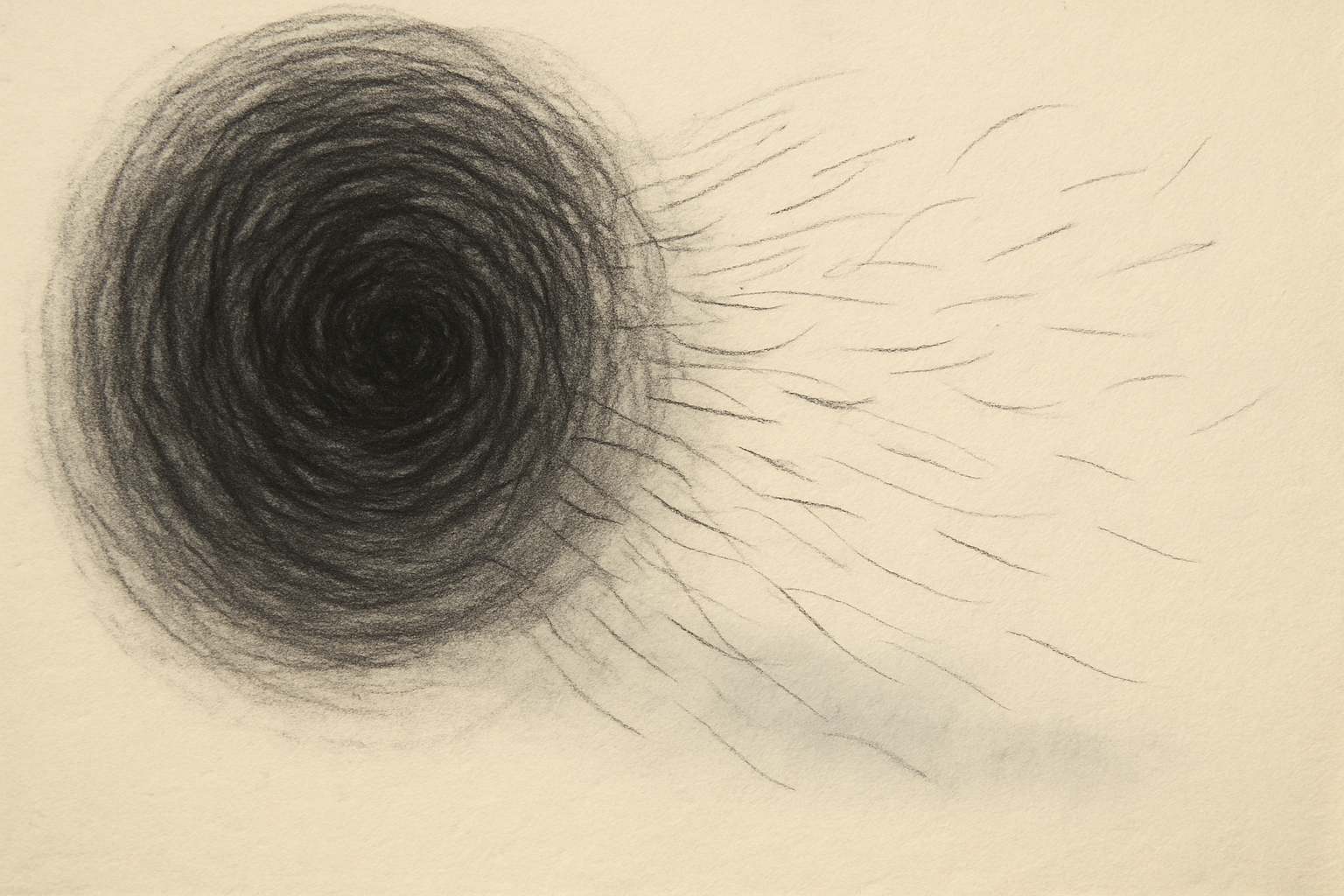
The Illusion of Contraction
La ilusión de la contracción
A reflection on how the experience of inner contraction and expansion is revealed to be interpretation rather than reality, and how negativity serves as a shield against vulnerable sensation.
The Illusion of Contraction
A reflection on how the experience of inner contraction and expansion is revealed to be interpretation rather than reality, and how negativity serves as a shield against vulnerable sensation.
The expression is "not two" rather than "one," and this is deliberate. Some traditions speak of oneness, and in a sense this is a semantic distinction, but the Indian philosophical culture is very rational and mathematical, very precise. The expression "not two" comes from Hinduism and Advaita (Advaita literally means "not two"). You cannot say it is one, and you cannot say it is zero. If you say it is one, you imply two, three, four, five. So it is a more correct expression to say "not two." It appeals more to the rational mind. But "one" appeals more to the heart. It feels more heartful and connected, whereas "not two" implies the emptiness of what we are, which can be frightening. "Oneness" implies connection and beingness. In a sense, it is a good combination.
The subtlety of the final shift
The question was asked: can I speak to how the unraveling of subjectivity becomes more and more subtle? And it was noted that I once described something about this process as disappointing.
The disappointing part was this: it seemed like it should have been more intense, a big explosive moment. I had had so many powerful experiences that I thought the last shift, the one that felt to me like the biggest and most total, would be equally dramatic. But it was very, very subtle. It was not a big, powerful experience at all.
I said it was disappointing for the purpose of communicating that you should not expect something big. But after it happened, it was far from disappointing. It was miraculous, the best thing ever, the thing I would want everybody to know, and the reason I am here, the reason I will probably speak about this until I die if I can. So it is far from disappointing. But it was disappointing in the sense that it was not a big experience. In fact, it was not an experience at all. It was so small and subtle that it is very hard to describe. It was just this shift from a place of being there in a subtle way to simply not. A very delicate shift. But then everything changed to such a vast degree. It was so beautiful. And it still changes.
Not everyone's path is gradual
The unraveling of subjectivity does become more and more subtle, though it is not like that for everybody. For some people it happens more suddenly and dramatically, very total and complete. But in my case it was a very, very slow process: more subtle, more subtle, and then the last shift, which was the most subtle of all, was also the biggest.
At the same time, there are little tastes along the journey that confirm the movement is going in the right direction. There is this tasting of something, an unknowability, a sense of awe. We speak of awe, the experience of knowing something beautiful for the first time: traveling to a new place, going to see beautiful mountains, being struck by something we cannot grasp with our thinking. When that veil is seen through, everything becomes that, because the knowing of everything is revealed to be just a thought. It is seen to be a very thin explanation for reality. The unknowability is the nature of everything, and it is like awe all the time. It is the beauty of this, all the time.
The floor is not solid
What we are experiencing here, for example: you could think the reality is a solid room with people in it, and we came here, and all of that. But the direct experience of it, how it is for me, is absolutely mysterious. The floor does not seem solid to me. I know I can walk on it. I predict I will be able to. But I do not experience it as solid, and I know that the past experience of solidity was a thought, a belief system. The direct experience is not known to be solid. It is not known to be normal. And so everything is singing this mystery of creation all the time. It is the mystery of "what is this, where does this come from," without the actual thinking about it.
It is a bit like being on psychedelics all the time, micro-dosed. I remember when I tried psychedelics for the first time, a few times. That shift is the closest I can recall to my current experience. Not like a big dose, but a smaller dose. It is pretty much constantly being on this subtle vibe. That is the closest description of how I experience things now. It is just beauty. And I think this is simply normal. It is how it always was, but I was pretending it was not. I was busy pretending I was here, having a problem with life.
Dissociation and the observer
During self-inquiry, to see what you are, to become that which observes consciousness and not what is appearing, that process can be driven by dissociation. By dissociation I mean stepping out of life, avoiding certain aspects of life. It can serve as a way of coping.
What we are talking about, the beauty and awe and mystery, is not going to be found in that stepping back. It is fully in the flesh. It is fully in the seeing. It is fully in the journeying with your family, with your life.
There are many maps for this. One describes the process like this: you are a human being, you realize you are God, and then you forget about that because you do not care, and then you are no longer a human being. You are just an ape. I liked that description because "becoming an ape" removes all the complication. It is simple: I am an ape on a rock. But it is not simple in another sense. It is the including and transcending. You realize you are God, but then, so what? Now what are you going to do? Live. Live what? This. What are you? Human.
Negativity as a belief system
If you take just one thing from all of this, let it be this: the negativity is a belief. There is a bias toward a negative point of view that feels safe because it is known. But it is a belief system, and it creates a storm. It is a way to avoid sensation, a way to avoid pain, a way to avoid fear, a way to control what you feel. Even though it is painful, the negativity you have chosen and that you recreate feels safer than what you do not know. But it is a belief system.
What I mean is this: even if you want to call it fifty-one percent, you believe there is a fifty-one percent chance that things are negative, that they are not going to go well. I think it is much higher than fifty-one. You say "I don't know, I don't know, I don't know," but underneath there is a knowing that tilts toward the negative.
For you to create that negativity and experience it, you have to believe something to be true for which you cannot actually know it to be true. It is a negative read on the situation, on the family, on whatever. It is a bias toward negativity, which obviously does not feel good, but feels better than the scary thing you do not know, because the negativity is at least familiar.
The sensation underneath
There is a specific sensation you are trying to avoid, and the negativity saves you from that sensation. If you learn to be with that sensation, you do not have to do anything about the negativity. It will simply go out the window because it will not be useful anymore. But that requires you to go through something you would rather not face. The sensation is truly scary, painful and frightening. Just know that the negativity is a thought. It is a belief. It is not true.
Contraction as interpretation
You spoke about a sense of expansion and contraction. Take it to be an illusion. By that I mean it is not what it appears to be. You are, in a sense, misinterpreting and mislabeling an experience. It is going to help you move through it, see through it, and live more freely and deeply if you see it as a misinterpretation. What you truly are does not contract or expand. But what you believe yourself to be does.
It is important to see the interpretation as well as the sensation. When you see for yourself that what appeared to be a contraction is actually an interpretation, when you see through it, what remains is a sensation. The sensation is not the contraction. The contraction is the interpretation.
You can describe a muscle contracting because that is what it is mechanically doing. But "you" contracting, your whole experience narrowing, that is something different. There are thoughts, emotions, sensations, the muscles of the body do contract, there is fear. But there is this whole thing that functions like a holographic illusion of you contracting. When that is seen to be what it is, you can describe it more simply: there is discomfort, there are thoughts, there is fear, there are sensations. But the contraction itself is just a way of placing yourself inside an illusion of being something you are not.
The snake and the stick
It is like seeing a snake in front of you, and somebody tells you: look more closely, you will see it is a stick. And you look and you look and you look, and then, oh, it is actually a stick. But it seemed to be a snake.
What you are going to see is that what appeared to be a contraction was all these thoughts together with a sensation that is uncomfortable. The more you see that, the more what seemed to be a contraction reveals itself to be made of thoughts. It will become hard to experience it as a contraction, because you have to believe a thought, you have to buy into a complex imagination with sensations and a story, in order to maintain that holographic illusion.
Distrust of the moment
What was shared in that moment of seeing was beautiful. How much of what we experience is interpretation rather than what is actually there. How every moment is simply unfolding. How much distrust there is, how much rejection of what is actually unfolding in the moment. The attempt to jump ahead to the next moment, to control the current one.
When you try not to be in the moment, the only way to do that is to go into thought. That is the only place where you can imagine not being in the moment. Thought happens when the future is imagined, when the past is remembered, and all of it happens in the moment. There is no other place, no other time. That is why it creates such chaos.
This distrust of the moment is absolutely natural. It is absolutely universal. It is the fear of the unknown and the sensations we carry from fear, from pain, from life. But the options are two: the illusion of not being in the moment, the illusion of controlling through thought and time; or the other option, which is to go into the vulnerability, the sensations, the scary openness.
I am here mostly to emphatically serve as an example that the other path is the better one. I have been there. I spent many, many years struggling to fix everything through thought. It simply does not work.
What to take with you
Where you have tasted that glimpse, the most important thing you can take with you is that you saw what is actually there. The shift in perception is the less important part. It is more important to realize: I thought I knew what that is, and I do not. I have this distrust. That is the key insight. The shift that happened is like the vehicle that delivers the nutrition. The nutrition itself is the realization: I thought I knew, and I do not.
Do not try to hunt for those glimpses. Try to see how what you saw can become more and more your truth, your reality, the way you operate in your thought. Then the releasing quality of those shifts will come more and more. That tasting of "I do not know what this is," that wonder, that awe: it is scary, but the more you can be comfortable in that uncertainty, the more there is freedom, well-being, peace.
Something like that can change your life completely. That is how it goes. It is that simple. You just have to trust that what you saw is true. It is real. Then live according to that, which is your truth. Trust that.