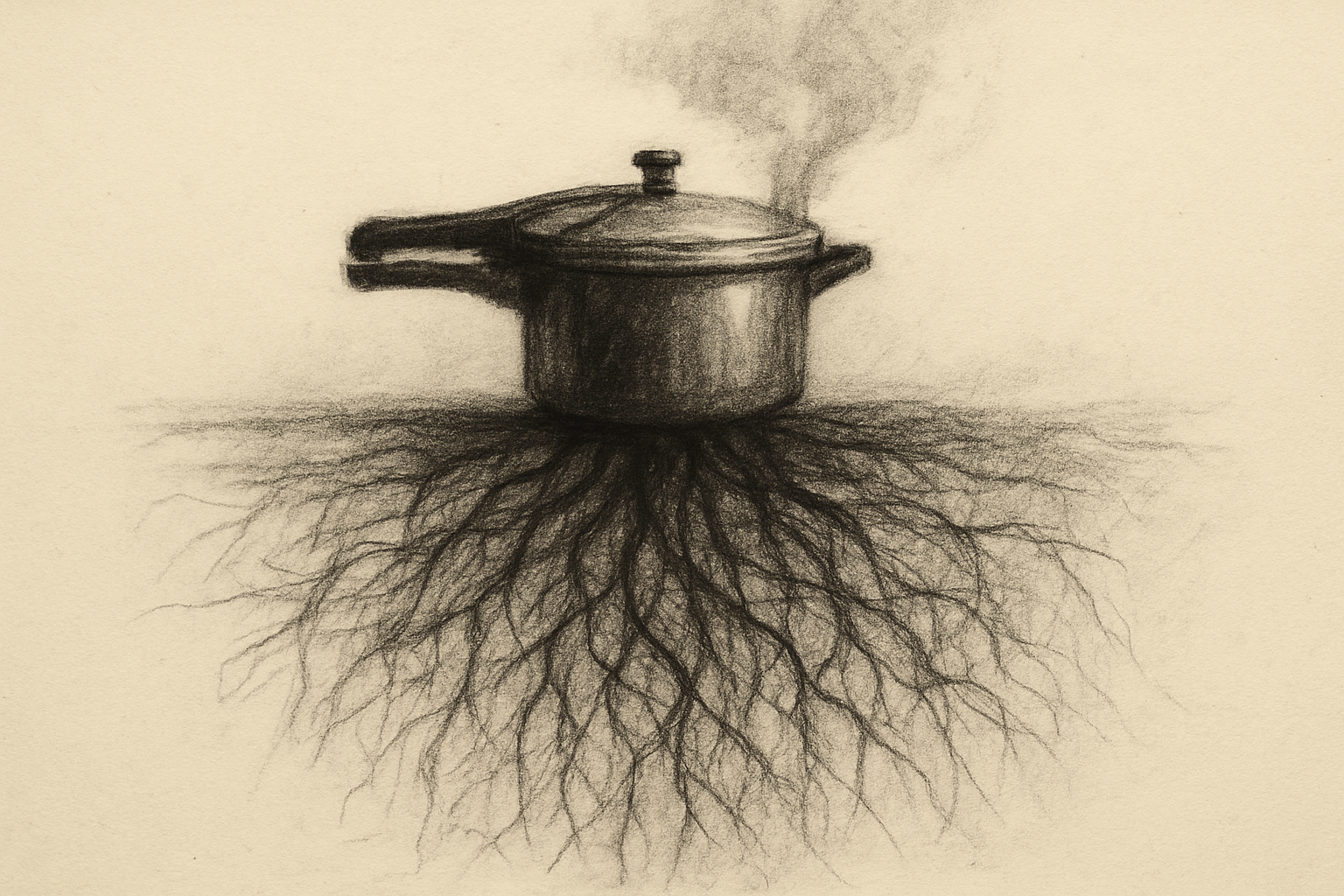
The Pressure Cooker and What Lies Beneath
La olla a presión y lo que yace debajo
A student asks about the roots of rumination, leading to a wider exploration of anger, sadness, physical pain, and the patterns of identification that sustain them.
The Pressure Cooker and What Lies Beneath
A student asks about the roots of rumination, leading to a wider exploration of anger, sadness, physical pain, and the patterns of identification that sustain them.
With ruminating, there's something underneath it that I have trouble identifying. Something is feeding it, but I can't quite tell what. I'm curious to hear your thoughts on rumination.
So you're describing what you mean by rumination, and you're wondering what's feeding it. What's the cause?
Or what's one idea. I'm sure there's lots of things that feed it, but what would be one, or any thoughts around that kind of energy? It's really active.
The pressure cooker
The way I see it is: think of a pressure cooker. The pressure cooker has a valve, and when the heat gets too high, the valve releases the pressure. In this case, the valve opening up and releasing the steam is the rumination.
What happens then is that the ideas in the rumination will be of the sort that tries to figure out how to undo the pressure. So the rumination is either just chaotic, simply releasing the pressure of energy through the thought process, or it's an attempt to develop a strategy for how to release the pressure.
The pressure itself is an energetic in the body. It's going to be some form of what I would summarize as fear, or pain, or both. It will be discomfort, some kind of energetic in the body that you can recognize as sensation.
Rumination as withdrawal from sensation
There will be something in the energetics of the body that the rumination is, in a sense, helping you detach from or withdraw from. You focus on the rumination, on the thoughts, and then the sensation goes to the background or even becomes numb, unknown. You forget about it. But if you are able to some degree separate from the rumination, let it happen, and actually get in touch with sensation, you're going to notice an energetic that is uncomfortable, that is hard to be with. You might have moments of experiencing that sensation more directly, and then the rumination will slow down or pause.
Being able to be in touch with the energetics of sensation matters because it's not just sensation. It's an actual energetic. Think of it as the pressure of voltage, a life force, a life energy. When we are unable to really be in touch with that and flow with it, when we cannot bathe in the intelligence of what it is, then the mind becomes a crutch. We go to thought to cope. And then, because of how the mind works, there will be repetitiveness, patterns. That's what rumination is: the cyclic "here I go again with these thoughts about this and that, which I was thinking about yesterday or this morning." There will be themes, but it's really some kind of energetic at the level of sensation in the body.
The threat of direct contact
Once one is able to be more in touch with that, there are deeper ways to engage with it. But the root has to do with the sense that this energetic is hard to be with. If I go there, it's unknown. There is some sense of "me" ending, some sense of threat, some sense of not being safe in the sensation. And in a sense, it's actually true, because what we abandon is the imagination of self.
In the rumination, there is going to be an imagined subject character that is "I." If I go into those sensations, that "I" and the direct contact with sensation cannot happen simultaneously. So if I go directly into sensation, "I" will go, and then the direct energetic of sensation will flow more freely. That battle between the two is the pressure cooker metaphor. The heat builds, and the more we want to live, the more alive we want to be, the more we experience this tension. Because the other way is to suppress life energy, life vitality, to keep life very controlled and stable. Then rumination will settle as well, but that's not the life I recommend.
Anger and sadness
I'm curious about anger and sadness. If I feel the anger in certain places, is that actually the source of it? Or is it just where it shows up, possibly coming from a different source, like sadness about something completely different?
I would say they are very related. There are positive uses for anger in the sense that it's a way of relating and expressing something where the energy of anger is what is required. But when we use anger as a way of coping, it becomes a habit.
What's hard for you to feel is very particular to you. That forms through personality. But in general, we can use anger to avoid pain. When something triggers a pain we have not fully dealt with, a common way to avoid engaging with it is to go into anger. On the other hand, we can also suppress anger and fall into something more like depression: low tone, low energetic, low vitality, because anger is uncomfortable. But often, what is underneath the anger is pain.
Feeling versus emotion
Then there is sadness. To me, sadness is what I would call a feeling, not an emotion. The difference is that an emotion belongs more to the world of thought, whereas a feeling lives more at the level of the heart. The more we are able to clear all the habits of thought, the more we will live in the world of feeling, which is the world of the heart. And in the world of the heart, there is sadness.
What happens with sadness is that it is usually very simple. There isn't a lot of thought context, and it can actually be sweet. It's not something there will be much of a struggle with. But anger can also be a way to avoid the vulnerability of sadness, or the vulnerability of pain, especially in the context of relationship.
The primary and secondary layers
I think sometimes the anger gets directed toward the self, and that makes you feel sad or depressed. But also, if there's something you didn't know was there, like you just realized you're angry, that might be the deeper one. That's the one you want to get in touch with, because it will free up your energy. When you do contact the deeper one, whichever it is, it probably feels fresh, cathartic, releasing. Whereas the other one will be more chronic, always present. Is that correct?
Yes. So there is what's called a primary and a secondary emotion. Whichever one is deeper is the primary. If you're chronically sad and you just realize you're angry, then you want to get in touch with the anger.
That fits. I usually don't explode in anger, but I'm often a little sad. I never thought about the anger until just this week, and it was so intense.
That's a huge breakthrough.
It was also strange. Completely new for me.
And what you're angry about could be really important. It could be time to put your foot down about something, or set a boundary. Or it could be something from the past that you're processing.
That takes me to the other part of my question. If I feel angry and certain topics come to mind, is it likely that those topics are actually what it's about? Because I have the feeling it's not. I have the feeling it's something older.
It could be misplaced. Anger is messy. It's easy to misplace it. You think you're angry at this thing right in front of you, but actually it's something else. However, if you're having this fresh, illuminating experience and something is coming up, trust it.
Anger as a doorway
When you get in touch with the anger, there is likely going to be something even deeper than that. But anger is the doorway. The more we can flow with all human emotions, the more we free up what has been in the shadow. What are we avoiding? You might find it's just anger that needs to be expressed. But there might be a pain underneath that you're not in touch with, something even more primary, past the anger. Or it might simply be that you need to respond to something in your life that you're not addressing.
Anger is a life force. Anything we say no to in the spectrum of emotions and feelings is just cutting off a part of the life force.
Saying no, meaning not allowing it to be?
Not being able to be in touch with your anger when it's there. In your case it's anger. For the next person in the next moment, it could be sadness, or pain, or frustration, or whatever is moving.
It also feels very old. It doesn't feel fresh.
If I were to suggest something rather than tell you, I would say there is pain. Getting in touch with the anger is going to be the doorway through which you'll get in touch with a deeper pain, which will be the doorway to healing more deeply. And don't see it as something bad or wrong.
There is probably some kind of negative judgment toward the energy of anger itself. Thoughts like "that's not me, I don't get angry, that's not who I am." Once those judgments clear, anger can become simply an energy that is available when needed. When it comes up, you're aware of it, you recognize it, you can move through it, and you can also get in touch with anything deeper, if anything is there.
A good exercise is to simply say, "I'm angry because," and state a reason. Then say it again: "I'm angry because," and state another reason. Say every single reason you can think of, big or small, and notice when something moves for you. It's a game. A serious game.
That sounds intense.
It can be really freeing. If you haven't been in touch with your anger and it has basically been suppressed, getting in touch with it might be a little chaotic at first. But it could be really powerful for your development and your growth as a person, as a woman, and in your life. Very freeing, because it's a deep, powerful energy.
Physical pain and identification
I've been going up and down through months of a lot of physical discomfort. Part of it I attribute to physical causes: my muscles are contracted, I wake up in pain, unrested. It could be hormonal. Yesterday I was at the beach, and lying in the water was so lovely because the body floats. I realized, looking at the sensations, how it's easier to access the borderlessness of the body when it's relaxed, like in the water. But with physical pain, it gets a lot of borders, a lot of edges. I know those are sensations, but physical pain and identification: how do we navigate that? I know that pain isn't supposed to be "me and my body," but it creates much more defined edges and borders.
There is no such border.
Precisely. Because of the physical pain, I find it harder for that to be true in my present moment.
No. It's just harder for you to choose not to believe it.
Identification, yes.
But it's your choice. It's not something that happens to you.
The attachment to pain ending
The cause is that you want the pain to end. You're attached to the ending of pain. So you create a border, you create a "thing," and all of that comes from the attachment to the pain ending. It's you choosing to believe, "I will be okay only when the pain ends."
If I'm not experiencing these particular, very harsh edges, then I won't be so identified.
It's all a decision. It's all a domino effect, a consequence of a choice. Then your experience looks like it validates your reality, but you chose the assumption in the first place that creates the domino effect.
That makes more sense, of course. I knew there's no actual border at the physical level. But if there is a kind of loop, it keeps saying, "Here is the border."
Yes, and the attachment is this: "I will only be okay if this ends. The pain has to stop for me to be at peace."
Obviously there are aspects of pain where you ask: is there anything in life, in medicine, that you need to do? This goes back to bypassing. Don't think you can resolve everything spiritually when the body might need attention. So don't bypass that, which I don't think you do, but address all of the pain in the way that's reasonable to address.
Can I be okay if this never ends?
But then there are pains, tensions, discomforts that are just part of life, naturally. With those, you can work with this perspective. For example, one question that can help is: can I be okay if this pain lasts for the rest of my life?
You're going to have a fight with that question. It's going to feel like: no, this needs to end. The question is mostly just a way to bring the attachment to the surface. There will be something like a tantrum: "It needs to end. Only if this ends will I be okay." There will be a fight with life, with God, with whatever. But all of that, "this pain has to end for me to be okay," is you creating an entity: "I know what I am, and what I am wants this to end and knows I will only be okay when this ends." All of that is imagination, and it is a choice.
I've had a lot of chronic pain, and the breakthrough is this: there is no need for the pain to end for absolute, total peace and satisfaction and well-being. And then a lot of the pain and its consequences actually stopped, because much of it had to do with attachment at the level of physical sensation, pleasure and pain, constantly poking at something so that it stays aggravated.
Where identification takes root
If the thing you're attached to is, say, romantic relationship, there is always going to be a struggle around that dynamic, a lot of distress and activity at that level. If it's around the body and sensation, then that's what's going to be energetically aggravated. But it really all stems from what we have, for whatever reason (genetics, upbringing, all these conditions) chosen to create an identity around. And that can change. It moves.
I find that the closer we get to what is most deeply our pattern of identification, the more vulnerability there is, a shyness around it, even a shame. Because it's going to be closer to something we are almost hiding from ourselves, trying to hide from others and from ourselves. There is a sense of embarrassment, or shame, or vulnerability around it.
I can see that.
Yes, just very generally speaking.
I have one more question. What is the right relationship to power?
No small question.