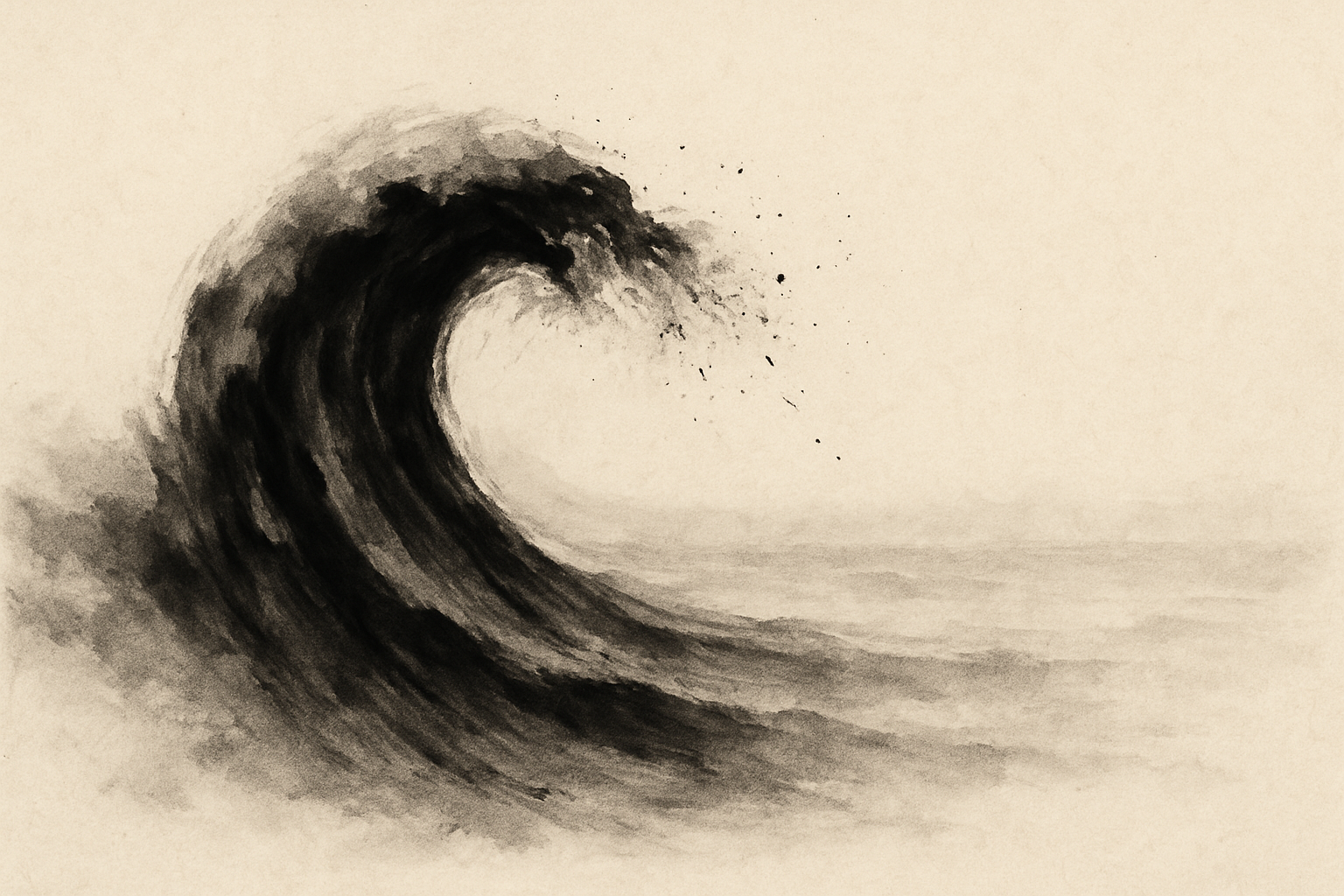
The Wave Cannot Grasp the Ocean
La ola no puede atrapar el océano
A student asks about the nature of self-identification, and the teacher explores how the constant effort to grasp a fixed self dissolves once it is clearly seen to be futile.
The Wave Cannot Grasp the Ocean
A student asks about the nature of self-identification, and the teacher explores how the constant effort to grasp a fixed self dissolves once it is clearly seen to be futile.
(The student's initial question is addressed by the teacher mid-stream.)
It's like a fish trying to understand the ocean. But in that metaphor, the fish is somewhat separate from the ocean. A better image is a wave in an ocean trying to understand water. It cannot analyze water because water is what it is. It cannot separate itself from the ocean in order to look at the ocean.
The reverse movement
What can happen is the reverse. All the energy the wave invests in being separate from the ocean can fail and give in, and then it is just ocean. All the energy placed into being separate from the seeing, the seen, the perceived, the others; all the energy placed into being limited by the body and maintaining that separateness: that effort can drop. And that can happen spontaneously, or it can happen through a process of seeing. Seeing that there's no point. And then also seeing that there really isn't anything you can identify with.
In the meditation today, I was speaking to this. The more you see that everything is fluid and there are no things, the more the mechanism of attaching to things gets undermined. It's like trying to catch a river in your hand. At one point you realize that it simply can't happen. You can try to turn the water into a thing, like a rock, but it's water. Every time you do that, it's an effort and a failure, and that is suffering: the effort to identify with something when it is all fluid, all in motion.
Spontaneous or understood
When that efforting stops (and it can stop spontaneously, or it can stop because it is seen through a form of understanding, even an intellectual understanding), then what can happen is this: Usually we experience sounds, sensations, perceptions, and thoughts, and then, using thought, we create two layers. One layer is "inside," and one layer is "outside." There is that which perceives and that which is perceived. There's a sound, there's the naming of the sound, and then there's the placing of the sound outside, over there, and the placing of that which perceives in here.
When all of that efforting is seen and begins to slow down and stop, what can happen is that the seen, the heard, the sensed becomes the inside. All of the interpretation of that layer dissolves or becomes part of that same field. It's just thought. Sensation, perception, sound, and thought all become very clear, without that pushing: the sense of pushing the seen outside and the seer inside, the heard outside and the hearer inside.
Looking for the seer
This is actually always your experience. There is just the interpretation, the mechanism of putting the heard outside and the hearer inside. One way to see this is to look at something, or hear something. It's easier when you look at something. You could look for the thing you're seeing and then look for that which sees, that which is experienced as the perceiver. For example, you can look at the screen and then look for that which perceives the screen. Try to find it, and then go back and forth. Then try to see: what are you referring to when you find the seer?
You'll notice that the only thing you can refer to as a seer is either a sensation or a thought, which is also the sensed or the thought. It's not the sensing or seeing itself. The seen and the seer are just a ping-pong between perceptions. We're not seeing something "out there." Someone with a more scientific mind can understand that all representation of the world is created in the brain, so it's internal. You are not seeing something out there. You are seeing an image created by the brain. You only ever have contact with the image created by the mind. The same is true with sound.
Then the mind creates an imagined space and projects the sound as if it's occurring over there, projects the image as if it's occurring over there, and imagines a seer that is seeing the scene. But there's just the scene. If you refer to something as a seer, you're going to thought, you're going to a sensation, and all of it is the same. It's appearing in the same field, not separated from anything that appears.
Time as interpretation
Time itself is appearing in the same way. It's just the way the mind interprets change and then uses memory to create a map of time. Change is just movement, and everything is always moving. There isn't ever anything that's not moving. And that's why, again: trying to capture the river in a fist. Once it's seen that everything is moving and you cannot capture it, you stop trying. First you may freak out, because you realize, or have the sense, that you're going to die. All you ever thought you were is that little bit of water you're grasping in your hand. When you realize you just can't have it, there's a temporary panic, often a pain, and then a release. A release into: "Oh, I was always just the river. I was always the ocean. There's no need to grasp. I was always just this: everything appearing, empty, full, timeless, without a real beginning or an ending."
That clears a lot. Thank you.
You're welcome.
In the meditation I was watching how there's this constant reference to an image of myself, to my face or my body. Every time it appeared, it was a different image, supposedly "me."
The river of self-images
Yes, that's the river, in the metaphor I was using. And I bet that goes on almost constantly.
Most of the time I don't notice it.
There's nothing to do about it. Just noticing is enough. It doesn't need to stop.
It stops once you see deeper, doesn't it?
It doesn't stop. The mind never stops. Probably when you die. But it calms. To a very large degree it calms. However, we tend to interpret that as "you need to calm the mind in order to get there." It's the other way around. When you see, then the mind calms. It's a side effect.
What you're describing is important: seeing this constant effort of trying to refer to an "I" that is a thought, trying to make that thought be "I." The more you see that activity, the more it becomes transparent and clear to you. You'll be able to see that it's not particularly useful. There is actually very little use for doing that constantly.
Now, if I'm having a conversation with you and I tell you a story about my day yesterday, I'm going to invoke an image of me. There's going to be an invoking of that image, but I'm not grasping it as "I." Think about you yesterday. Is that who you are? No, that's just a memory of you yesterday. That's how I experience talking to you about me now. Any sense of an image of "I" that I'm referring to appears to me to obviously be an image, like the image of me yesterday or the image of some person I saw on the street yesterday. It's just another image.
It's useful if I'm talking to you and I tell you a story about me. My mind can imagine the person and talk to you about that. But it's not experienced as "that's what I am." There isn't this grasping, this trying to make that image into "I." So for the rest of the day, if I'm not telling you a story, I might at moments contemplate something where I reference a thought about "I," but it's known to be a thought. It's like doing a calculation. If I'm doing one plus one equals two, I don't think the one is me and the two is the other. It's just one plus one equals two. There's a usefulness in that. There's a usefulness in contemplating the person. But what you can start to see is that very little of the day requires it. It's like doing math. How often do you need to do math in the day?
You could think, "Well, every choice I make requires me to contemplate." Not really. Choices come from a much deeper place and don't actually work like that.
So you're saying what is needed is just to keep looking at that, and at some point there's a kind of choice that says, "I don't need to do this so much," and you just decide to stop doing it?
Seeing, not choosing
No, it's not a choice. At that level, the seeing has a consequence. It's like believing in Santa Claus, and then seeing that Santa Claus is your father. You see the evidence. So the belief in Santa Claus being some old person coming from the North Pole dissolves. You don't have to make a choice there. You don't have to make a choice to believe that Santa Claus is your father. The belief that Santa Claus was an old man at the North Pole disappears as a belief. It becomes known to be just a thought, just a story.
I often say "it's a choice," but in a different context. In a deep sense, it is a choice to believe that Santa Claus is real. It is a choice to believe that you are only the image in your mind. But let's not confuse things, because different kinds of language are useful for different kinds of moments.
In particular, it's not a choice in this way: once you see, you see. The whole process of "me, me, me, me" is images. "I, I, I." The more you see that, the more you start to realize, "Well, that's not me. It cannot be me. And what's the point of this?" Something can get severed. Something can break, which is the ability to believe in a story. It's like with Santa Claus: you start to see different levels of evidence, and toward the end you are really, really wanting to believe in Santa Claus, because you're very attached to that story and it's a very painful thing to let go of. There are fond memories and emotional attachment. But at some point you see through it and you grow up. In this case, you wake up. You can't go back. Nothing I can do now could convince you that Santa Claus is real.
I notice the pull is stronger with certain things, with certain stories. In the meditation I started thinking of the story of my separation, and I noticed it pulled me more into it.
The pull of emotion
Yes, because there's more emotion.
The spell is bigger there?
Yes. What really drives that is some uncomfortable sensation, some pain or fear. The story is a way to separate from that and control it, or numb it. Once you're able to see that no matter what pain or fear appears, it's just an energetic that comes and goes like a river, then trying to control that becomes unnecessary.
Two flavors of experience
It becomes obvious. You start to have a very calming experience where you can go back and forth between two ways of relating and interpreting. You can go into that identification, that contraction, and it has a very particular flavor: suffering, contraction, repetitive, torturous. And then you can have the freedom to drop that (because you've seen through it enough) and go into the actual sensation that the story was helping you numb. You realize the sensation is just some form of energetic, and it's an aliveness, even if it's fear and pain. It's a life force. Then it can move, and it can start to feel quite beautiful, quite loving.
You start to taste these two options, going back and forth. Back into the contraction, torture, suffering, identification. Then into the free fall, the openness and vulnerability of the energetic of fear and pain moving, whatever discomfort is moving. At some point it starts to become very, very clear. You see the two options plainly. One is like eating junk food, and the other is like gourmet food.
But at first you don't realize that. At first it's like giving a three- or four-year-old a choice between a fast-food burger and fries, or caviar and sushi. The child is going to take a bite of the sushi and spit it in your face. But when you're older and more mature, you start to realize: one is much better, much more valuable, much more nutritious, much higher quality. It's just better in every way.