The Kaleidoscope of Attention
El Caleidoscopio de la Atención
A question about the teacher's claim that directional seeing is an illusion, leading to an exploration of how attention moves on its own and why we mistakenly believe we are controlling it.
The Kaleidoscope of Attention
A question about the teacher's claim that directional seeing is an illusion, leading to an exploration of how attention moves on its own and why we mistakenly believe we are controlling it.
You mentioned earlier that directional seeing is an illusion. Could you please explain a bit more?
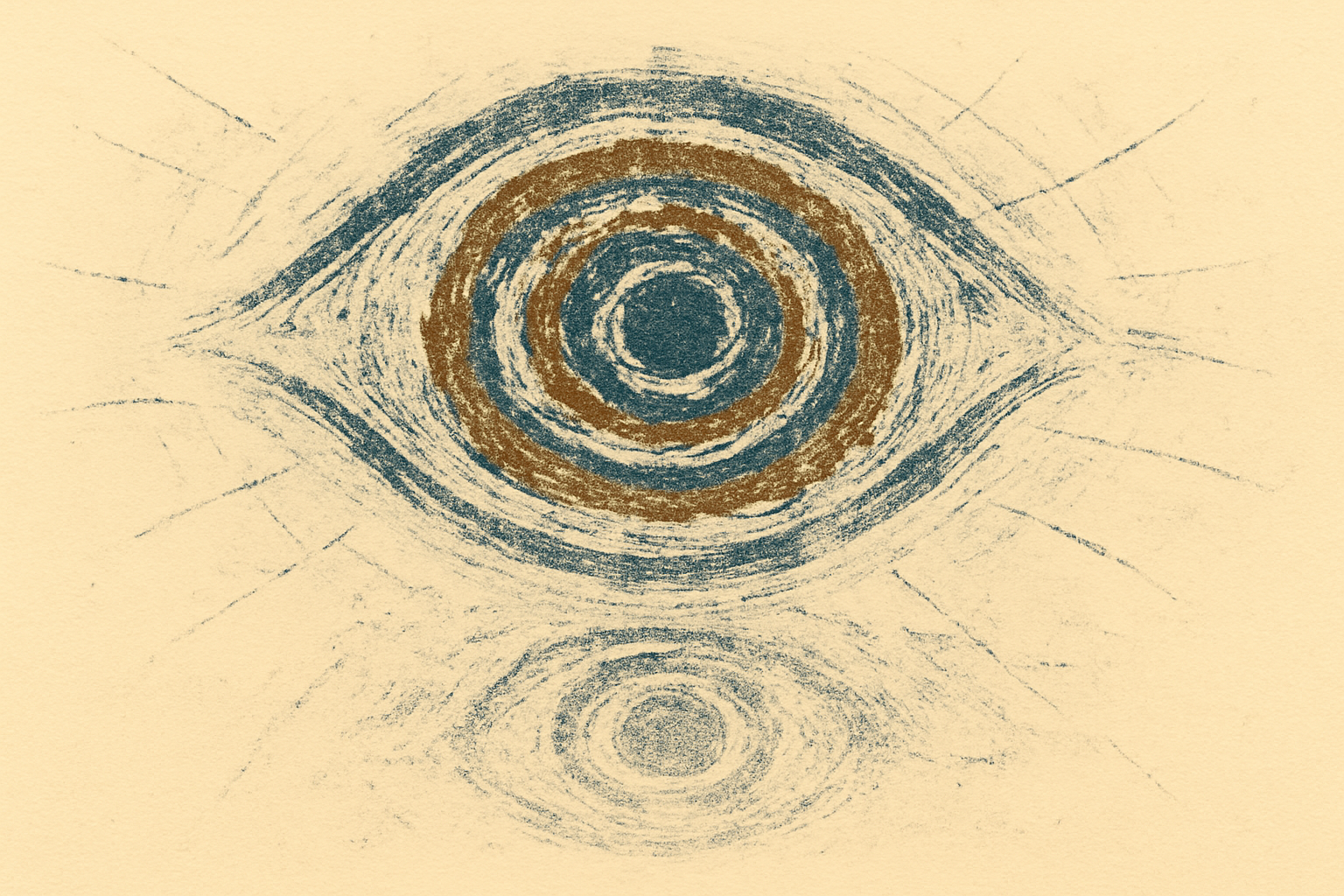
It appears as though we control what is being seen. If I say "your breath" and you pay attention to your breath, what happens is actually a movement of attention. Think of it as a kaleidoscope: a toy where you look through one end and see colorful shapes and patterns. When you turn it, the little colorful pieces inside shift and rearrange, transforming what comes through the light into something new. As you move the kaleidoscope, what's actually in front of you starts to change and morph in usually very pretty and interesting ways.
What you're looking at when you look through a kaleidoscope is an illusion. You're not seeing what's really there. If you think that reality is what you see through the kaleidoscope, you're going to be seeing mostly an illusion.
The mind as kaleidoscope
As a metaphor, the human mind and attention are like the kaleidoscope moving. Attention morphs experience. It changes and transforms the experience of the reality that we're in. But the movement is happening on its own. It's like a ripple in a river. We enjoy the experience of believing we are doing that, that the movement is "I." But it's not.
In the metaphor, attention changing is simply morphing the experience, transforming the focus. If you bring attention to sensation and close your eyes, everything changes at the level of experience. If you think about a mathematical equation, your entire experience is transformed. Your mind is shifting, attention is shifting, what's being focused on is shifting. But the actual movement, the turning of the kaleidoscope, is life itself moving on its own.
The attachment to "I am doing"
Then there's an attachment, a liking of the sense that "I am doing the movement." There is an enjoyment in claiming, "I am the source of this movement, I am the doing of this movement." That is the core of what I'm calling an illusion. Not only the sense that something fundamental is moving when attention changes (not much actually is changing; it's a rearrangement of experience, but fundamentally reality is not changing), but also the sense that "I am doing this change."
When that is seen, when it becomes clear that all of this movement and changing of experience is not arising from "I" as a separate person, then what remains is everything that is seeing and everything that is knowing. There is no central, localized source. But the trick is this enjoyment of the experience: "I am directing attention, I am choosing the movement, and I am that which is moving." That is the illusion. And it only persists through intentional forgetting of what I truly am.
That's a really clear explanation. It helps my understanding of attention and noticing. Noticing has no direction.
A deeper enjoyment
The more that is seen, the more there can be an enjoyment of something more pleasurable. Because the enjoyment of "I am doing, I am moving, I am choosing" comes with struggle. Then it's "I" that needs to move and change things in order to get what I want. As opposed to the enjoyment of this never-ending, ongoing, multidimensional, colorful creation, all of it witnessing itself being born from itself, without any deep preference.
If pain is arising, it can be danced with, as opposed to struggled with and fought with. There is a peace and a freedom there that is not possible within the illusion of "I am choosing, controlling, deciding."
The unpredictability of attention
As a practical exercise, look at thoughts as they arise. Can you know what the next thought is going to be? It's pretty easy to see that it's very unpredictable. The same thing can be done with attention. If you sit and meditate and let attention do what it does, it will bounce around unpredictably. Can you anticipate where it's going to go next? You can't, because what is going to appear in experience next is not predictable.
There could be a bird sound, and then that's where attention goes. Would you have been able to anticipate that attention was going to go toward the bird sound? Not until the bird sounded. Attention then goes to a sensation in the hand that appears. Would you have been able to anticipate that? Not until the sensation appeared. The same with a thought: a thought appears out of nowhere, unpredictably, mysteriously, and attention goes to it, which leads to another thought. Attention is constantly moving, and then it can be interpreted as "I am the attention, I am the choosing of the movement of attention." That is the core illusion.
No central origin
When we do this work and are able to disidentify to a degree from the mind and the body, we can still remain very identified with attention. To see that attention is actually life without a central origin is like asking, "Where did the wave begin?" Think of the experience of a wave at the moment it's about to crash. The experience of that can be something we claim as "I am crashing, I am this movement, I am choosing this." But it's actually something that began without a beginning. What I am is everything and nothing.
So, for example, your love of music and playing piano every morning: that's like a cosmic event.
I didn't choose that.
But that's what we tend to identify with so strongly: our preferences.
Even a preference. Why did I like piano? Is that "I"? Where did that come from?
It's very clear. Thank you.
You're welcome.