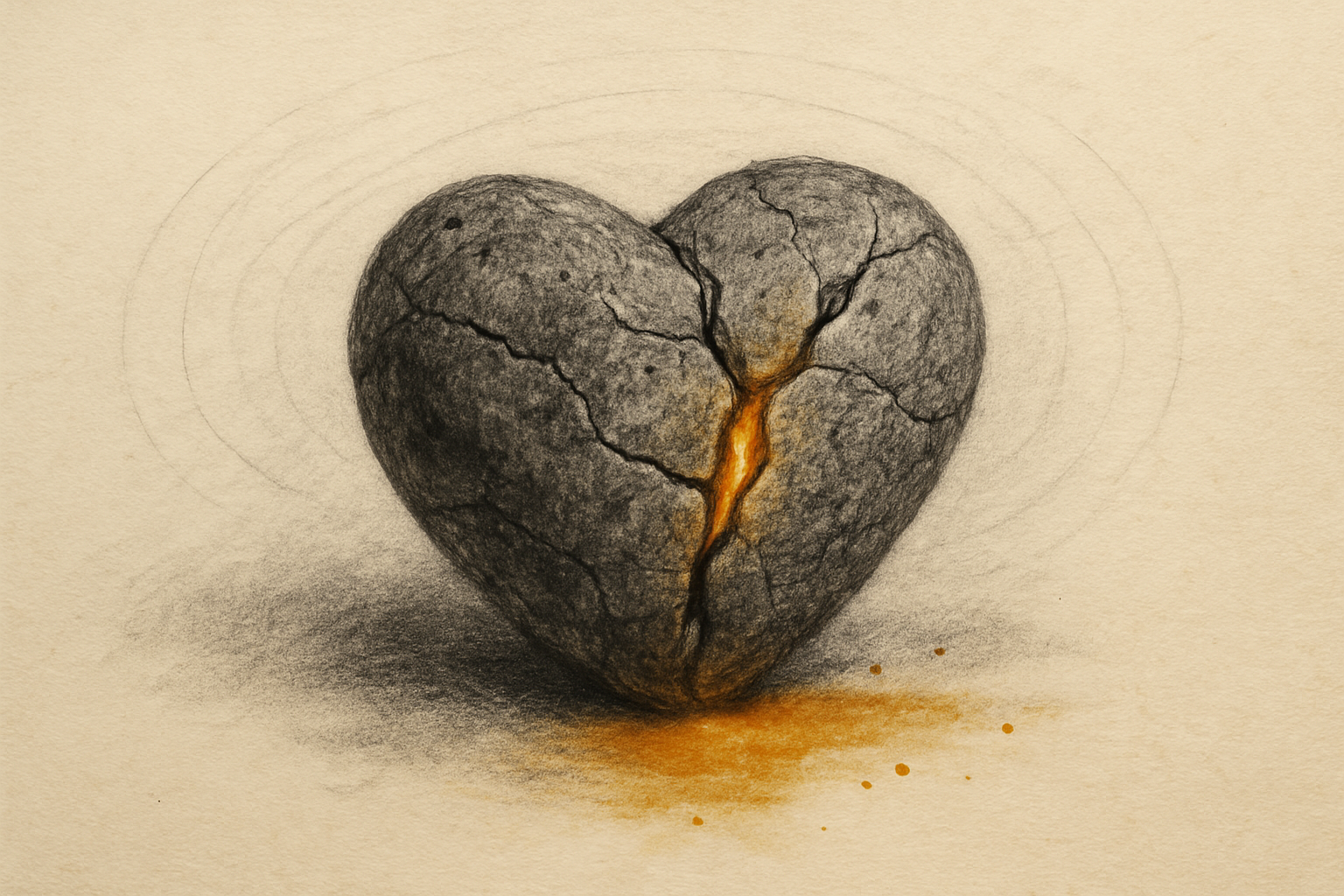
The Heart That Can Take All Wounds
El Corazón Que Puede Recibir Todas las Heridas
A student describes waves of bliss and stillness arising in daily life, alongside a deep-seated fear of fully opening up, rooted in past pain and broken trust.
The Heart That Can Take All Wounds
A student describes waves of bliss and stillness arising in daily life, alongside a deep-seated fear of fully opening up, rooted in past pain and broken trust.
Something has been stirring over the last week or so. There have been states, almost like waves, of what I can only call bliss. It feels a bit like being drunk, a bit unreal. There's bliss in the body, and a kind of stillness with it all.
For example, I went to my step-grandson's hockey game, and I couldn't even follow the puck. It was just presence with everything. My husband asked if I was bored, and I actually wasn't. I was extremely happy. It's like, what else could you want? But it's hard to explain that to people.
Then, maybe a day or so ago, something else came up. I'd compare it to a pebble in a shoe. There's this fear. A lot has been seen and felt, and I can see that so much of the mind's activity is nonsense. But there's this fear, and when I try to feel into it, it's basically a fear of completely opening up and surrendering.
When I sat with it, I felt something very innocent. I don't know if it's mine or from the field or what it is. What came was the trust issue: I trusted, and it brought pain. So I'm just trying to feel into it and sit with it, but I can't quite get to that final letting go. I totally feel and know that the mind, the ego, whatever it is, cannot protect you. It's just a veil. But there's still this something.
Yes, naturally. As the veils of illusion become thinner and thinner, there is a recognition of what is there. You spoke of bliss, and you also said stillness. It's important to recognize that they are one.
Obviously we're using language and words, and I don't know exactly what you mean by bliss and stillness. So there's a bit of a leap in our communication, and at that level I have to go with the intuition of what you might be referring to. But what's important is to see that they are one.
The clarity that is not of the mind
There is a deepening clarity, but it's not a mind clarity. It's not clarity in understanding concepts. It's the clarity of seeing what is. The illusion, the veil that mind presents, the one we are tempted by: ultimately it's the temptation to ask for a sense of safety and to look for safety where it is not, where it only appears to be. It appears to be in thought. And so we can go into thought to find that safety, though it will be an illusion.
When you said something about "a final letting go," or the resistance of fear to fully open up: you spoke about opening up, but that's not really the fear. The fear isn't opening up. The fear is what will happen if you do. And so then you spoke of pain.
The illusion of protection
Naturally, we go into the sense of safety and illusion, which basically means trying to be less hurt and less afraid of being hurt. This is ultimately the choice. But it's also where things can become absolutely, radically clear, and that clarity helps with the choice.
If it becomes absolutely, radically clear through experience (not through mental understanding) that we cannot end, then the fear of death has a different quality. It doesn't mean the fear doesn't appear. It doesn't mean it doesn't exist. It just has a different quality. It has a softer quality. It has a flavor to it, rather than a power that directs all of our experience.
The same happens with pain, and they are very related, because we fear pain. What hurts is many things, but when things end, the ending of what we want or wanted or are attached to, that can be anything: from illusions, thoughts, and fantasies to very real, non-mental things. All of those can cause very real forms of pain, emotional and physical.
Pain is very real. Pain does not end.
Stillness is also in the pain
But to see that the stillness you are tasting, discovering, seeing is also in the pain, is also in the fear, and therefore the flavor of that blissfulness...
The bliss can have many flavors. When we start discovering it and tasting it and really getting in touch with it, it can have very substantial qualities. Then it can become much more subtle and quiet.
I think what I mean by bliss is peace. But it's a nice feeling in the body, like relaxing. Physically, my mother was talking to me and I couldn't even reply to her. There's that kind of effect.
Exactly. It does affect the body. That is an effect on the body of a recognition of stillness, of peace. You could call it silence. When it became really clear to me, suddenly everything was that. Absolutely everything. And nothing could not be seen as that. It is stillness. All thoughts, all emotions, all pain: everything was just that.
That happened for me quite suddenly. It was a before and an after. But what I'm getting at is that it's a process of clarifying, so that the choice becomes simpler.
When protection loses its purpose
If you experience the clarity of this stillness in the pain, in the fear, then the matter of protecting yourself, the concern, the energy of holding back and not opening up, the trust dynamic (distrust, trust, distrust, contraction, opening): it will lose its purpose and power.
You see in your experience, you recognize clearly in your reality, not through an understanding of my words, but in your own experience, that the very beautiful peace and stillness that sometimes appears as blissfulness is also there when pain is present.
Before the mind has integrated this, before it has had sufficient exposure, it can only say: pain is bad, fear is bad. And then: I need to manage and reduce those. Then there's this struggle of choice and control around that, because the mind cannot see the multidimensional complexity of it. There can be pain and peace and love and fear and absolute perfect stillness and divine creation all at once. When that is seen, the mind has to catch up. The body-mind energy of protecting and closing up starts to lose its purpose, because it exists in service to avoiding pain at all cost.
The self-flagellating monks
This is something my teacher used to speak about quite a bit, in a high-level, general way, and I only really grasped it much later. I often talk about fear and pain and moving into that, and he used to speak about self-flagellating monks.
Flagellation is basically self-whipping. These were monks whose practice was to whip themselves. That was their meditation practice. It came from a very deep misunderstanding of Christian teachings. The recognition was: when there's a lot of suffering, something really powerful can happen, something magical can come after. It happened to Christ, it happened to many saints. And so the logic became: let's create that suffering in order to accelerate the process. If I'm okay with the pain, then I will be free. At least I will have the opportunity to know what those who have been in great pain and suffering came to know.
That is obviously not how it works.
The point is: it's not about creating pain. It's not about mindlessly moving in the direction of pain, or pursuing an agenda of pain for the purpose of something else. That is a delusion. What matters is the pain that is divinely created by a life lived fully, with an open heart and an open mind, and then whatever pain and fear that brings.
The image of Christ's heart
The perfect image, to me, is Christ with his heart in his hands. All of it is there: the wounds, the bleeding, a pierced organ still being offered in that pain. It is less about being a martyr, less about enduring pain for no reason. That image represents the recognition that the heart, when fully given, fully opened to life, can take all of the wounds, all of the pain. In that image, Christ is not destroyed, not devastated, not collapsing. In the fullness of that offering, there is no real damage.
And there's incredible strength in this, which the mind cannot grasp. It also echoes the "turn the other cheek" teaching. It's basically the same thing. It's not weakness. But you're right: the mind says, "The heart, exposed? That's terrifying." I know it's nonsense, but it's deep-seated.
It needs to be known in the experience. It can't be known through a book or somebody's words. Words can give you the direction of where to explore, but it needs to be explored in your own flesh. It's embodied. In the flesh.
So I'll just sit with it and see what it wants to tell me. Thank you.
You're very welcome.