The Illusion of the Donkey
La ilusión del burro
A student shares her fear and self-judgment before a difficult conversation with her ex-partner, and the teacher explores how we imagine ourselves as a separate entity we can whip into performing better.
The Illusion of the Donkey
A student shares her fear and self-judgment before a difficult conversation with her ex-partner, and the teacher explores how we imagine ourselves as a separate entity we can whip into performing better.
I just wanted to thank you. The meditation was great and powerful. At one point during what you were saying, something shifted for me. I have to talk today with my ex about lawyers and residency matters. I haven't spoken with her in many months. I was noticing I was afraid, and I was also judging myself: not only afraid of the thing that might not work out, but afraid of her, of what she might think, that she might be really closed off. And I was judging myself without even seeing it. Like, "Hey, you're still afraid."
I don't know exactly what it was, but something you said brought me peace suddenly. It was almost as if: yes, it is like that. If the situation goes badly, how lucky, in a sense how grateful, that I can still feel, that I didn't close up, or at least not completely. Even the fact that I still feel the fear. I just wanted to share it because it was triggered by something you said. There's always a lot of judgment, at least in me, around the fears and the pains. Like, "I should be over this," or, "That should have happened differently."
The servant mind and its illusions
This is part of what we were exploring with the metaphor of the servant mind. Why are you asking the servant to create a narrative of someone doing something wrong?
The "me," you mean. Yeah.
What illusions is it offering you?
I don't know. It's very moving for some reason.
"Things can be different. You have the power and the control. It's all really up to you." These are the illusions.
Yes, it's clear what you mean.
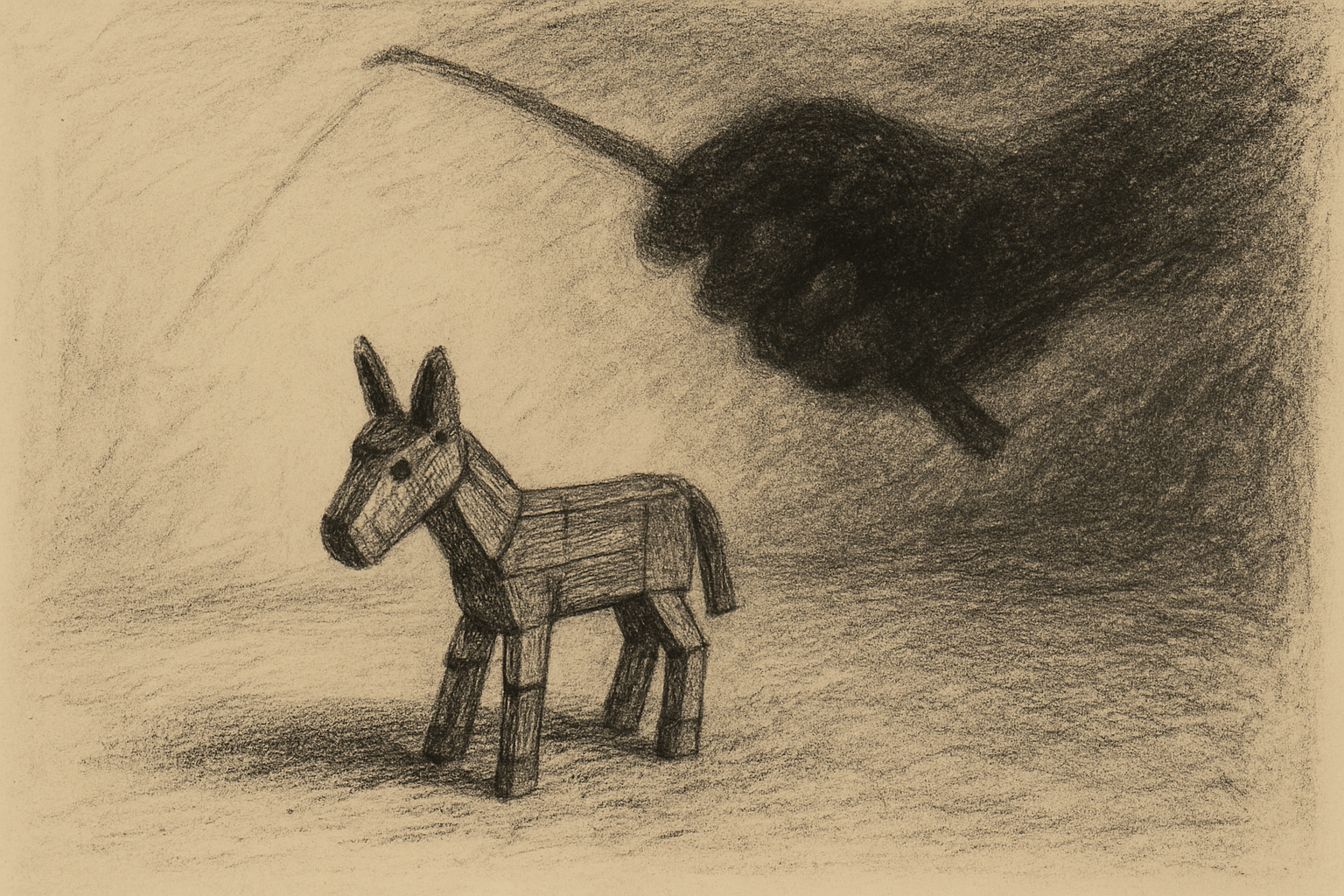
The donkey and the whip
The image of what I am is like a donkey. I just need to whip it enough for it to go faster up the hill. If I kick it enough, if I scream at it enough, it's going to start making things happen the way I want them to happen. But if you see that the donkey has no real control, there is no donkey. You see the illusion of donkey. It's just, as I once heard someone say, "taking care of itself." You simply witness.
When I say "there's no donkey," the metaphor of the donkey is this: there is a localized, centralized entity that decides independently, autonomously, with volition and control, and that entity is "me." I call that "I," and then that "I" can supposedly manipulate reality. But there is no such separate, independent, localized agent.
We imagine this entity. We think we are the entity. And then we whip the entity in our imagination, which actually produces emotions, because the body is going to respond. We take the image of what I was calling the donkey, and in our imagination we wrap it into the image of this body. So in the mind, the body is getting whipped all day. What's going to happen? There's going to be chemistry, emotions in the body from that whipping. Metaphorically, it's going to be stressful. It's going to be exhausting.
When the pattern loses its grip
And I know this because I was an expert donkey-whipper. I think I could only see about ten percent of what was going on at the time. It was pretty constant. But now, when something from that old personality pattern comes up here and there, it's almost like an amusement. It's almost like, "Oh, how does this go again?" It doesn't cut very deep, and it doesn't last very long, because it's not very entertaining. Sometimes it is fun to say, "Oh, you were an idiot." But then it's brief, and it has a very different quality to it. Even when at times there is stress or a real worry, it's quite occasional compared to before, when it was basically going on all day long in some form.
In that sense, I think I have a similar personality type, maybe not as extreme as yours was. Thank you.
Thank you.