The Cage That Isn't There
La jaula que no existe
A student describes being consumed by chest tension and overwhelming emotions, and the teacher challenges the belief that well-being depends on the absence of uncomfortable sensations.
The Cage That Isn't There
A student describes being consumed by chest tension and overwhelming emotions, and the teacher challenges the belief that well-being depends on the absence of uncomfortable sensations.
I've been having a really hard time this past year. The deeper I go into this work, the harder it's been, sitting with a lot of the feelings and energies coming up for me. There's a lot of anger, pain, sadness. My mind is so active. I can see what's happening, but once I get more in tune with my feelings around it, there's a sense of real helplessness, powerlessness, and intense fear. That really activates this body-mind thing you talk about. For me, it manifests as a contraction in my chest. My chest just gets so tight. Sometimes, as you've encouraged, I sit with it, and it settles, because I know it's just my body-mind activating. But sometimes it doesn't settle. And when things happen in life, these reactions trigger more often, and then it gets into my sleep. I feel so helpless in my sleep because my mind is so powerful. When I'm awake, I feel like I can be with it, I can tell myself this is just an interpretation, just a coping mechanism, and I sit with it. Lately I've been trying to go into the sensations and be in the present, knowing that the thoughts are just activating the body-mind, and that overwhelm and contraction and fear loop because my nervous system just does that. So my question is about this sense of helplessness and powerlessness. I realize that if I'm in this moment, sitting here, I'm actually safe.
When are you not in the moment?
When you say "when I'm in the moment," I would ask you: when are you not? I understand that most spiritual teachings talk about not being in the moment, that you have to be in the moment. But the reality is, when are you not in the moment? Is there an actual possibility of not being in the moment? Can you be in yesterday? Can you be in tomorrow? Can you be in two minutes from now? Can you be in thirty minutes ago? That one thing alone is going to blow down the whole house of cards.
I'm not sure I understand.
You said, "When I'm in the moment, I realize I'm safe." My question is: is it even possible for you to not be in the moment?
I guess what I meant was, when I stop interpreting.
You can still be in the moment and interpret. You're still in the moment. What's wrong with interpreting? I'm constantly interpreting the moment. There's no way I can reach for an apple if I don't interpret that there's a body and an apple and I can reach for it and it's delicious. What I'm trying to point out is that you recognize something changes. You realize you were distressed and then you're not, or that you felt unsafe and then you realize you're safe and it's okay. Something like this.
Well, I realize it's my mind working, but my body takes time for that acknowledgment.
How do you mean it's your mind working?
I feel like the contraction and the overwhelm come from the thoughts and interpretations, and then they manifest in my body physically.
Most likely, yes. The question is: what's the problem? You could tell me, "I have this tension in my chest and I want it to stop."
Yes, there's tension in my chest. It gets more intense and more overwhelming over time. I don't know if it's always been that way and I've just been...
Staying with what is happening now
How is it now? Because now you're going into narrative, into time, into how it comes and goes. How is it now? What's the problem now?
I still have that tension.
And what's the problem?
I don't want it anymore.
So let's dive into this not wanting. What do you think you will get when it goes?
I can feel at ease. When it's not there, I can be more myself.
Why is having tension in your chest determining whether you can be yourself? And what is this "yourself" you're talking about? What I'm understanding is that whenever you've felt good in your life, you've not had this tension. When you've felt bad, you have this tension. And you think the tension is the cause.
Well, I'm probably the cause of that tension.
The assumption underneath
Let's go back. You have a desire for this tension to end because then you will be at ease. There's an assumption that when there is no tension, you are at ease, and the solution is to remove the tension.
Or the other way around: I'll be at ease and then the tension won't appear.
So then the tension is not the problem; it's just being at ease. How can you be at ease so that the tension won't appear? Now we're getting somewhere. There's an assumption that the problem is the tension: if I remove the tension, I'll be at ease. And now it flips: maybe I need to be at ease and then the tension will go away. So do you actually know which one it is? Is the lack of ease causing the tension, or is the tension causing the lack of ease?
I think it's a combination.
But how do you know?
I don't know. That's why I'm here.
There you go. Otherwise it's speculation and assumptions, and then you're believing things you don't actually know. Maybe you can be at ease while there is tension. Maybe you could be in distress while there is no tension. I could probably guarantee that's the case. You could have no tension at all and not feel well, and vice versa, have moments of feeling well while there's tension. You just forgot about it. It's like having a headache. Can you have a fun time while having a headache? Yes, depending on the intensity. It does not require not having a headache. Could you be having a really bad time while not having a headache? Also yes.
It feels like it gets more intense over time. When it does come up, it...
There's a looping that happens. But what I'm trying to get at are your assumptions and beliefs around this relationship with your sensations. What normally happens is an over-focusing on something as the problem when it's not.
I feel quite overwhelmed by it. The physical sensations lead to a lot of tension in the rest of my body and pain.
Well-being is not dependent on sensation
I would suggest that what's causing that is not the sensation, the tension in your chest. It has to do with your beliefs. You could have pain in your body and tension and be absolutely fine and free. Not a bother in the world about it. "Oh yeah, it would be nice if that wasn't there."
I see that possibility, I guess.
It's hard to believe it.
Yeah.
It's hard to believe because you have a contrary belief. And it's not about having another belief. It's about seeing. I'm trying to highlight the fundamental belief here. You can't believe this possibility because you hold a contrary belief, which is something like, "I can't be okay unless this tension goes away." When I propose to you, "What if you can be totally fine having tension and discomfort and pain?" you say it's hard for you to believe that. That's because you believe the contrary. So now we get to a root, which is a belief. The belief is that your well-being, your okayness, your being at ease, depends on a sensation in your body. I would even say that's a choice: to choose that belief, to choose that interpretation as true, to make it true, to make it real. And I know what I'm saying may sound simple but will probably be very challenging.
You just get so irritable from it. Really irritable.
Because I'm going at it, and there's a part of you that doesn't want to see this or acknowledge it. That's going to activate resistance.
I mean, I get really irritable from the sensations in my body.
Are they happening now?
No.
I suspect that the irritation you're speaking about is something else. It is related to the conversation we're having.
I'm not feeling irritable right now, but I am having a difficult time believing what you suggest, although I do want to believe what you're saying.
This is not a new belief to adopt
I'm not proposing for you to believe what I'm saying. I'm talking about a possibility, and you're saying you don't think it's possible because you believe this other thing. I'm addressing the belief you have, not selling you a different belief. When I was talking about it, you started to talk about being irritable. Just really consider this, and again, this is not a belief for you to buy or take from me: consider the possibility that you are choosing to make your well-being conditioned and dependent on sensations in your body, on a certain tension. You've made it all about the tension. What if you're choosing that?
I'm choosing the tension?
Choosing to make your well-being conditioned on the tension. "I cannot feel well if there is tension." And what if you're even creating the tension? It's like clenching your fist and saying, "I can't be well while there's tension in my hand." Then you relax. "Oh, isn't that better?" Then you clench again. "Oh no." Then relax. "Oh, so much better." What if that's what's happening?
I don't know if that's how it works.
I'm just saying, what if? What would it imply? What would it mean? And what if there could be tension and you can still be happy and at ease? "Oh, there's tension, and I'm going for a walk, and it's beautiful out, and I'm in love with life. Oh, and there's tension. Tension in my chest. Okay. And how beautiful life is." Why are they mutually exclusive? That's what I'm telling you is a choice: "I cannot be okay while there's tension." What if this tension is with you for the rest of your life and 4,800,000 more lives after this one?
I don't feel like I can cope with it.
Don't. Just don't be bothered with it. Just let it be there. Don't go for it.
I don't want it. Get rid of it, please.
The ugly painting on the wall
It's like there's an ugly painting on the wall in your apartment and you don't like it. You can't get rid of it. Can you live there? Are you going to just decide to be miserable? Do you have to cope with it? No, just ignore it. Don't make a big deal out of it.
I guess I make a big deal out of it and it's consuming me.
That's what I'm telling you is a choice. Like the painting on the wall: "If only the landlord let me paint over it, then I will be okay." Well, you could be enjoying your apartment with an ugly painting on the wall, which, by the way, is subjective. The idea that the tension is a bad thing is an opinion. That it's distasteful, that it's unpleasant: that's an interpretation. Maybe it's life. Maybe it's your heart aching. Maybe it's your body tired, a combination of all the aches of your upbringing and being a mother and feeling this and that. It's such a tender, gentle thing to be carrying, and there's nothing wrong with it. So it's not even about ignoring it. It's just being gentle with it and not trying to get rid of it.
I struggle with that a lot. I hear everything you're saying and it resonates with me. It's all my mind, the convincing.
But you have to be really radical and stick to the truth.
I'm choosing this.
Examining the belief through analogy
You have a worldview that your well-being is dependent on something that's happening, which roughly is this tension. "If only this went away, I'd be okay. If it's here, I'm not okay." And now it's consuming you. Let's stick with that one thing right now.
Think of something a little more extreme. Somebody who loses both their legs in a war. Think of a hundred people who lost their legs. They can't walk, can't run, can't swim, can't do a lot of things that one could interpret as requirements to be happy. I imagine that, along with losing those legs, there are phantom pains, a lot of discomfort. But there are people who have experienced this and actually are very happy and have a good life. And some who do not. Many people share a condition that one would think makes happiness impossible, yet others have the same condition and are happy with it. I even have a friend who is in a wheelchair and is one of the most joyous people I know. He is always joyful, and everybody around him feels it. He's just spreading joy. It's incredible. Honestly, I don't know if I were in a wheelchair whether I could be as joyful as he is.
Now, as a thought experiment: is this tension in your chest really the thing that defines your well-being and happiness? Is that really true? As a thought experiment, you must come to the rational understanding that it cannot be. It must not be this that determines whether you're okay or not.
That completely makes sense. It's like I'm trying to blame it on that.
Exactly. People who have had rough conditions, like losing their legs, and are miserable are believing and blaming that incident for being miserable. "If only I had my legs, if I was able to walk, if I was able to run again, then I would be happy. Otherwise I cannot." I empathize. I have not lost my legs. But that is what happens. I have lived that dynamic in different ways. I have had those conditions in my belief and my thinking. I was miserable for most of my life, and that's exactly how it worked. I had beliefs: "If only things that are were not, and things that are not were, then I would be happy." And it was just a belief. I believed it with all of my energy and might in the most stubborn way possible, until it got so bad that everything I did just made it worse. Then the whole thing fell apart, and I saw it all as false. It became so obvious. Profoundly obvious. The shift was radical. Well-being and absolute satisfaction have nothing to do with anything I feel, experience, think, or what my body is doing, whether there's pain or fear or not. Nothing to do with any of that. And I was very shocked for months. It was hard for me to believe the reality that I was experiencing as real and true.
The cage
I guess I'm blaming this thing for not living the life that I want to.
Now we're getting somewhere. What is that belief helping you with?
So I don't have to take responsibility.
Right. Take responsibility. Do things you're afraid of. Live life more fully. Take more risks. Feel the pains that you feel. All of this whole thing about waking up is ultimately about life and living. It's about helping you realize the freedom that is already here so that you live and go for what you really want, and so that you can be with the fears and terrors and pains that life brings and not shy away and turn around. If you're here so that you don't feel pain, don't feel fear, and you find some wellness in some very limited life that is "awake" but requires you to not experience difficult things, you're not going to get that. Not at least talking to me.
I see how it feels like a cage.
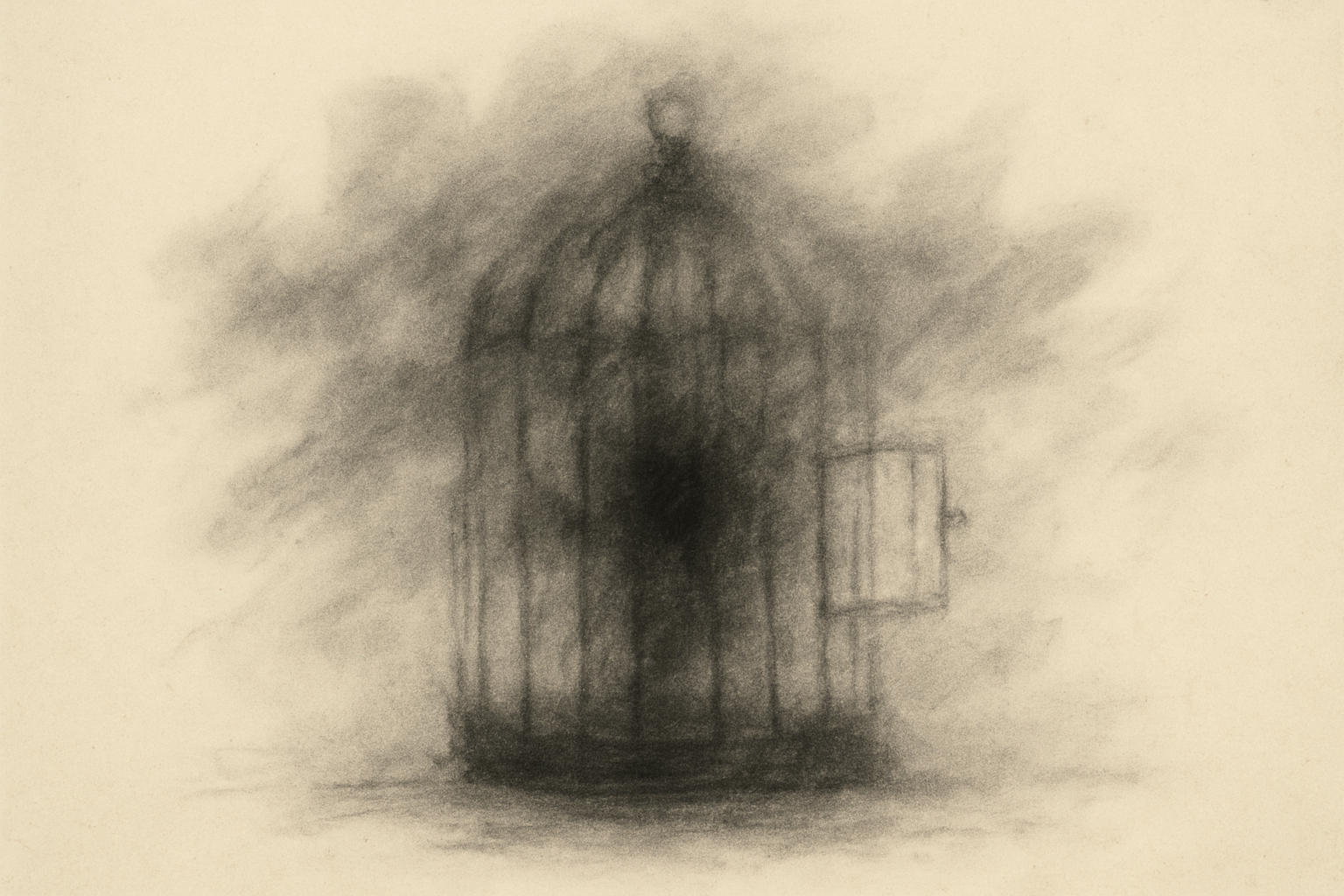
It's the bird with an open cage. It flies out, freaks out, flies back in, and then it's like, "This cage is so small." There's friction with the cage. And then there's the never-ending obsession with it, the addiction to it. Because ultimately it is an addiction: the addiction to not facing what happens when you fly out of the cage and into never-ending life, abundant, scary, painful, beautiful, with other birds and other things and things that come at you and want to eat you.
I really see it now. Thank you so much.
You're welcome. And ultimately, when we wake up, what is seen is that there is no cage. You were pretending it was helping. You were struggling with the imagination of being in a cage which never existed. You were imagining the cage. It's just a distraction. It's imaginary. One hundred percent. There is actually no cage. There's a cage if you believe there is one. In your reality there's a cage because you believe the imagination of it. That's what reality is to someone who believes a thought. Reality isn't, "Oh, I'm believing this thought." No, it's: "This is reality that I'm experiencing." And then one can see, "Oh, that is a thought. I was believing that." But this is the process of disidentification from thought.
It's like a child who believes in Santa Claus. To the child who really believes, Santa Claus is real. It's not experienced as a belief in Santa Claus. That is reality. There is a person who comes and brings gifts and flies with reindeer and all of that. In that child's mind, that is literally the reality they're living in. And then some evidence accumulates, and then there can be the undoing of that belief. And then it's like, "Oh, that's not real. It's a nice story. It's imagination."
This is the same, except what we imagine to be real is not that pleasant. It doesn't feel good. It brings what in Sanskrit is called dukkha: dissatisfaction, suffering. But we prefer it over the abundance of free life. In the metaphor, the bird prefers the dukkha, the discomfort of a small, smelly cage, over flying out and being free, because flying out and being free is scary and will bring pain. The imaginary cage feels safer. But in reality, going into a mind and its beliefs is not really safer. It's the illusion of safety. It's not really better. It's the illusion of something that feels better. And then we start to realize, "This doesn't feel very good." And that's because you're limiting yourself and your life. You're literally believing something that's not true, and that never works, nor does it feel good ultimately. Temporarily it helps. I understand that very well.
How am I working against myself?
Don't take it that personally. I'm talking about humanity. I'm talking about myself. You're not special that way.
I think I realize how I'm just my own worst enemy.
But you're not special that way, because that becomes the next cage. "Oh, me, I'm even worse than everybody else. I'm such my own enemy, even worse than everybody else's worst enemy." That's specialness.
Thank you for directing me to my belief, the one that's been putting me in this cage.
You're welcome. You are very unique and special, just like everybody else, without exception.
The more I listen to what people share in this group, the more I feel we have more in common than not.
Yes. It's universal. It's human mind nature.