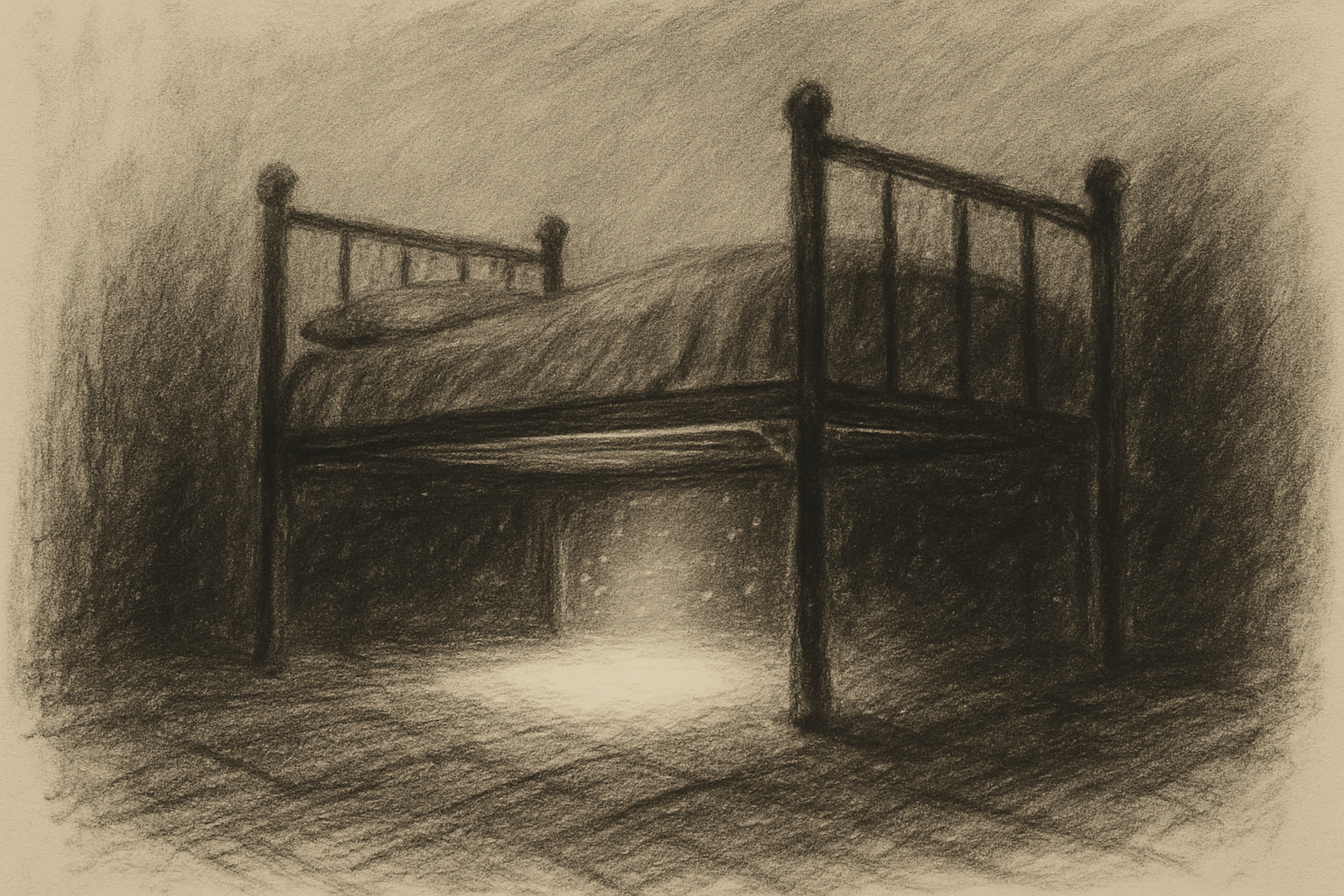
The Ghost Under the Bed
El fantasma debajo de la cama
A question about whether life takes care of itself, and whether that includes providing what each person needs to awaken, leads to a wide-ranging exploration of perspectives, the beauty of ignorance, and why we fear looking at what causes our suffering.
The Ghost Under the Bed
A question about whether life takes care of itself, and whether that includes providing what each person needs to awaken, leads to a wide-ranging exploration of perspectives, the beauty of ignorance, and why we fear looking at what causes our suffering.
I was wondering what you think of the statement that life takes care of itself, and that it takes care of itself in each individual. Even the basic needs, and what people sometimes call synchronicity, is really life taking care of itself, not as something separate from what we are.
For every statement, for me to do a proper job commenting, I would have to say the opposite is also true. Life takes care of itself, but that could also mean killing you. That could be the way it takes care of itself, because that is what happens. The freedom that I talk about doesn't have to do with everything going well in the normal sense.
I don't think that's what I mean.
The paradox of two perspectives
Yes, correct. Life takes care of itself. But you are life, so take care of yourself. It could be the paradox of the two perspectives, to a point where you can see it both ways simultaneously.
Well, you say "you are life, take care of yourself," but when I feel myself as life, I feel things happen. Things appear. Actions happen effortlessly. It's not that I have to do something; it just flows. So saying "take care of yourself" implies I have to do something as life.
Because if I say "you are life, take care of yourself," there are two there, right? There's you and there's life. This is language. This is the mind. But that's where you could say life will take care of you, or will your life take care of yourself? These are different perspectives. I was talking about paradigms, perspectives, interpretations of what's happening, and this is what we're talking about now. These are ways of interpreting or seeing life and experience. If any perspective, any paradigm, is seen as fundamentally true, as a real part of reality, it's going to be a limitation.
A useful paradigm, not an ultimate truth
Back to your initial question: I would say yes, it's true. If one has the tendency to interpret things as "life is just this dangerous thing and I have to take care of myself, and it's me against the dangers of the world," which is also a paradigm, also a false reality (true only in a very limited way), then the paradigm you are asking about, that life takes care of itself, is a very useful one to bring in as a contrast. It counterbalances habitual conditioning that it's you against life and you against the dangers of the world. So yes, possibly for you it is a very valid, more expansive, more aligned, more true perspective. But just as a statement, I would have to say everything I said before.
Maybe I was referring more to the sense that life gives you what you need to, you could call it, wake up or recognize yourself, even if that means suffering or external hardships. I was referring to it in that way.
I also agree, but it's also a perspective. It's not something I would sign off on as true. Anytime there is suffering, what is happening is the opportunity to be free from it. But why does suffering arise? That's not easy to answer. Is life's purpose to wake you up? I don't know. I don't think so. I think waking up is not that important from the perspective of life, of the vastness of mystery, because you are also already awake. Suffering, ignorance, and illusion are insignificant, like the planet Earth seen from space. Life doesn't care if you wake up or not, because you already are awake.
But there seems to be a tendency for life, through its different manifestations, to want to recognize itself, its truth. Or is there?
The beauty of ignorance
Yes, and there is also a tendency to not want that, which is more common. It's both. There's a really strong tendency to attach to illusion, to ignorance, to be identified. A really strong tendency. And I see that only as something beautiful.
Interesting.
I read something decades ago where someone asked a teacher a question along the lines of, "I've been doing this for so many years, I'm in such a struggle and suffering, and nothing gets better." And the teacher said, "You're so far away from home. The further you are from home (meaning realization, awakening), the richer, the vaster, the more abundant is your journey, with more and more experiences. So take your time and enjoy it."
I'm not saying this as though it's your situation. I'm saying it to reflect how there is no negativity in not being awake, no negativity in ignorance or illusion or identification. Isn't that beautiful?
So you could also say life wants to go through that cycle of really deep ignorance and coming out. Both things.
Yes. And I can say that personally, I know that in myself as directly as I've wanted food when I was hungry. I know that I've wanted to be in suffering and ignorance, and I chose it and I wanted that very deeply, as much as I wanted to wake up. And I got what I wanted both times. So be careful what you wish for, as they say. This is where I'm speaking more from the perspective of life: what I wanted was given, was created.
But you wanted it as life.
Yes.
The belief that keeps you from looking
Really, it is a big threshold in awakening: removing the belief that it's not possible for me, or it's not possible now, or it's not possible until later, after such and such happens. All of those are beliefs, and they are really difficult for us to let go of. Let me put it that way rather than "difficult to get rid of," because they're not viruses. They are what we are attached to.
It is very difficult for us to let go of the belief, right now, that you're not awake, and that what's causing you suffering is the real thing. You can wake up right now to see that you are awake, and that which is causing you suffering is not real. There's a ghost under the bed. You look: there's no ghost. Fear disappears. If what's causing you suffering, you see it's not real, where does suffering go? This that appears not real is mind. It's mind. Just imagination, like the ghost under the bed. Pure imagination.
The bigger question is: why is it that we imagine the ghost under the bed and then we are afraid to look?