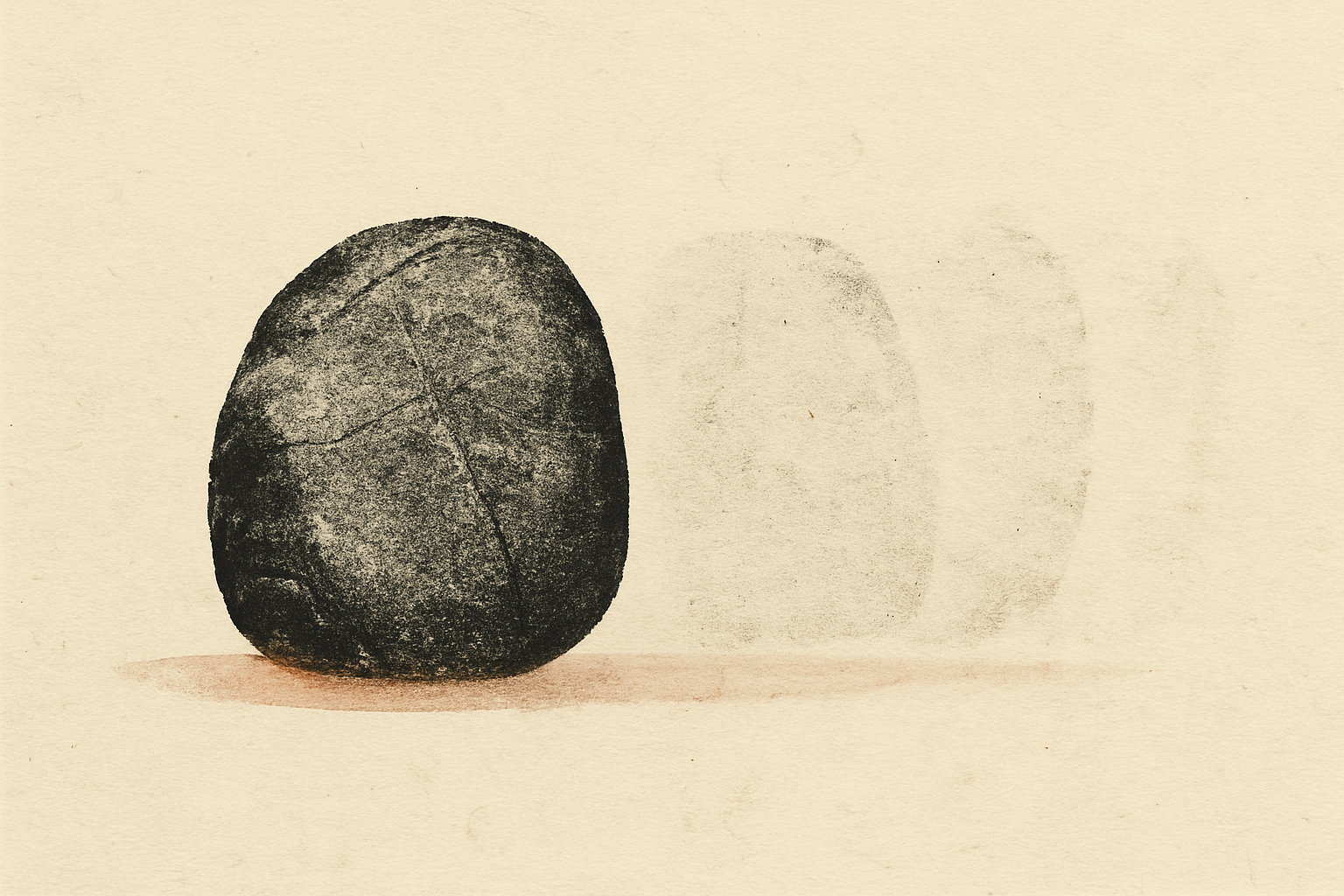
The Stone Is Already Perfect
La Piedra Ya Es Perfecta
A student describes oscillating between spaciousness and old patterns of fear, anxiety, and shame, particularly around feeling "asleep" in social situations. The teacher works with the metaphor of Michelangelo and the discarded stone to point out how the belief that "this moment isn't right yet" perpetuates the very struggle.
The Stone Is Already Perfect
A student describes oscillating between spaciousness and old patterns of fear, anxiety, and shame, particularly around feeling "asleep" in social situations. The teacher works with the metaphor of Michelangelo and the discarded stone to point out how the belief that "this moment isn't right yet" perpetuates the very struggle.
I have many beliefs about how I am when I'm around people. My fear, anxiety, and insecurity used to overwhelm me. That was the fullest, truest, most real thing to me. I didn't see anything else. I was stuck there. Now, as I create more space in myself, I can question these things more. The anxiety, fear, and insecurity are still there, but I have more perspective on them. They aren't as much "me." They don't define my whole world. But at times I go back to the fear and think, "Yes, this is me, and I'm asleep," and I feel ashamed about that.
So my question is: how do I deal with this in and out? The shock of feeling, "Okay, I'm not this fear, I'm not my anxiety," but still feeling that they're partly there, lingering, with beliefs behind them. And there's also shame about that asleepness in me. Maybe because I grew up around people who were very asleep, or because I was ashamed of people in my life who were asleep, I judge myself for being asleep. It's this in and out of stuff coming up and then settling again.
When you say you're asleep or you go in and out of being asleep, what are you referring to?
When I'm in dialogue with people, sitting with my family, I tend to put on certain masks. I don't feel secure enough with myself, and the role I'm putting on feels like an asleep presence. It's hard for me to sit with that.
So it's basically a judgment, right? Going back to the metaphor of the painting, or the stone in the market for the sculptor: you always have, in this moment, what's happening. You're talking about a circumstance with your family, but that's a reference point. What matters is always what's happening in this moment. Whatever you can clear in this moment, then at any moment, what comes up is what you look through.
What I'm hearing is that when this happens, in the moment it happens, there's a judgment: "This should not be as it is." So there's "I'm putting on a mask, I don't feel comfortable, I'm not in the presence I could be in." That's the painting. There are colors and shapes in the painting which you call "not being present, putting on a mask," whatever comes up. And then: "I don't like this."
It could be something about your family, or about you, but it's all the painting. Imagine you're at a dinner with your family. In that dinner, you are part of the painting. Your thoughts are part of the painting. Your emotions are part of the painting. What your family is doing is part of the painting. All of it is part of the painting of what's appearing. And you are looking at it saying, "That's not right, that's not right, that's not right. I'm not okay until that's different. Right now, this is how it is, and it's not okay."
The slip into self-judgment
The proposal is: look at that first. You have no clue how things should be. In that moment, you're the person in the market throwing away the stone, believing you know the stone has no value.
I come with all my preconceived notions and...
That's a slippery slope, because now you're putting more interpretation. That's a judgment on you. That's another appearance, and now the narrative, the thoughts: "Oh, this is happening because I'm coming with my preconceived notions." That narrative ends up in the painting. There is an "I" that's not okay because of narratives. You were just creating a narrative out of self-judgment, and that's happening because of a negative view on yourself. So you're perpetuating, creating more.
In this moment, what appeared was the metaphor we were talking about earlier: the owner of a stone in the market throws it out because he believes there's no value there. Michelangelo comes, sees the beauty in the stone, takes it, and creates a beautiful sculpture. That's a metaphor for a choice that can happen in this moment. One is the approach from a belief system, a judgment, a certain kind of thinking that "I know how things should be," looking at the stone the way the owner did. The other is the openness and not-knowing of Michelangelo, through which creativity can see the beauty lying more deeply in the stone.
When I was pointing that out, you took the position of the owner of the stone in the market and described that. So this is what's appearing right now to you in this moment: me pointing out that position. And that invoked a narrative of negativity about you. I wanted to pause that, because that's not where I'm going. You can choose right now which perspective you take. You can take both. You're free. You are both Michelangelo and the owner of the stone at any time.
See how, in that moment, the painting that was appearing was me saying, "You take the position of the owner of the stone." That's your painting right now. And when you saw that in the painting, the thoughts were, "Oh yes, because of my past, my conditioning, my previous beliefs, I come and I do that." That's more painting. That's more thoughts. That's more interpretation.
I guess I'm learning to hold that negativity I have for myself.
I think we can cut through that, because it's literally happening right now. You're pushing it away. You say, "I'm learning to hold that negativity." No. It's a choice right now. In the metaphor of Michelangelo and the owner of the stone, the decision is instantaneous in the moment. Which perspective do you choose? It's always happening right now.
If you say, "Well, I'm taking the position of the stone owner, but he's conditioned, he has these beliefs, he's negative, and I'm learning to deal with that," you're none of that.
That's true. I'm none of it, but I have it within me. I know it lives in my beliefs, but it's there. It's not... it's like it's not there.
This is where everything we've spoken about today applies: you have this choice, and it's based on beliefs. Right now, what you're describing, "this lives in me", yes, beliefs come up. But all of that, in this moment, is just the makeup of the painting of your life: your thoughts, your beliefs, your emotions right now.
When you take the position of, "I'm a little stuck here with these beliefs, I'm stuck in this situation, things will get better when I work with this," that's the position of "There's something wrong in this painting. I'm still working with it, but right now it's not okay. It'll be okay when I work with it, but I still need to change the thoughts, the beliefs, the emotions, the colors here and there. Once I get that to a better place, I will be okay."
The completed shift
What I'm suggesting is that the shift is complete. Everything that's happening, your thoughts, your emotions, your conditioning, all of that, what if it is perfect exactly as it is? It's divine creation. It's Buddha nature. The painting is absolutely gorgeous. The stone is the most beautiful stone. Michelangelo, in that moment, saw the most beautiful sculpture that could be made with that stone. There's nothing wrong with it. It is absolutely perfect. And he made the most incredible masterpiece from it.
All he had to do was see the beauty, take the stone, and love it. Love his creative process. He enters the creative process in complete love, as an artist of that magnitude does, and creates a masterpiece. All of this is metaphorical, but this is your life: how to take everything that is your thoughts, emotions, beliefs, conditioning, and past, not as something that has a problem with it that will be okay once you work with it. Michelangelo isn't seeing the stone like, "This stone is fucked, it has all these problems. I'll see if I can fix it. Once I fix it, maybe I can make something okay with it." That's not how he approaches it.
Maybe I'll add some background. Growing up very sensitive, with parents who didn't know how to meet that emotionality, I grew up denying that I was sensitive, pushing away emotions, pushing away reality. Now, since it's a bit clearer, I can allow myself to be more needy in a way. I think it's okay in the process to say, "I need something to make up for what I didn't have," but not to take it to an extreme of, "I need this to survive." Well, in some cases it really feels like that. I'm playing with something delicate.
What you're sharing is all fine. Is there something wrong with that? Maybe I'm misinterpreting, but I'm hearing you say, "Yes, but I have this in the way. There's something..."
Limitations. Personal limitations.
"It's something I'm working on. It's a personal limitation, and only once it's resolved will I be able to take the position of Michelangelo."
Yes, because we are works in progress.
But that's not the point of the metaphor. The point is that the stone is perfect as it is. It's perfect as it is, and it's a work in progress at the same time. What you're missing is that the stone is perfect as it is.
Right. I think that is something I'm missing.
The only way you can experience that the stone isn't perfect as it is, is through beliefs. Through the judgment that the stone has limitations. Through the idea that the stone has limitations. That's why it gets thrown out by the owner of the store, whereas Michelangelo sees perfection. Those are the beliefs that can be seen as beliefs and thoughts, because they're constantly putting you into a place of, "This isn't right as it is now. It'll be right tomorrow when I work on it."
The shift is to see that "this isn't right right now" is the belief. "I do not know, and it's preventing me from seeing the beauty in what is, as it is," which is always a work in progress. This is where I talk about waking up versus growing up. The growing up is never-ending. This moment is always a rock being worked on, a painting being painted on. It never ends. There will always be parts I'd like more, parts I want to shift. It's always this never-ending growing.
So you're saying the agenda dissipates? The reason why I'm doing this, the whole up and down, the bumpy terrain?
Yes. The agenda is the interpretation, the belief that this moment as it is, is not right, but it will be better, it'll be okay later. It's very subtle.
I'm beginning to see that.
Including all of your conditioning, all of your emotions, all of which I will not debate, you can talk about your past, your situation, your circumstance. All of that is your reality, your experience. All of that is the painting that's appearing to you, with all of the memory, all of the interpretations and beliefs and thoughts about everything that's happened to you and your circumstances right now. All of that is the painting.
I guess I just feel at times like I want to share these things, because it brings into life that there's nothing that needs to be hidden. Sometimes I feel I need to put on this act, that I don't make mistakes, that I'm perfect.
I hear you, and that's beautiful, and this is a space for that. What I'm pointing to is that all of that is the painting of your life, with all the experience of the challenges you have, and it's all this beautiful creation. All of it is perfect as it is. And at the same time, you can be the creator, continuing the painting with all of your needs, all of your pains, all of your fears, all of your experience of personal limitations. All of that is part of the painting.
Then you'll also see there are a lot of other parts of you that are not limitations, not difficulties: all of your gifts. The sensitivity you talked about is a really strong sign of connection to beauty and heart. Metaphorically, that's the Michelangelo. The sensitivity is what notices beauty, and it's also what notices, "Oh, this part here is a bit painful. Let me spend some time with these colors to shift this." But not from the place of "This isn't right, something's fundamentally wrong, it needs to be fixed."
It's really a process for me to bring back that original beauty into the sensitivity. It's sometimes difficult when others don't appreciate that. I need to find a way to feel that aliveness in a world that can seem so dead and asleep. I need to work really hard.
That's where you can see: others don't see this beauty. You can see the beauty in others not seeing beauty.
That's a tough one.
No, "the tough one" is a belief. You're resisting it.
Yes, I'm resisting it.
Choosing not to see it. It's a thought, a belief. That's where I'm going with you: you have the choice.
Maybe it's too painful to see that.
"It's too painful" is a belief. "Painful" is a fact: "Oh, look at that, there's pain." "It's too painful" is a belief, meaning "I can't do that because there's too much pain." In fact, I'm pretty sure it's the opposite. It's not painful enough. You can totally go there. You're free to go there. You can handle the pain.
Everything you just described, "others don't see this," and so on, all of that is beliefs. Everything you named was something that's not okay. And you can see the beauty in that as well. The world that is so fucked up, the ignorance, the asleepness you're talking about, see the beauty in that. The beauty in others being asleep. As beauty.
Does beauty start where pain ends, or...?
Beauty is everything, everywhere. But we have to be careful: it doesn't mean it's "okay" in the sense of allowing it. For example, "this part of the painting here on the top left, I see the beauty in it, but I have to go right away with these colors and change it." When I see the beauty, I'm getting a more accurate picture of how it is. I see it more directly, without the interference of beliefs. Then I can paint with it from deeper wisdom and understanding, because I'm connected to beauty constantly, and to love and wisdom. Whereas if I see it, react to it, don't like it, then I'm going to go with friction and anger and pain, and I'm going to make a bigger mess.
So when you see the people you experience as not awake: first of all, know it's an assumption, an interpretation. You don't know their level of wakefulness. But trust your intuition. The more you see it's an assumption, the more you'll have a deeper, truer intuition, not a belief. Then see the beauty in that. And see, "Oh, maybe that inspires me to share something, to respond to that in a way that creates an opportunity to dance with my wakefulness, my presence, and bring that to this moment with these people." Not because I'm reacting to them or judging them as not awake, but because whatever I feel could have a little more wakefulness, which I cannot know. That's always important to keep in mind. I cannot know.
Aliveness as our nature
The way I've been seeing it lately is that we are alive beings in our essence. We are movement, and we're alive. Not feeling is not natural to our being. Not being in touch with things, closing doors on things, is not our natural state. Coming from a place where that was the most natural thing, it's interesting to see how it's playing out.
Yes. All of our human aspects can become present, alive, accepted, known, not rejected, not pushed away, not seen as problematic. Then they're all part of the canvas. They're all part of the instruments we have for creating, for painting. What kinds of colors do I have? What kinds of brushes are available? The sensitivity, the kind of mind you have, the personality. All of it becomes the canvas and the brushes and the paintings.
The message I'm trying to put forward is that every moment is that canvas, and it's absolutely beautiful. Seeing it as not is the position of a belief. When I see it as beautiful, that doesn't mean I can't see ways to create and shift it in ways aligned with my sense of beauty, my taste, my intuition, my wisdom, my love. At every moment, that creativity also grows, but not for me to get anywhere. This is the endless process, the growing up, where my tools get better, my color palette gets better, my personality, intelligence, wisdom, all the metaphorical tools, and also the canvas keeps shifting as I work with it. But coming from the place where it's beautiful as it is, versus something's wrong with it.
In Advaita, "something's wrong with it" is actually described as ignorance, but it's the belief. Ignorance is the belief in something that's not true.
If you could be in touch with the beauty, the essence of it, you could also be in touch with the essence of the pain that exists.
Exactly. Because it's not seen as ugly, it can be known and tasted fully. Because it's not rejected, it's part of the canvas. You can go into that part of the painting, swim with it, bring your brushes, create, touch it, taste it.