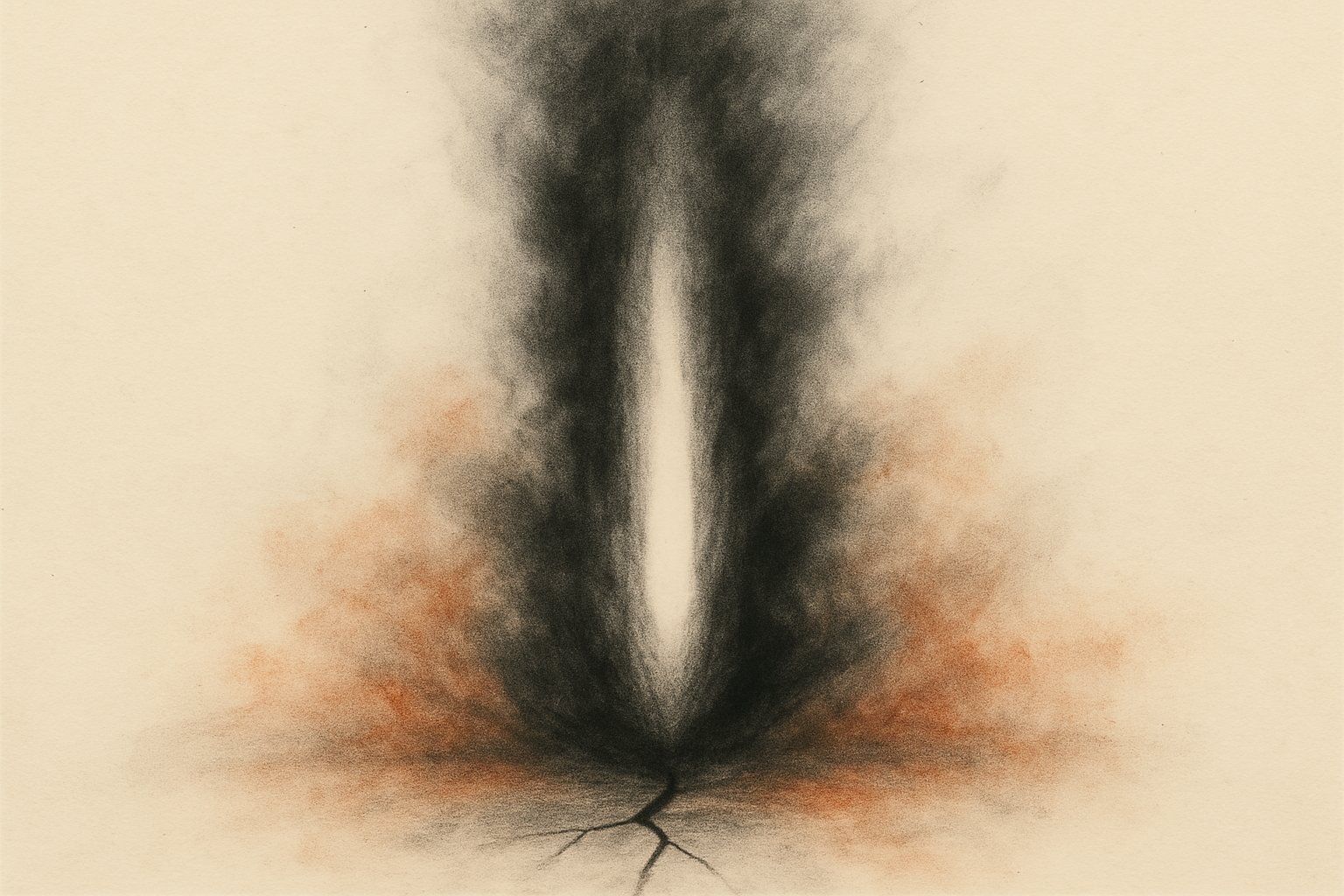
The Fire That Does Not Burn
El Fuego Que No Quema
A student asks about the recurring cycle of peace and difficult conditioning, leading to a deeper exploration of sitting with unbearable sensations, the metaphor of Dante's Purgatorio, and the wound of separation.
The Fire That Does Not Burn
A student asks about the recurring cycle of peace and difficult conditioning, leading to a deeper exploration of sitting with unbearable sensations, the metaphor of Dante's Purgatorio, and the wound of separation.
Do you sometimes feel like when you're at peace, all of a sudden all kinds of thoughts come up because of past conditioning? Does that happen to you, or has that fallen off?
That has mostly fallen off. I did have a lot of that. To have been able to go into deeper places, I don't know if I would call it peace, because I never really knew peace until a kind of big shift happened. I had tastes of it, glimpses, but they were never quite the same thing. In the past I would have these experiences where peace would come after being able to be present to difficult feelings, and then there would be another cycle of deeper, more difficult experiences.
Yes, as the capacity grows, it just happens. It's an amazing process because then it has a life of its own.
Life has a life of its own, for sure. The process has its momentum. Once it's put in motion, it just goes on its own.
The welcome and the unwelcome switching places
When I was in France at a retreat, it was the first time in my life that I felt the welcome and the unwelcome almost switched. I was feeling so much come up at once, and after a point I said, "This is perfect. Bring it on." Then I got COVID, and everything got much worse. It was very painful, on many levels. And I thought, "Someone planned this retreat for me. Thank you." But what am I thanking for? What's going on?
Ever since then, I noticed a shift: less resistance, more seeing that the good is in the bad and the bad is in the good, and that this dichotomy is artificial.
The decision that something is essentially bad is just the sheer rejection of it, because we can't be present to the sensations it produces.
Going into what arises
This is why, when someone was sharing earlier, I pointed out that there is another version of that meditation. I could have said, "Bring up some memory or think of something current in your life that distresses you and contemplate it." That's a very different thing from what I invited. It's not necessarily a bad thing to do, but I wouldn't make it a regular practice because it can seem masochistic. It's more the other way around: if something is coming up for you, then contemplate it, go into it, go deeper into it.
If you're sitting to be quiet and thoughts about something difficult from the past keep arising, the solution isn't to try to calm the mind and push them away. You go into the sensations that you are reacting to, the ones that bring up the stories.
The more we can deeply enter the experience (and it's going to be fear, pain, shame, all kinds of difficult feelings, but those are sensations, feelings, and emotions), the more we can be present with that and touch it, we become somewhat desensitized. Not because we no longer feel them, but because we no longer react to the sensation.
Dante's Purgatorio: feeling what cannot be felt
In Dante's Divine Comedy, in the last part of the Purgatorio, the transition from purgatory to heaven happens through actually feeling everything. Feeling everything that the person in hell cannot feel. That is why it's called purgatory: to purge. It is this cathartic purging of feeling what one has been unable to feel.
In hell there is no time. It is eternal, because one is in a position of complete avoidance. In purgatory there is time, because the person there has a sense that the pain will end. In the book, the souls actually carry a divine knowing: they are told by the angels that they are not there for eternity. They are there until they are able to purge.
But at the end of purgatory, because it ascends higher and higher, there is a final transition. That is the fire that does not burn. Dante must walk through a path of pure fire, and it burns. He is told, "You have to walk through there. It is going to feel like you're burning, but it is not going to damage you." That is the final transition, which leads him to heaven. And in heaven, again, there is no time. It is eternal peace.
That burning is the ability to sit with the most difficult sensations, to feel the most difficult feelings.
So purgatory is needed to be able to go through those. The angels guide or help?
The angels appear throughout the whole story. One of the key messages is that purgatory is not an eternal place; it is temporary. It is a process that will end once you are able to sit with the sensation, the burning, the heat, the discomfort, the emotion or feeling that is difficult. Once you can sit with that for a certain period of time, you are no longer reacting to it.
It can even become something of an acquired taste. There is a sense of deliciousness in that sensation. Even fear, even pain. Not that we go looking for pain, but when it appears, it's like, "Oh, there's that tingle of fear, that tingle of these sensations that I'm no longer in a position of reactivity toward."
Peeling layers deeper
Then it can get more and more intense, because we go deeper. At first, the sensation might just be the stress of an active mind. But the active mind is there because we are asking it to hypnotize us and distract us from something we don't want to feel. So we peel that layer and find, "Oh, there's actually a pain or a fear."
If we sit with that pain or fear until we are more okay with it, the mind calms down because it is no longer needed to distract us from that sensation. We do this over and over again, deeper and deeper, until we cross that fire that does not burn, which is the last sensation we find unbearable. If I were to label it, it is the sense of being separate.
That's the one. That's the seemingly unbearable one, beneath all of it.
Yes. And it is basically the fear of death. But what can die is only what is separate. Only what exists in time can die.
It's almost like the fear of death is a recognition of the absurdness of "Where could I go?" without realizing that we're noticing the absurdness. There's something automatic there that maybe we can't quite see.
At the level of sensation, it has to be met. You can mentally say, "I can't go anywhere," but that is not a knowing as deep as the level of experience.
My point is that there is so much wisdom in the fear of death, more wisdom than I realize. It comes from a knowing that death isn't truly possible. We don't like separation because it's not right. We notice that it's not right, but we're not aware that we notice it. It's so interesting.
The angels as purposeful presence
You were talking about the angels. Are they portrayed in that book as time-bound or not?
No, I think they're eternal beings. I don't remember the details of the metaphysics, but they appear as entities throughout the whole story, almost from the very beginning. The first angel appears in hell.
I find the whole notion of angels fascinating. I was studying with someone who took every single word in the Jewish Bible, from beginning to end, and researched the origin of each word. The origin could come from any one of ten or twelve dead languages. He came up with some amazing things. He was a physician; it was just his thing.
One of my favorites was his work on the term for angel, which in Hebrew is malach. We have a word in modern Hebrew, melakha, which means a very specific kind of work done for a very specific purpose. That's what we think of when we think of an angel: "You're an angel; you showed up just at the right time." They fit right then and there, through a divine whatever.
That's beautiful. Malach.
It helps me because it's like there's a whole puzzle, all these different pieces.
Maps, not puzzles to solve
They are all maps. Don't expect things to resolve once you follow the pieces together. It's not a puzzle in that sense, because that could be the mind trying to figure things out: "Once I find all the puzzle pieces and put them together, I will arrive." But that is what the mind believes is the solution, and it is never going to work.
These are all pointers and maps. That is why a lot of teachers made a great effort to contradict themselves, so that you couldn't create a map where all the pieces fit together neatly.
That makes sense. I also want to mention what you were saying earlier about sitting with it, allowing it, going deeper and deeper. It gets hotter and hotter, but ultimately what I see is: it's not what is happening; it's our relationship with what's happening. I keep hearing you talk about that in different ways.
Yes, it's the relationship. That is what I'm bringing up. It is to relate to things rather than try to avoid and cut off. To touch, to go into, to sense, to be present with, so that we can actually sit with that which is why we identify as something separate.
The wound of separation
Say that again.
To be able to sit with things until we finally sit with the one thing, the last thing, the deepest thing we avoid. In the purgatory of Dante, that is the fire that doesn't burn. What we are avoiding is the sense of being separate. We attach to a sense of being separate in order to avoid sensing that.
Saint Francis described this by saying that by believing we are separate from God, we create a wound. That wound is so unbearable that we try to fix it as separate individuals. But it is a wound that the separate individual cannot heal. Only through the recognition of our divine being, only through the end of the sense that God and I are separate, is that wound healed. Because the wound is the consequence of believing that I am separate.
The sense of separation and the wound are really the same thing. But the entity that is separate cannot heal it. The mind cannot assemble the puzzle pieces and fix it. The person cannot fix that wound, because the very existence of that separate self is the wound. The being itself of that sense and belief in a separate self is the wound.
Your deepest desires, the ones that come from trying to fix that deep sense of "I'm not okay, life is not okay," cannot be fixed or healed by me, by the "I." It can only be healed through surrendering, through the death, through going through the experience: the fire that doesn't burn, the sensations of the fear of death, the surrendering through that wound. Then we lose the sense of "God and I" or "the world and I," and that wound disappears.