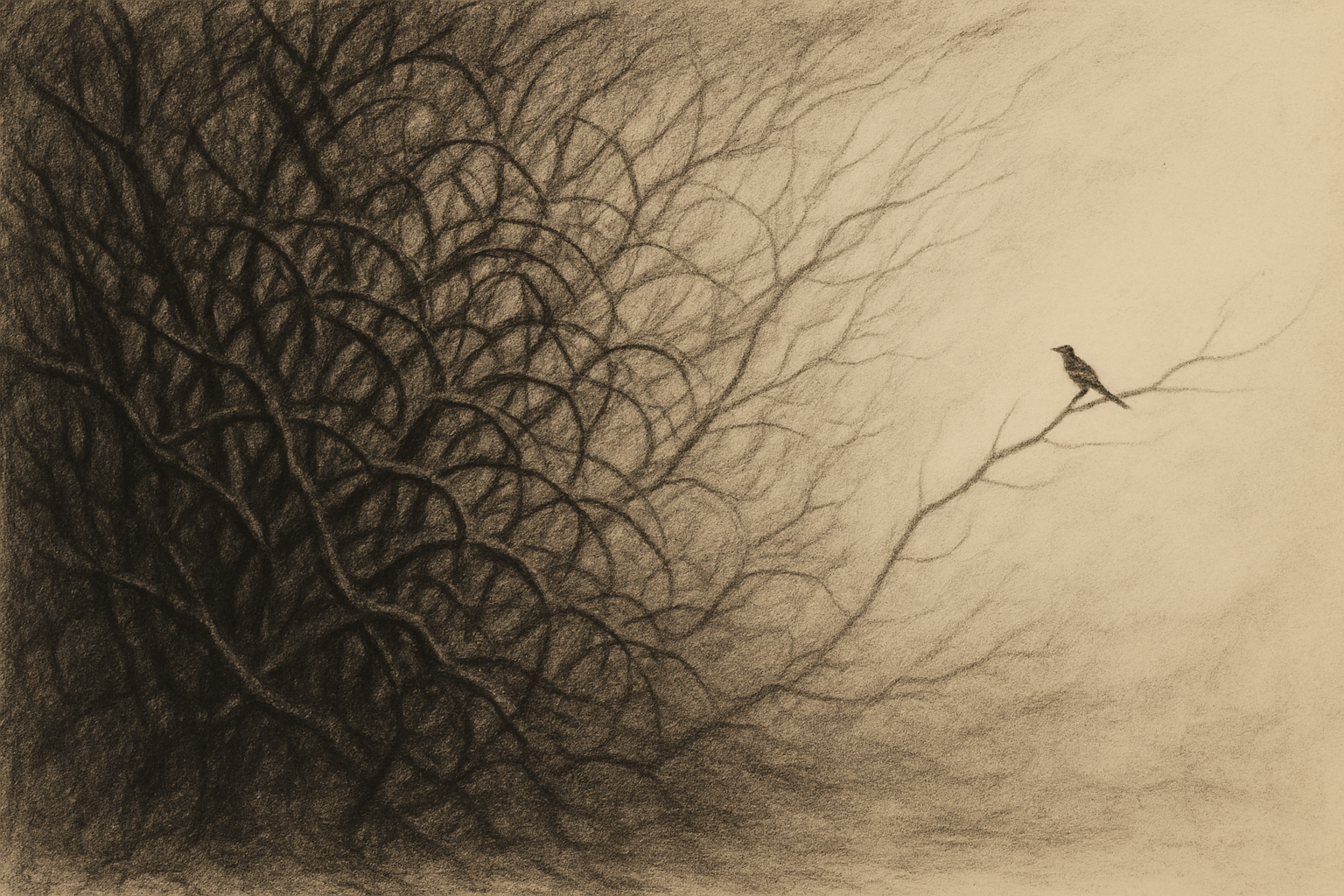
Recognizing the Messages That Come with Fear
Reconociendo los Mensajes Que Vienen con el Miedo
A student describes how recognizing the repetitive belief systems that accompany fear helps them return to direct experience, and the teacher explains the physiological basis of these protective patterns and how safety emerges from sitting with what we've been conditioned to avoid.
Recognizing the Messages That Come with Fear
A student describes how recognizing the repetitive belief systems that accompany fear helps them return to direct experience, and the teacher explains the physiological basis of these protective patterns and how safety emerges from sitting with what we've been conditioned to avoid.
One thing that has been helpful for me is getting familiar with the little belief systems, the little messages that the mind sends out that come along with fear. When I hear those, I say, "Ah, yeah, that's familiar. I know that one." It's so obvious when it repeats itself, so obvious that it's not true. It's frozen in time. That helps me step away from that little monologue and go back inside. If I remember to just go inside and check, it's like: I know this. I'm afraid of fear. Oh, it's just fear. Okay, go inside, check it out, you'll see.
It's such a simple process, but the conditioning is strong. I got a book that has been extremely helpful for me, and it talks about the whole physiological process that gets set at a very young age. So it's not just psychological; it's a whole physical pattern. In other words, it's all about being gentle. It's all about being gentle and forgiving myself and just being right here, right now. What's up? That's it.
The brain physically needs to change
That's exactly what I was telling a friend two days ago. To invite this gentleness and patience, because your actual brain physically needs to change. The habitual patternings of thought are hardwired in the brain. They are malleable, but the synapses and neurons need to start making different connections. That's what you're describing, because from a very young age we learn how to not feel certain things. The way the energy of an emotion is dealt with is through patterns of thinking that push the energy in a different direction. And by energy, I mean electrochemical activity. Physics can see it. It's a real thing.
Over time we develop these patterns. We can bring attention to that process of thinking, which is what you're describing: noticing, "Oh, the habit of this kind of thinking." But what's actually there is fear. So you start getting in touch with the fear. There's a direct contact with that energy of fear. And what's going to happen, one hundred percent of the time, is that the pattern of thinking will slow down, because its purpose was to keep you from feeling the fear. That was the coping mechanism for a young child, because the fear was too much for that psyche to relate to directly. The same goes for pain. It's basically fear, pain, shame, all kinds of forms of fear and pain, emotional and deeper.
Sinking into what the mind wants to escape
As you're able to sink in, which is what I was pointing to in one meditation about the hot tub: the mind is saying, "I want to get out of here, it's just too hot. I want to get out of here, it's just too hot." The more you can sink into that and realize it's fine, and actually the flavor of the fear or the pain is quite interesting, the whole mechanism of protective thinking that was pulling you away starts to realign. It starts to align to a pattern of safety. The mechanisms of the reptilian brain, which are saying "fight, flight," start shifting to: "Is this safe?" And that is well-being. That is peace.
Because if you can be in terror and in pain and feel safe, then there is peace.
When nothing is left to defend against
Now, the mind cannot imagine this. But when you are able to be in terror and in pain and feel at peace, feel safe (let's call it that way, because it's more like the pattern of the brain), and you can feel safe because you've sat with it again and again and nothing happens and it's totally okay, you start developing a sense of safety.
Well, then the mind cannot imagine anything that it can't feel safe with anymore.
And then it would freak out.
It'll freak out, but then it'll just stop. Because the whole function of the mind is to protect you. The thing is, you come to the mind and you say: "Please, master, protect me from fear and pain. Help me. Create the veil of illusion so that I can manage and deal with fear and pain. But don't protect me from seeing reality."
Once you open up and see reality, which means sitting with fear and pain, the most intense fear and pain you can conceive of, and then sitting through it and discovering you are safe, the mind goes: "There's no reason for that anymore."
The dragon that just needed to be seen
There's a story from an animated movie where a character approaches a dragon, ready to fight it, ready to take it down. But then the relationship to the dragon changes. Instead of fighting, it becomes: "Oh, you're very angry. What's going on? Poor dragon, you seem very hurt and angry." And the dragon responds: "Oh, thank you for seeing me."