The Mind's Strategies and the Map of Distraction
Las estrategias de la mente y el mapa de la distracción
A student shares how stepping back from compulsive work habits revealed patterns of self-doubt, and the teacher offers a framework for understanding how awareness changes where we locate our problems.
The Mind's Strategies and the Map of Distraction
A student shares how stepping back from compulsive work habits revealed patterns of self-doubt, and the teacher offers a framework for understanding how awareness changes where we locate our problems.
During the meditation, when I noticed the distractions that came up, I saw something I had been caught in for months. It was this voice saying: "I have to work, I have to work, I have to work, because I need money." It was really about my ego sense, telling me I'm not enough, that I can't do things well. When I decided to simply stop working, to stop chasing more, something important shifted. Trust appeared. I saw that what I actually want is to do my best with my work, to learn what I need to learn, but in a more grounded way, with confidence, rather than just looking at what everybody else is doing.
I appreciate this opportunity to see all of this, because sometimes the mind tries to pull me somewhere else. It was as though I had been looking outward at many other people, trying to see myself through them, instead of actually knowing myself. And what I found was a being who only had a finger pointing to the past or the future, always saying "poor me, poor me." I looked at all of that and thought, "I don't even know who wants all this." And of course, I bought the ticket.
You bought the ticket.
Yes, with the finger pointing. And in that moment I said, "No. No more. This is the last time I show up like this." Now I continue to see those patterns, but I feel good, because that is their life. My life is my life. In this moment I can see the whole panoramic picture clearly, and I can simply say: okay, I'm here.
You mentioned something about stopping work. Is that something that happened recently?
Yes. About six or seven months ago, I decided to stop. I told myself: you are not working right now, just see what happens. I let go of what the mind had been saying about me, and that was the real change.
And when you say "stop working," you mean literally?
Yes, literally my job. I had been telling myself I wasn't doing things well, that I needed to take more courses to get more clients, one course after another. And then I said: just settle, stop, try to relax, enjoy. What is the problem? I live with my partner; he covers part of the expenses. So I felt I could do it.
The mind's strategies
The mind is always going to come with strategies. Something doesn't feel right. We feel something is missing, something is not okay, either with the moment or with ourselves. If we are really lost, the problem is going to appear very far away. It is going to be the government, or something equally distant and projected. That is what happens when we are deeply lost in beliefs, in the story the mind is offering.
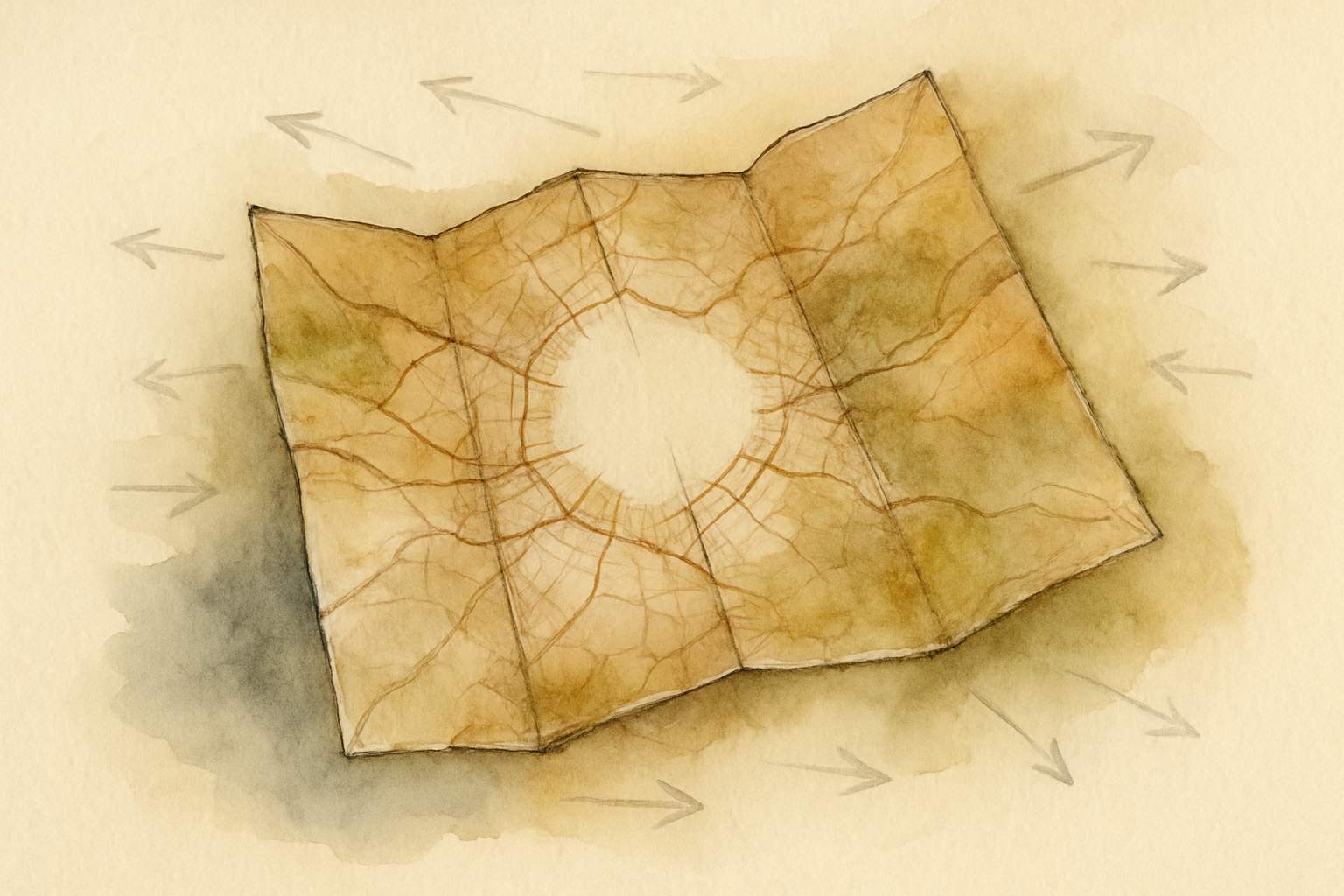
You can take this as a kind of map. If we are very distracted, the problem is going to be far away. The more aware we become, the closer the problem gets. It becomes more of a sensation, something at the level of feeling: an anguish, perhaps, without much story content attached to it.
Distance in time
It is also going to be far in time. The problem will be something that happened long ago, and the solution will be placed far into the future. As we become more aware, the beliefs about what is far away start to fall, because we begin to see the falseness in them. We are essentially removing our own self-deception. There is a lying to ourselves in believing, for example, that if the government were a different government, then I would be okay.
You can also notice that the farther away the problem is placed, the more irresponsible one becomes. The problem and the responsibility are both far away. "I have no responsibility. I am a victim."