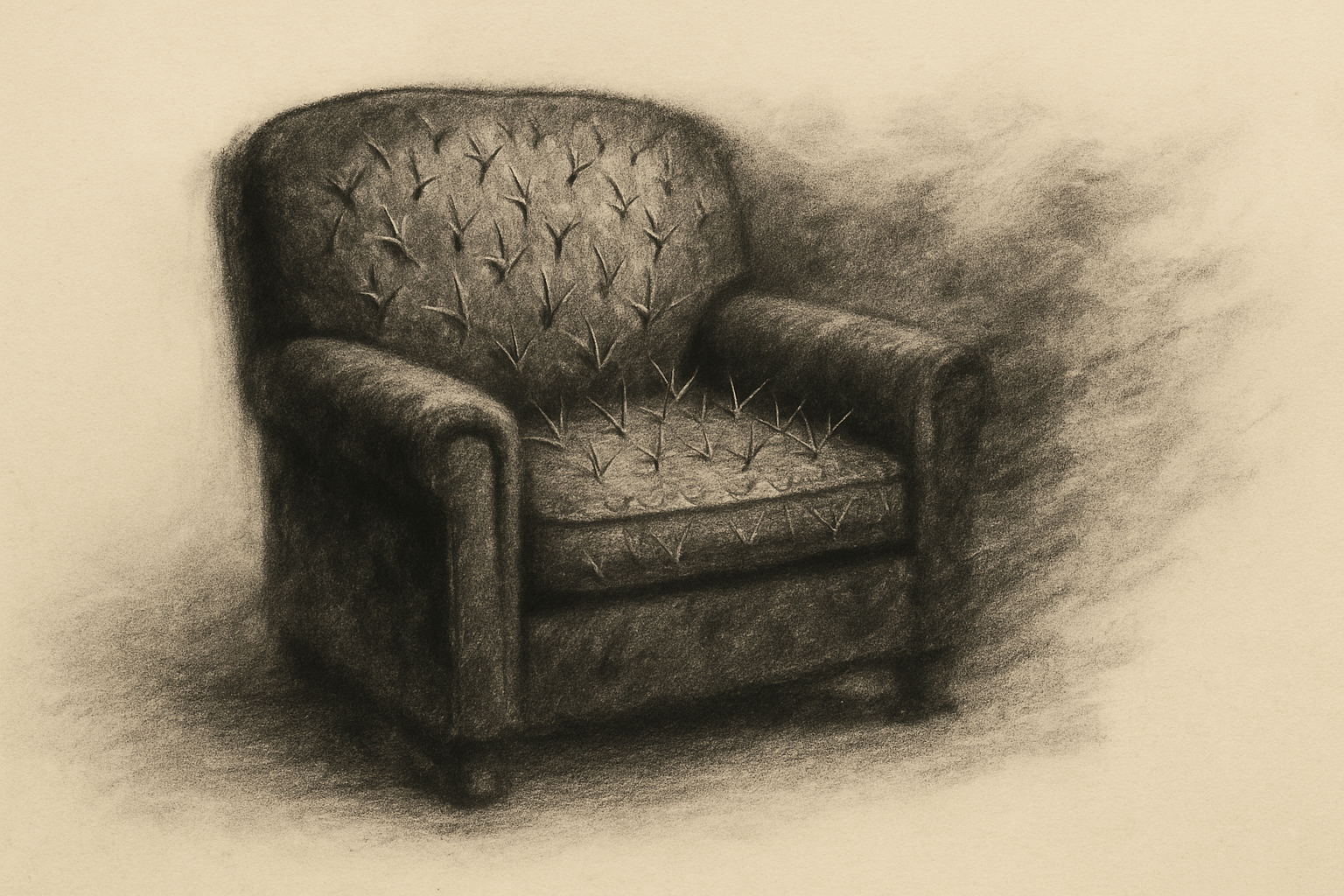
The Addiction to Comfortable Suffering
La adicción al sufrimiento cómodo
A student shares his history of difficult meditation practice and a recent experience of disidentification during a sit, leading to a discussion about how narratives of regret disguise rejection of the present moment, and why what we truly long for can feel threatening.
The Addiction to Comfortable Suffering
A student shares his history of difficult meditation practice and a recent experience of disidentification during a sit, leading to a discussion about how narratives of regret disguise rejection of the present moment, and why what we truly long for can feel threatening.
When I first experimented with meditation in 2009, I couldn't do it, or at least I felt like I couldn't. I tried again in late 2010, and that's when I really got on a path. I would do these very long raw vipassana sits, and it was just awful. There may not have been a three-minute period without it being awful. I think the issue was that I was so cut off from my emotions. Going into a place where I had to be alone without an intellectual distraction was extraordinarily difficult.
Looking back, if I was trying to experiment with getting into a bathtub, I jumped straight into boiling water. And my reaction, which is a big part of my narrative, was to tell myself: "This is terrible. You can't take this. You're doing this wrong. It's not working." So I had this aversive relationship to meditation, and it was really showing me my aversive relationship to experience.
It did change my behavior over time, and I made some progress in my material life. But for the first seven and a half years on the path, I was just doing that. It wasn't until I tried psychedelics that I had a profoundly beautiful experience. I could be in the water. I could be in the hot tub for that. Peak experiences are pretty easy to be around if they're good. And then there would be this tail at the end of the psychedelic experience where there's still some drug in the bloodstream and things feel good, but you're also coming back to consensus reality. I could be present for the difficult things in my life because there was enough of that quality to just be present for it. I wish I had designed something like what you were describing, a way to get into the water and let it warm up, earlier on that path. I spent so long doing it in what was probably one of the hardest ways possible.
The loop of regret
Mostly what I hear is what you've experimented with and explored, which I think is amazing. And then I hear the regret of how you did it, that you could have done it better, that it was the wrong thing. There's a lot of self-doubt. I think what you did is great. And I'd be surprised if where you're at now doesn't feel as good as you think it should. And from there comes the regret: "I could be in a better place. This is not right." But the regret is in a sense spoiling something, which is just back into the loop of something being missing.
I hear what you're saying. I do look back and think it's unfortunate. When I see friends who are in a similar place now, I guide them away from practices of that nature, toward a more gentle entry. But also, it is what it was. I'm not too hung up about it now, because it was just the circumstances. I was embedded in a culture that only told the story of "you must go through hardship," that rejected anything like a gentler path. I was deep in that culture. My family was in it, I was in academia. That was just going to be how it was. There is some regret there, and I hear what you're saying, but it's not something that troubles me too much anymore. I was upset about it for a while, angry for a while, but not now.
Every approach will fail
I have a strong sense that you are throwing the baby out with the bathwater. There's something to those full-on vipassana explorations that is really valuable. But they're not an end in themselves. No practice is going to get you to where you want, because what you want is now. Every single practice, every single approach is going to fail. I guarantee it. Whatever you have found now that you think is a better approach is going to fail too.
The good news is that if you try everything you can and it all fails, you will discover yourself. But first, because we are compulsive addicts, we need to try everything, every escape possible, until it all fails. In a sense, every meditation practice is an escape tactic.
The conceptual mind is working hard to piece this together in a way that's consistent. But I see what you're pointing at.
What you are experiencing right now
What matters really is what you're experiencing right now. And by "right now," I don't mean only this present second. I mean what you were experiencing when you were telling me your history, and what you're going to be experiencing ten minutes from now. At any moment. So notice: you're experiencing regret, and that is a mental and emotional reaction to a memory. There is a dissatisfaction, a sense that something is missing. The belief is: "If I had done something different, I would not be experiencing this. I would be feeling something else." And you have the rational support for it, because you tried mushrooms and that showed you something else. There's a very logical reasoning to it. But you could do mushrooms for a long time and you will find yourself caught in a similar problem, different in form but the same in structure.
Everything you explore and experiment with has its value, as long as you do it from your deepest intelligence and discernment at the time. I'm not saying go become a heroin addict and call that valuable. I'm saying: whatever you experiment with, follow your deepest calling. So now it's no longer vipassana, it's something else. That is valuable. But it's going to fail.
I see what you're getting at. The pointing is putting me there. Let me tell you another story quickly. There's a guy at my work who is on the spectrum. He fixates on things that are other people's domain, then goes and messes with it. In software there's a territorial aspect that matters. He did this to me on Friday and ambushed me in a group setting. Somebody I thought was an ally sided with him, and I was very upset because there was a sense of threat to my job. My boss didn't really mediate. I was upset. I talked to a couple of people and just couldn't calm down.
Then I went off to a meditation group I always go to on Friday evenings. Walking there, I was furious. I thought, "I have to sit in a stupid meditation and I can't calm down. It's going to be terrible." I get in, and my best friend is leading the meditation, but I can't stand his meditation instructions. I go there to be supportive and be part of the group, but the way he does it drives me a little nuts.
So I'm sitting there, his instructions are bothering me, I'm trying to meditate, and it's not working. I'm thinking, "This isn't working." But I'm actually feeling fantastic. There's this narrative part of the mind coming in and saying, "No, you can't feel good, because you should be upset about this. And this meditation is terrible too." And I'm like, "Is it?" There was a little bit of narrative resistance to what was actually happening. The narrative was rejecting the experience of the meditation while I was going, "Actually, I'm doing okay." I felt good, but then there was this voice saying, "No, you don't, you can't." And then it was like: the good feeling can be here, and also that voice can be here. It was the oddest thing.
Disidentification
It sounds like your friend was leading a really good meditation. Because what you're describing is disidentification. You had a stepping back from the belief.
Yeah.
When you say, "I can have this thought and at the same time be having a good experience," that is disidentification.
It was an acceptance. There was an annoying narrative going on, an argument about whether this could be a good experience. And it wasn't that the good experience won. The acceptance was just acceptance of the goodness and the competing thought storm together.
But what was that goodness? Because you came in with anger, and then you said you were feeling good. Can you say more?
It was legitimate. Something I would desire. It wasn't just peace, but, well, maybe it was peace. The sympathetic nervous system calmed down for a while, and then there was relief and acceptance.
Not believing the narrative
So you were feeling good. And then you had the narrative that was annoying you: the meditation directions, whatever it was. For me, the fact that you could at that moment give room for that feeling of goodness and not have it be spoiled is a disidentification. It has to do with not believing the narrative enough. Because when you're fully identified, that narrative becomes true and real. It will actually create emotions that do not feel good.
There's a kind of limbo where we notice these are thoughts. We notice the nature of the thoughts. When you say, "This is a thought of such-and-such kind," that is already a separation. You can see the narrative as a narrative. That is already disidentification, and it's a massive release, because you are not believing something that is a habitual belief. I'm sure this kind of thing is something you've believed often, for a long time.
I want to really highlight: that's a very significant break in identification. There is still a limbo in the sense that the activity of the mind is still pulling, still intense, still convincing. There's a push and pull, and there's an emotional aspect to it that will produce sensations. But the fact that you are feeling the contrast, that something is good, something is okay, that matters. And I wouldn't be surprised if that release is actually related to the fact that you were disidentifying.
The more you see the narratives you buy into and believe, and see them as narratives (still active, but not attributed with truth), the more that release deepens.
Regret disguised as wisdom
For example, the narrative you had earlier about the interpretation of your past and that regret: that's going to produce a reaction. The dissatisfaction with the moment, which you might interpret as "I don't feel okay because I did something wrong, because I chose the wrong approach to meditation, and now I need to figure out a different way, and in the future it's going to get better because I'm on the right path." But actually, this narrative is what's making this moment have a flavor of dissatisfaction.
The regret of these memories is the rejection of the present moment disguised as a rejection of the past.
Yes. And it's disguised as wisdom.
And as an honorable strategy to improve your life.
Exactly. But it's actually creating the habitual form of comfortable suffering. I say "habitual" and "comfortable" because it's the one you're okay with, the one you're used to. Because if you move out of that, you move into the unknown. And that's where the hot water really burns for a while. That's what I'm talking about when I mention going into fear and pain. It's not all fear and pain. There are always contrasting realizations. There is some form of well-being. We do get seeds of release and peace, something that keeps us going. But it comes with letting go of something we're addicted to, which is a form of contraction, a form of discomfort and suffering. We let go of that, and what we experience is: "No. Give me back my comfortable narrative."
That's what I was talking about earlier: we can go into that with intention, with awareness that this is what's going to come up. And over time, we will react less to what arises.
The threat of well-being
What we're reacting to is our true nature. Even the well-being of it can feel too overwhelming. I know that can be very counterintuitive, because you would think that would be exactly what you want. But there's a part of us that does not want that. That's why I use the metaphor of addiction. We know it's easy to look at an addict and see that if they could wean themselves off the substance, they would probably do better. But you can understand that for them, that's not what they want. It is very similar for every human mind: the addiction to a certain kind of narrative that produces a certain kind of emotion, a certain kind of contraction.
That's why the present moment, immediately, if I say "what you are longing for is right here right now," you're going to say, "No." And then we have a conversation where there can be a back and forth, but I am always going to lead to that. Find the way in which you can discover for yourself that it is here. But there are going to be things coming up right now that you don't want to experience. That's why we humans experience the present moment as "no, I want that or that or that."
But the perennial message is: stick with it, it's here. "Seek and you shall find." But the full passage says: "Those who seek should not stop seeking until they find. And when they find, they will be troubled. And then they will reign over the all."
I've only ever heard the first part of that. Where's the rest from?
It's left out of a lot of spiritual circles. Because it doesn't sell.
No kidding. I see what you're pointing at. There's a lot of that experience of coming into the present and then a part rejects it, and that part generates a lot of fear, which makes the rejection much easier.
Exactly. It's very convincing. Our mind is a perfect tool at convincing us of whatever we want to be convinced of. But it's us who wants to be convinced. We go to our mind and say, "Convince me that this is terrible." And then it produces this very honorable story: "Oh yes, you will be great if you do that. You're doing the right thing. You're going this way." It's human nature. And for me, at least, it's pretty hilarious.