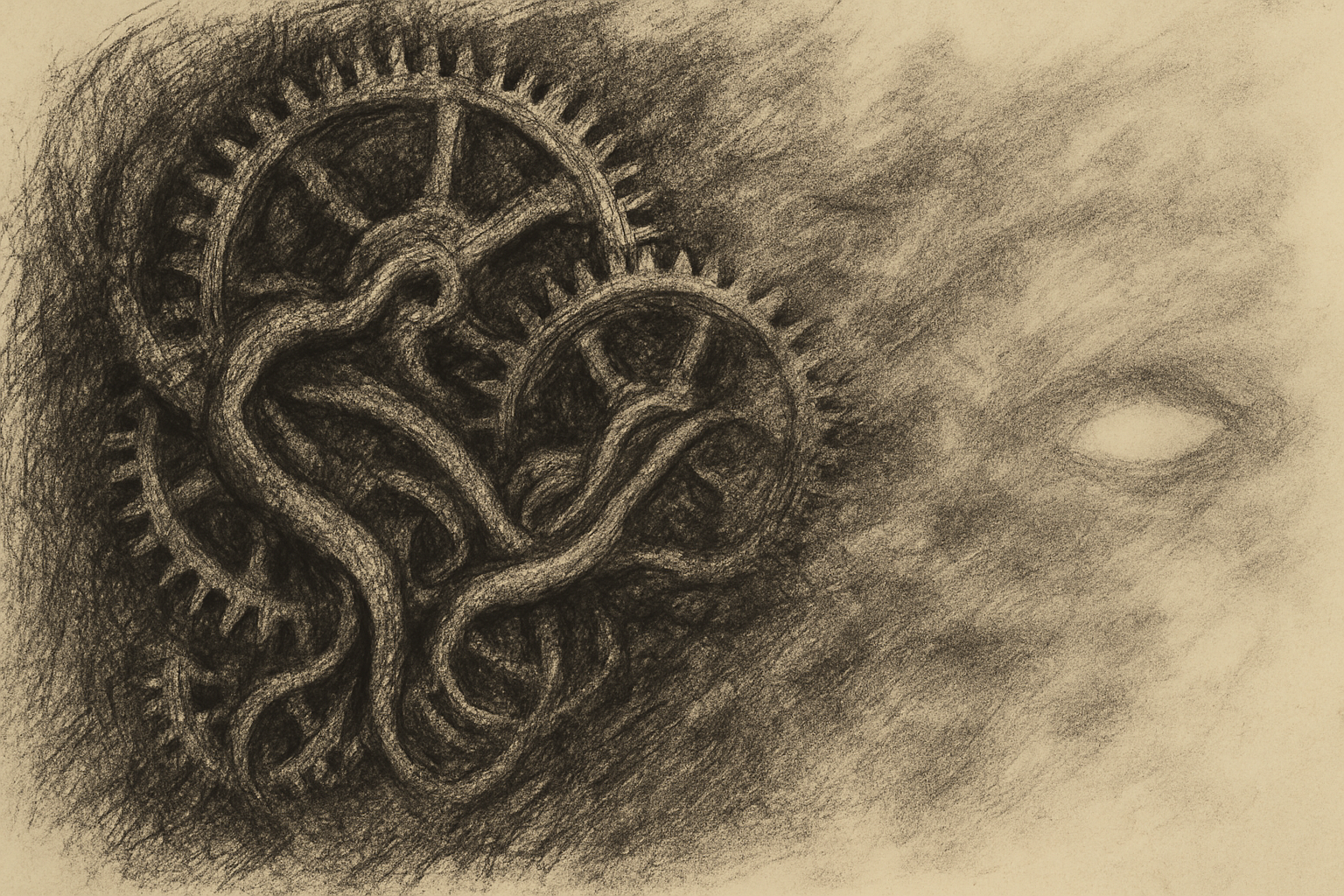
The Machine That Takes All of You
La máquina que se lleva todo de ti
A student describes the relentless flickering of the mind and the compulsion to fix and control experience. The teacher explores how identification with a mental self-image fuels this compulsion, and how seeing, not doing, is what allows the process to unwind.
The Machine That Takes All of You
A student describes the relentless flickering of the mind and the compulsion to fix and control experience. The teacher explores how identification with a mental self-image fuels this compulsion, and how seeing, not doing, is what allows the process to unwind.
I feel as though this meditation just perfectly describes my entire experience. What came up for me is how you describe the flickering of thoughts, the mind going to a memory, a fantasy, an image. It's nonstop. And through this process of meditation and the peeling back of layers, there can be even more turmoil. I feel like that's a perfect description of what I'm experiencing right now. It's really hard. I noticed that quite often I'm just constantly misinterpreting my reality.
What's actually happening is that you're just starting to notice. It's not that you're doing it now for the first time. And that's a good thing. It's also not unique to you. It's a human condition, which is why that study shows up. The only way to stop misinterpreting is to know that you are misinterpreting. If you think you are interpreting correctly, then you remain stuck, because ultimately everything is an interpretation. The problem is when we believe we know reality.
I completely understand that this process, which is traditionally called waking up, is hard. The only reason we do it is because not doing it becomes harder at some point. We are in a sense stuck between two difficult things: being asleep, believing we know what reality is and what we are, or the process of waking up, which is very uncomfortable but has many rewards along the way that keep the process engaging. At times you will have glimpses of embodying the true nature, and these tastes keep us coming back. But the process itself, which I emphasize because very few people do, is quite hard. It's worth it, though.
The compulsion to fix
I'm starting to realize that quite often when conflicts arise in my everyday life, it's like you say: we're wanting to grasp some sort of belief, some map to refer to. We're trying to label things, judge things, because the mind constantly wants to fix things. It feels like the cartoon image of a little devil on one shoulder and an angel on the other, and it's so hard not to listen to either of them, or to stop listening to what you're used to interpreting. Sometimes I tell myself, well, maybe I don't need to always fix something.
That's exactly what I was going to say, because you mentioned this compulsion to fix. That's very natural, and you're describing a very profound impulse. That impulse originates from a misunderstanding. This work isn't about fixing anything or anybody. It's about seeing that nothing is actually missing. The misinterpretation, the belief that something is missing, is what starts this compulsion. What I'm saying is not for you to believe. It's just pointing to a direction. But it's something that can be seen by you and has to be seen by you.
I find that there are so many forces at play, and I feel like I need to have some control over the outcome.
That's the compulsion to fix. That's the compulsion to fill something that's missing, to fix something that's broken. That compulsion and control come from a belief of knowing what you are.
Identification and the map of self
This is described and named in many different ways, but one of the words used is identification. Your mind, all of our minds, create a map of reality. This starts to develop when we're very young and gets more and more complex. In this map, which is the constant naming and understanding of reality, there are more foundational elements, like the map of our physical environment. But there's also the map that is the story in time of who I am, where I come from, where I'm going, and the people around me. All of this creates a very complex image, which is traditionally called ego.
This complex image is actually an ongoing process, not a solid thing. It's a process that the mind is constantly producing. Then identification comes, which is: I am that. I am that image. But this begins so early that we forget it's a process of fantasy, of identification, of belief. It begins with discovering the power of imagination as a very young child, around two years old: being able to imagine myself in a situation, or imagine myself with a toy, or as a little character. This process of "I am this object, I am this thought, I am this concept" starts to get built.
Then what happens is the inability to step out of that, because it becomes so involved. There is something alluring and attractive about it, because it's an infinite world of imagination, and it also helps us deal with situations. But now this conceptual construct is experienced as: I am this and not anything else. We know that when we are born, this ego isn't developed, yet there already is being. We already are. Then this construct, which is a very positive aspect of human beings, gets developed. The issue is that we fall into the belief that this is what we are. I am that and only that. And so now life is based on protecting, controlling, and ensuring that this is what it appears to be. That's where the compulsion to control and fix becomes a mechanism. We are constantly trying to improve, fix, and manage, because as soon as a state becomes too uncomfortable, this process gets shaken. There is a fear of this ending, and that is experienced as fear of death. But it's only the belief that we are this mental construct. That's the only thing that ends, or can end.
The longing to remember
That compulsion, that wanting to fix and control, comes from a sense that something's missing. There's a pain, a longing, an anguish, a restlessness. But we attribute that restlessness to something wrong in that which we're identifying with. What's actually missing is that we forgot we're not that. That's the pain. The longing is to remember what we are, to see that we are not that. It's a very healthy longing. It's the seed of the search for our true nature. It's what can be called conscious suffering. There is a suffering that comes from being completely immersed in the process of identification. And then there is a conscious suffering, which is the remembering. That process has a lot of back and forth, turmoil, and some sense of release, because in a sense something does die.
Yeah, sure feels like I'm going to die any moment. So in a sense, as we develop into our own person from infancy, we develop this construct of an ego to help us maneuver through life, and that's a very healthy thing that we all need. But as we keep building upon this construct of ego or identity, it's like it's over-serving.
Yes, because we are attributing to it what we are. We project our being onto it, and it's a very narrow thing. Not only is it narrow, it's impermanent, constantly changing, and so there's a restlessness. That's why there is compulsive thought, compulsive controlling. And the recognition of what we are can be, and often is, experienced as a dying and disappearing, an expansion into a nothingness, because only in the mind are there things.
This is one of the surprises from physics. The notion that the world was atomic, that there were separate, independent, really existing things, was challenged when certain experiments proved incomprehensible. From that, quantum physics was born, which showed that at the most basic level there are no things. There are fields of probabilities, movement, and energies. Particles are interpretations. And that which is experiencing, the nature of that, is infinite, unknowable, and peaceful.
Seeing, not doing
So in a way, I need to let go of this constant need to fix things.
No, you can't do that. That's not something you can do. What you can do is what you're already doing, which is see the nature of that process. You're not in control. What you just mentioned is another attempt at control, another attempt at fixing and solving. That's very normal, but it's just the mind coming in again and again. The solution is in a sense easier, because you don't have to do anything. It's a seeing, not a doing. Just seeing things for what they are.
When you say, "I see the flickering of the mind in the meditation," you're describing this: I see this, and this is what's happening all the time. Then you might think, "Okay, I now need to stop the flickering." No. Just seeing it puts a process in motion. It's the practice of looking at things, seeing what they are, and only in the seeing does the process shift. It shifts outside of your control. It shifts naturally. It just starts to align with your updated understanding. When you see the compulsion to control, just seeing it will release something, because when we see this process of identification, it starts to remove the energy that fuels it.
Think of it as a machine that's in motion. You're in the machine driving it, pushing and pushing. The moment you see you're doing that, that seeing stops the energizing of it.
That's a really hungry machine. It takes all of me.
It takes all of you because you're giving it a lot of energy. And I want to highlight, it's not you specifically. It's the human condition. There's a lot of investment in the belief that if I try this next thing, finally it's going to work. In a sense, we're taking a bank loan to keep financing this, and it's not working. Only in seeing that it doesn't work do we start a process of undoing, which is traditionally called waking up.
Four stages of awareness
It's like I'm either unaware that I'm feeding the machine or I'm aware that I'm feeding the machine.
Yes. My teacher would say: first, we are unconsciously unconscious, unaware that we're doing this. Then we become consciously unconscious, aware that we are identifying, that we're feeding these control mechanisms. Then we become consciously conscious, when that starts to slow down, stop, and unwind. Then we become unconsciously conscious: we're no longer aware of not doing it; we're just in a natural state. These are not fixed states that we move through in a linear way. It's a continuum. We vibrate more in one place, then start to vibrate more in another, and we gradually become settled in a more natural state.
Emotion and deeper feeling
The only cost of this process is that we need to learn to feel what we feel. This collapsing into the belief that we are a narrow, limited mental construct helps us numb our experience. It numbs it by creating a bunch of emotions that might be unpleasant but are known, knowable, and controllable. You could have depression, and that's helping you not feel a deeper pain or anger. You could have a quality of being constantly angry and upset, but it's a kind of anger that's controllable. The emotional body is numbing us from deeper feeling, and that's how I would distinguish emotion from feeling. Emotion is part of the mental process.
First, we need to learn to know our emotions, because we could be so identified that emotions are driving us and we're unaware of that. Then we can learn to experience emotion directly, and beyond emotion, what is the deeper feeling? Feeling is a lot simpler but more intense. I describe it as fear and pain: a deep pain or a deep fear.
The thought-emotion loop
Is the constant fixing a distraction from those emotions?
Exactly. It's a distraction from going into the emotion directly. The emotion operates in a loop: thought, emotion, thought, emotion. That's the engine. The thought could be a complete movie, a complete narrative, that is activating an emotional reaction. There are releases of hormones in the brain, and that feeds this engine of thought and emotion. It's all about time, about where I'm going, the state I'm trying to get to and control.
The way to stop that is not by trying to control the mechanism, but by seeing what's happening. This is the first step in meditation. Bring attention to the breath, because that anchors you and creates a contrast between present reality, sensations in the body, and what's happening in the mind. In that contrast, we start to see: there are thoughts and thoughts and thoughts. Then look more closely. What are those thoughts? What's happening more deeply? There's an anxiety. We can start to tap into the emotional level. Then we can see the whole mechanism operating, and just by paying more attention, things start to reveal themselves.
For example, we can realize: I'm scared. I'm really sad. Or I'm very angry. The energy of that deeper feeling can start to appear, the deep sadness, the deep fear. When that happens, you'll notice that the machine begins to stop, because it was servicing that numbing.
We're so afraid of those feelings.
It's just intense. The fear is that the intensity will be the end of us. But it's only the end of the conceptual image, because in a sense those feelings are beyond the mind.
Rationally I understand you, but emotionally I don't understand it.
That's okay. A lot of what I'm offering now is a philosophical framework. It's one that can help replace the map you currently have on how to operate, but it's just a step. What I'm describing can also be seen as just a mental map. It's like a thorn to remove a thorn. And I believe you have touched upon this deeper feeling, the fear and the sadness.
I do feel a great sense of relief when I do, because it does feel like the machine has stopped and I'm just in the moment. But why can't I stay with it? What is preventing me? I don't understand this avoidance.
The reason is that there's still a belief in knowing what you are. You can see it as deeper and deeper seeing, deeper layers.
The snake and the rope
I'll keep that in mind. Thank you. I feel like I have a lot to chew on and ponder.
Just remember that only seeing is needed. And what you need to see is right in front of you. It's just a matter of keeping your attention on your current experience.
There's a metaphor from Ramana Maharshi, a very famous Indian sage. If you're walking in the forest and you see what looks like a poisonous snake, you get startled and afraid. But then maybe you look more closely and see that it's not a snake. You interpreted a snake, but it's not one. You look more closely and notice it's actually a rope. When that happens, the fear is gone.
This points to a two-step process of removing illusion, and all it requires is to look more closely. You could see a rope, think it's a snake, and run. Whenever you come to that part of the forest, you're worried. But there's also seeing that it's not a snake while it's still not clear what it is. Maybe some other dangerous thing. That shows the in-between process: you've seen that something isn't what it appears to be, but you still haven't seen fully what it is. All that's needed is more patient seeing, getting closer. The metaphor reflects the relationship with fear. If you see what you believe is a snake, the impulse is to stay away, turn around, and never go back. But by going towards it, we face the fear. We feel the fear. There is a relief when we see that it's not a snake, but only when we see it's a rope does the fear stop.
What that metaphor doesn't show is that seeing it's a rope can be very shocking. There is a phrase from Jesus that says: seek, and don't stop seeking until you find. When you find, you will be troubled. And then you will reign over the all, or enter the kingdom, depending on the translation. There's this emphasis that seeking is not a bad thing. The problem is that we seek in the wrong place, putting our energy into fixing this mental sense of self.
Even by saying "mental," most people would not experience the self as mental. But I'm defining it as entirely mental. Our true self is not a mental thing. By seeing how much of what I experience as "myself" is mind, we start to disidentify. Because mind is experienced. Mind is appearing. Thoughts, emotions, all of that is appearing. What is it that is experiencing?
When all of this is seen completely, there is this experience that the saying from Jesus describes as being troubled or disturbed. It's a kind of shock. And then there is a liberation, a release. But that shock is just the surprise of seeing what we are not, what we always thought we were, and the surprise of seeing that what we are is so vast, so unknowable in a mental or conceptual way, so different from anything we could have imagined.