The Heart That Can Hold All Wounds
El Corazón Que Puede Sostener Todas las Heridas
A student asks about the guardians encountered in meditation, wondering whether the right approach is one of endurance and strength or whether something softer is called for.
The Heart That Can Hold All Wounds
A student asks about the guardians encountered in meditation, wondering whether the right approach is one of endurance and strength or whether something softer is called for.
I was wondering about how you guided the meditation today. Was it like a description of my mind, a description of a process that can happen with those guardians? I feel I'm coming into contact more directly with them, and they feel super big and strong. But you described something like a more loving attitude toward them, and that by doing this they retreat. That shocked me a bit, because my imagination about it was more like not fighting against them, but effort in the sense of withstanding what you can withstand, and maybe tomorrow you can withstand some more.
The meditation is very spontaneous. Even when I start speaking, I have no idea where it's going. But in hindsight, you could think of it as a myth, and in a sense, it's a map. Sometimes we need to upgrade our maps.
The warrior map and its limits
Maybe the map you're describing, which is more of a warrior approach, is a necessary map. It's useful and practical until you're in territory where you need a new one. Sometimes, to confront challenges in life, we find it useful to have that kind of strength: to push forward, meet the challenges, feel the fears and the pains, and keep going. But at some point, think of it like Newtonian physics. It's considered an old map. Newtonian physics explains reality in a coarser, less refined way. Then came Einstein, relativity, quantum physics: much more refined maps that include the previous ones but go further.
There comes a point where, if you're five years old and putting your fingers into a power socket, something more aggressive is required from the parent. If you're about to run into the street where there are cars, you need to be screamed at. In that context, subtlety won't work. It would be unskillful. In the metaphor I'm describing, the parent is the guardian at the gate of that danger, and it needs to push back with greater force. There's more of this working with courage and the warrior nature. It's a kind of archetype. In this meditation, I was invoking a different archetype, which could be considered more of the lover. It's another part of us.
From courage to intimacy
When you come to a point where you are able to meet these guardians, it's important to recognize that if you're not even meeting them, you need a simpler map: the map that says, go toward your fears, go toward your pains, take a more courageous approach to life. If you're living in a very safe, contained way and you're afraid to get into a relationship or apply for a job or face whatever situation is too challenging, you need a map with a simple directive: go toward fear, go toward pain. But now that you're meeting fear and pain, that pushing map, that aggression and warrior nature, is not going to help you get further. The upgraded map says: fear and pain are part of you, and they are at your service. You have graduated to a more refined level of understanding, where you can see that they are not external aspects and they are not something you are a victim of.
The meditation invites a perspective that has, you could call it, a higher level, where you are now positioned in a place that is deeper and truer, which is consciousness. And in that position, you can really explore what happens. Now I'm meeting fear, I'm meeting pain. But if I bring a position where I'm not a victim of this, where I am responsible, I can now co-create with what I was calling the substance, which is everything.
Friendship with fear
In the specific aspect of meeting fear and pain, I can now develop a very intimate relationship. And that relationship, I recommend it to be one of friendship. Friendship isn't pushing. Friendship is intimacy and contact. It's seeing that there isn't an opposition here. It's about that touching, that gentleness through the heart. A lot of what I was describing also invites a kind of faith, not faith in scripture or in beliefs, but faith that the heart is vaster than one thinks.
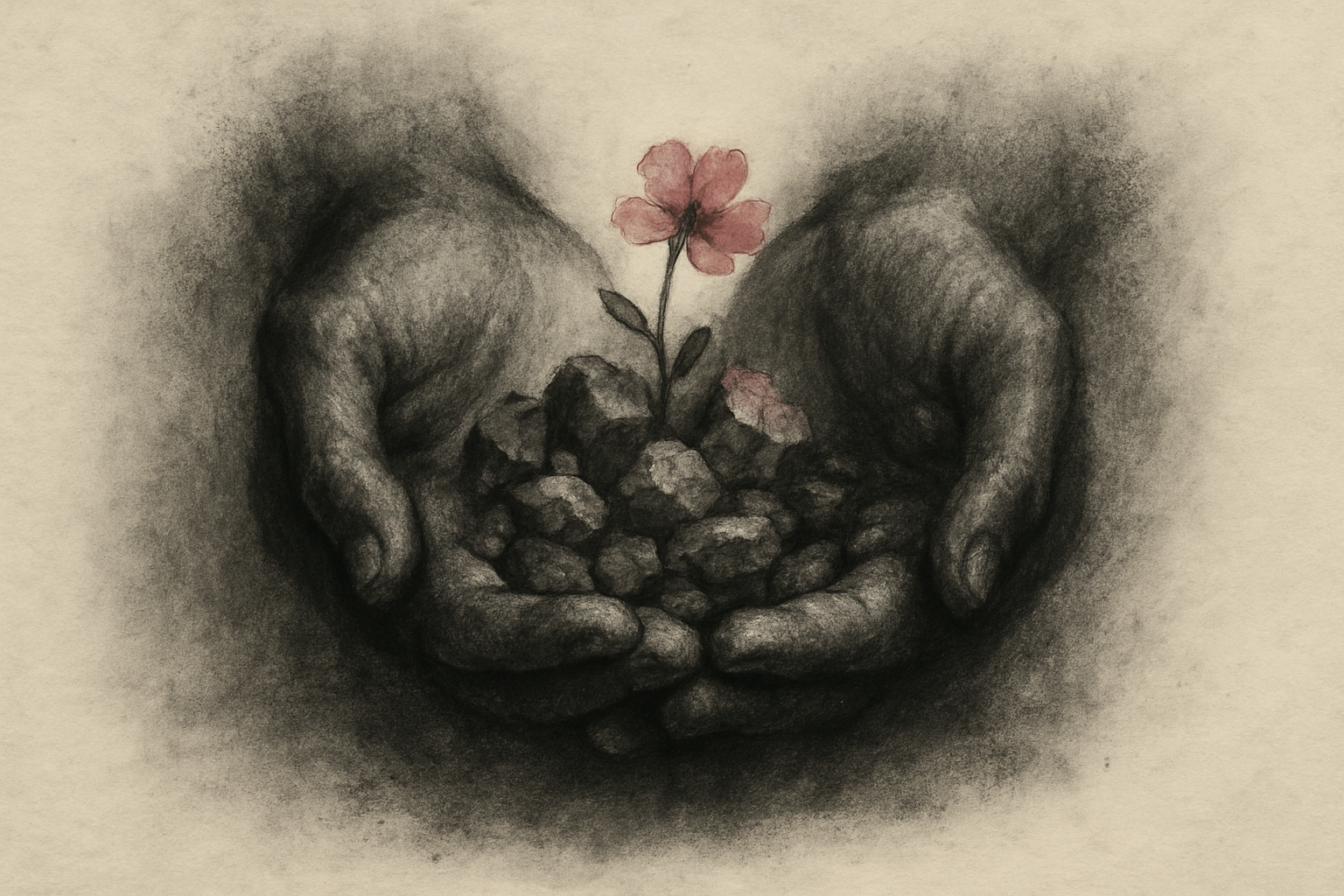
This has been represented in myths and in imagery. I often refer to the bleeding heart of Christ, the image where he has removed his heart from his chest and put it forth, and it has thorns stabbed into it and is bleeding. The image conveys a very deep okayness: that the heart can hold all wounds and remain completely loving and unharmed.
What are we really protecting?
This changes, or at least challenges, the paradigm of survival and safety and protection. Because what are we trying to protect? What are we trying to save? What are we trying to avoid? Really, we're trying to avoid fear and pain. And so, if we become intimate with fear and pain and discover that there is something in our nature that can infinitely relate to fear and pain, then we can discover that the danger we've been trying to avoid is illusory.
Yes, we will die. But the problem with death is the fear and the pain we imagine.
The root of all fear
At the root, it is always related to the imagination of what will happen when what I believe to be ends. Let me say that again: it's the imagination of what will happen when what I believe to be ends. From there, you can have offspring of lesser, smaller narratives. For example, if I'm applying for a job and I haven't received the letter of acceptance or rejection, what can arise is a fear. What can "end" is my imagination of the self who was an employee of that company. There is pain around the narrative of the self I believe to be, the one who would possibly be living that life, working for that company, and that ending. But it's an imagination of what I believe to be, of what I am, attached to a narrative.
A lesser fear is going to be a narrative of myself, versus the actual essence of what I am: being itself, existing itself. As we face those lesser fears (the ones that appear in life and work and love and relationship and the dynamics of life), once I've developed the strength and courage to meet all of that to a large degree, there will still remain a deep sense of anxiety, worry, concern. Something not okay. Something missing. It will be this deeper sense that that which I am will eventually end, and there is an anticipation of what that will be like. But it still is that which I believe to be ending will produce what I imagine, which is an anticipated pain.
Anticipated pain
Even when we have physical pain in the moment, we amplify it with psychological suffering: When will this end? Will it end? Can I handle it? Will I be able to?
For instance, even if you're in terror because you're choking, most of the terror is the imagination of what's going to happen, of not being able to breathe again. Whatever it is you imagine will happen, that will be the ending of what you believe to be. Most of it is that. All of it.
There are going to be intense sensations which will be difficult to meet, to touch, to immerse in without fighting. Obviously, act in the moment in the best way possible. If you're choking, try to figure it out, seek help. But if you're going through something and you're already doing what you need to do, then what comes up, the fear and the pain: there may be pain in the moment if it's physical, but the fear will be the anticipation of pain. What can happen, what will happen. That could be many narratives, infinitely many, but at the root is the narrative of that which I believe to be the essence of what I am, ending. And that only exists as an imagination. You cannot describe to me in any convincing way what it will be like when you die.
Even when we come to that edge in the spiritual work, where we egoically, psychologically come to that sense of ending (so when it's not in the body but in the psyche), there will still be an imagination, and the body will react to it as if we were dying. It will bring up all the physiological responses of imminent death. But it's an anticipation of an imagination. It's unknown.
I felt touched by the meditation, and I feel it was addressed to this, to what you're talking about.
That's great.