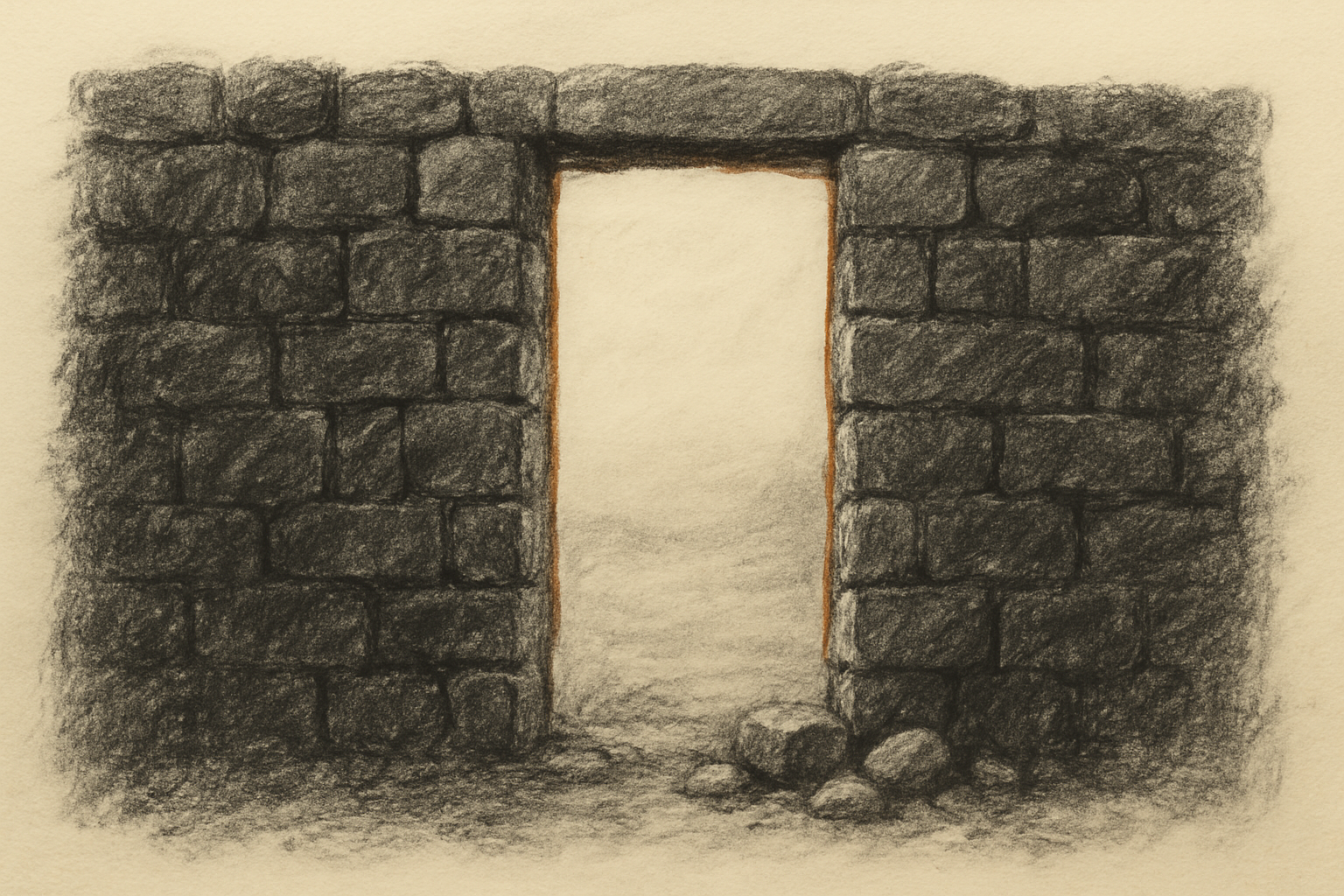
The Gate That Isn't There
La Puerta Que No Está Ahí
A student describes how defensive patterns around family relationships become a doorway to deeper seeing, and the teacher encourages moving from general understanding to specific, intimate investigation of what is actually being defended.
The Gate That Isn't There
A student describes how defensive patterns around family relationships become a doorway to deeper seeing, and the teacher encourages moving from general understanding to specific, intimate investigation of what is actually being defended.
I have this image of getting to the edge, to what's supposed to be the end of the world, that boundary. And I love the image of fear and pain as friendly creatures. I had this image of gargoyles looking after a gate, but they're not monsters. What was really beautiful was that first I realized the "reason I," the one who believes it needs to cross the gate, is the one who is never going to make it far. That one cannot cross. That's not the one who crosses.
And it's so loved. Sometimes I relate to this pain as if I'm losing the most beloved being. But it's not a losing. It's just a pain of, "Wow, I just love this being so much." And it's really beautiful to get to that point of surrendering: here I am, but I am not the one crossing. And then what is most beautiful is there's no gate. There is no gate.
The gargoyles at the gate
I started relating to all of this because of something I was describing over the phone: a really strong defense mechanism that gets triggered in me around my family. The pain of that is my gate. I can see how I try to defend myself, replaying old situations from childhood. But then it becomes uncomfortable. Who am I trying to defend? Why is all of this chatter happening, these imaginary conversations about how I'm going to talk to my mom, my dad, my sister? I find myself confused. This is not really what I want.
And then finally I come into contact with this gargoyle, this pain. What I'm afraid of is the ostracizing, that they're going to gang up together and leave me out. The moment I can connect with that, it's clear that all I have to do is love them again. There's no one to defend, really.
And that's when we can meet that pain and make it our friend, be warm and gentle. That's where the experience of no gate comes from. The gate is only the reaction to our own pushing the fear and the pain away. That pushing is what keeps us limited.
What was really beautiful was that at some point there was a shift. I was reacting, in defensive mode, having this imaginary conversation about how I was going to talk to my parents on the weekend and explain things to them, make them understand something. And then suddenly the shift came, also with an image: what happens if I apologize? What happens if I say, "I ran away. I may have rejected you because I was so scared. I'm sorry. I didn't mean that. It was just the best I could do at that time. I never meant to hurt you." And right there, there is no gate.
And it does feel like dying, really, at moments. It feels like the end of me in a way. Right before, it's like a lamb walking to the slaughter.
The heart can hold all of it
Yes, but then you see, and you're seeing more and more, and we see more and more in ourselves, that the heart can hold all of that. So you are free to explore creating something that before was not an option. For example, going back and saying, "Actually, I might have left out of pain and fear. I'm sorry. Let's come together and share and see what happens." They might have a problem with that, but the heart can hold that too. It's a very creative place. I would just say: give yourself time to really see what is most true and honest for yourself.
I also felt like you were describing exactly what we've been going through, and it's amazing how much we're all going through the same thing. When you say to bring coffee to the guardians, it just doesn't have to be a battle. It doesn't have to be a confrontation. We're all capable of something other than these extreme dynamics. The heart can hold so much.
It brings me to what you say about love. Some people think you can only have love for one thing or one person, but it's not like that. It's amazing how infinite it is. Just extending love to those areas of our life where there's so much pain and suffering and conflict, holding space for that, changes so much of the dynamic. The fear, the projection, the imagination of pain: it doesn't have to be that way. So much of the conflict we have in our relationships is just that.
How is it for you?
Defending something unknown
I feel like I spend so much of my energy defending myself, defending an idea. And I'm just starting to see that other people are defending their ideas of themselves too. I see myself in other people.
And what are you defending?
It changes. I feel like I'm probably just defending something I think I am, or what I project onto others that they think of me. It's all such an illusion, something I've had to use to survive.
And maybe it's something you thought you had to use. In order to change that, if you wish, it might be helpful to see more specifically what it's about. You see it changes, it's about many things, and it seems that it was necessary, which in the deepest sense it was. But for you to see more specifically what is at stake versus having an understanding that is appropriate but still quite general: that's the work. The general understanding needs to become something very specific, very personal, very clear and embodied. I'm trying to guide you to see that at a certain general level you are seeing it, but then bring it down into the specifics of how it works for you. It's a closer seeing of the details.
I don't even know what I'm defending.
And so when you find yourself defending, look more closely, because there is something you're defending. You have a right understanding that there's really nothing to defend. But until you see the specifics of when the defense is activated and what it's defending, you won't see the other side. Yes, there is no reason to defend anything, but there is a habitual defending of something. Does that make sense?
Yes, I'm constantly defending something. I don't know why. That's the craziness of it all.
What if it's not crazy? Yes, it's crazy. Now, what's the other side? Where is it reasonable? It is in service to something that you can discover and go, "Oh, that's what it is. I don't need that anymore." But until it's specific, it's going to remain this general, confusing "I don't know what it is. I can tell it's not necessary. I can tell it's happening." You won't see clearly until you open that box and discover, "Actually, this is what has been the reason, specifically for me."
Maybe I'm just trying to defend my hurt self.
Going deeper
And that's a start. It's not for you to figure out an answer right now. It's a process I'm inviting you into. Look more closely and specifically. Since you see it's happening constantly, you have constant opportunity to look more intimately, closely, and specifically. It's going to be playing out right in front of you whenever it's activated, which you say is constant. That changes the practice.
Think of it this way: you've been doing scuba diving lessons, you've learned the theory, you've tried it in the swimming pool. Now you have to go do a dive in the ocean, look at the creatures that are there, and get close to them. And you are doing that. So let me refine the metaphor: you've done a dive in the ocean, you've come out, and now you're training for a deeper dive. You go to a deeper pool, learn more of the theory for deeper dives, go back down and go further. But it's about being very intimate and specific about how it is for you. It's going to be very unique, very personal to you. At the same time, the humanity is shared. But in your exploration of yourself, it's individual, it's unique.
I haven't touched upon that. I'm still quite lost. I guess all I'm doing is just looking.
That's it.
I've always been a very observant person. But it's engagement that matters. It definitely feels frightening to engage in those things when you find and discover them.
And where you feel danger and fear, that's the way.
When you do have tea and coffee with the fear and danger, it's really hard. You do feel like you're dying. You don't know how long it's going to last.
Or where it's going, or what's going to happen. And at first, what we have is fear of fear.