Everything Is Inside, but the Inside Has No Walls
Todo Está Adentro, pero el Adentro No Tiene Paredes
A student describes a sudden feeling of claustrophobia upon considering that everything experienced as "outside" might actually be happening "inside." The teacher explores the difference between collapsing the world into a limited self and letting the self expand until boundaries dissolve entirely.
Everything Is Inside, but the Inside Has No Walls
A student describes a sudden feeling of claustrophobia upon considering that everything experienced as "outside" might actually be happening "inside." The teacher explores the difference between collapsing the world into a limited self and letting the self expand until boundaries dissolve entirely.
When you mentioned the possibility that everything outside of us is actually something happening inside, all of a sudden I felt a little claustrophobic. I had never even considered that possibility, but it's so true, because everything we experience is not coming from an outside world. Sight and sound: I think of them as belonging to an outside world, but when I thought about it that way, it was like, "Oh, actually everything is happening inside me." All of a sudden it got crowded in there.
That's interesting. I suspect you're getting a reaction from a shift in perspective, because there is still a definition of a thing that "I am," something limited, and suddenly it gets filled with everything that was previously pushed out. So it's crowded.
It's almost like solipsism. Solipsism is a paradigm where there is only the subject. Everything I experience is experienced by me, this subject, but nothing is real other than this subject. Everything else just appears only to me. The consequence of that is: there are no other people, there is only me. That comes from preserving the sense of a solid, limited, defined subject. Either everything else is not real because it's inside of me, or it's only real to me, and no one else is real. That's solipsism. I'm not saying you have this condition. I'm saying that in the way I'm pointing to this, there is a risk of a solipsistic mindset appearing. I just want to point out that that is not what I'm referring to either.
The crowded self
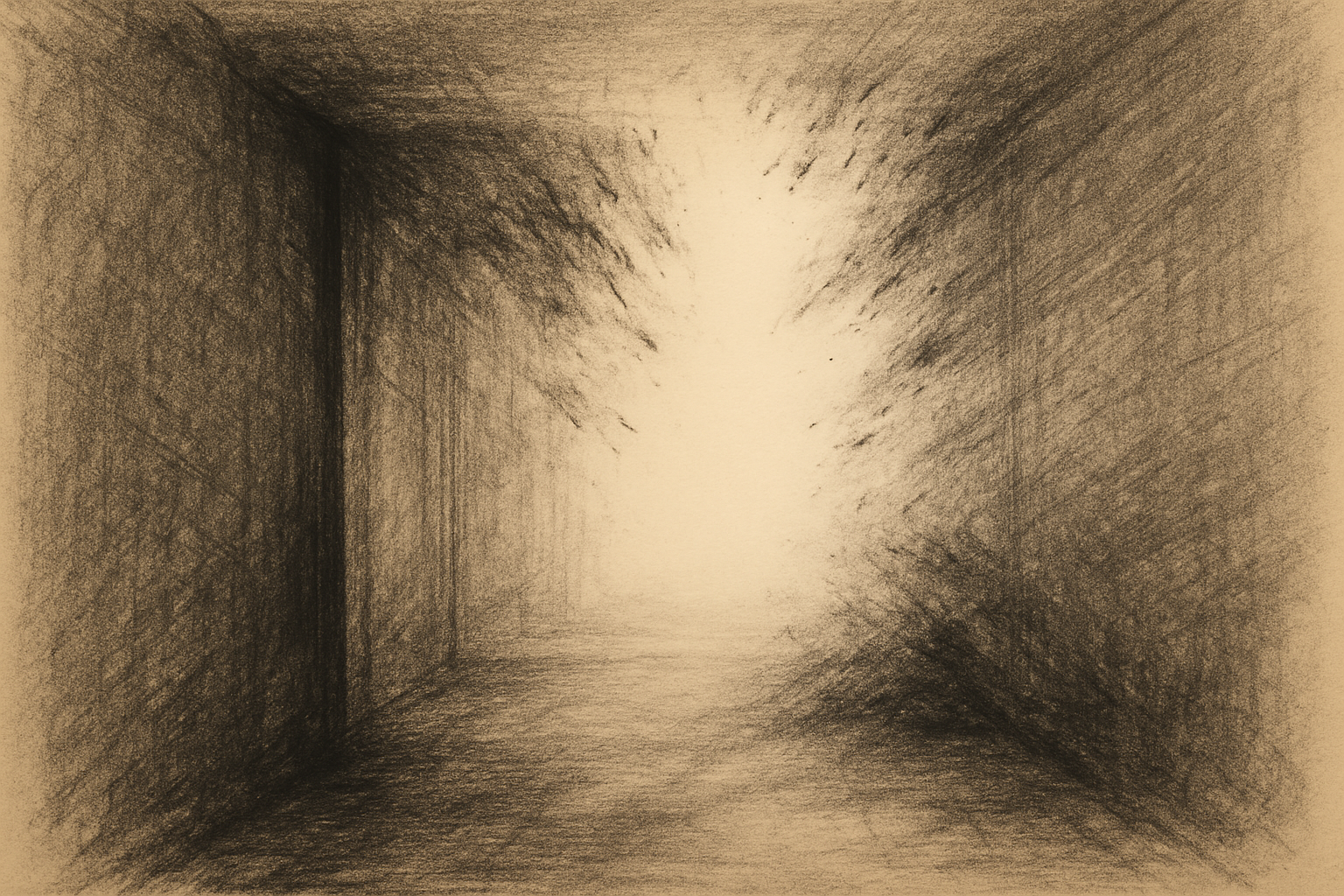
I suspect the sense of crowdedness arises because there is still a boundary that is "I." It used to be that only thoughts, sensations, emotions, and feelings were within that boundary, while the world was out there. The boundary defined what was inside and what was outside. Then suddenly you're making everything else inside of this limited, defined self, and that's going to feel crowded.
But I suspect it's a positive first step. In a sense, it's more expanded than the previous perspective, where everything was very neatly defined: this is inside, the rest is outside. The first step for you was, "Okay, now everything's inside, but it's crowded." And the fact that it's activating a fear (because claustrophobia is literally the name of a fear; "phobia" means fear) tells me you've shifted your perspective to something that is expanding the conditioning.
I would say that's not the final view either, but you can explore that sense of claustrophobia. I'd invite you to keep exploring the perspective where everything is inside and then there's an experience of claustrophobia. Stay with that, but don't stay there. Keep exploring the sense of smallness or the limit where everything is cramped inside, because in a sense you're collapsing the infinite universe into something limited, and that's crowded.
Expanding instead of collapsing
I think that's a positive step, but the direction is actually the other way around. That limited sense of self can expand to infinity. Everything is inside of me, but then the "I" expands for everything to fit, rather than the world collapsing into a small, defined "I."
I'm not talking about philosophy or intellectual understanding. I'm talking about experience. This has to be looked at in your current experience. Where is this sense of "I," and where is what I am experiencing? Is it outside? Is it inside? Ultimately, the whole notion of inside and outside collapses. Because if the sense of self expands to infinity, it's the end of a sense of self. It's the end of a limit. There is no longer the possibility of a self.
What I'm pointing to here is more of a rational clarification. For people with a more rational mind, there is a mathematical logic to it. But it's not important to think of it that way or understand it that way.
It's like there's this belief in these boundaries.
Yes. The question is whether those boundaries are parts of reality or whether they're like the boundaries between countries, which we know are artificial. They're functional, and obviously they can also be dysfunctional. But they have an artificiality to them. They are a kind of interpretation of the land, of the people, and so on.
Boundaries as interpretation
The sense that "I am here and that is there, and there is an absolute, real separation" is what I'm addressing. That's false. That's not true. But the sense of what I'm referring to as a functional boundary can remain. It is simply seen clearly as a functional thing. The experience of that separation is an illusion, a thought process. But then we believe it to be absolutely real.
To put it more casually: the experience is more like, "That cup with coffee is inside of me, but still I reach out to grab it and it's a thing that's separate." But even as I say all this, it very much does not describe my experience, because it really can't be described. All language works at the level of boundaries.
What I'm describing is also not a weird new experience. It's actually what we're all experiencing all the time. It's just the interpretation of it that makes boundaries seem real. It's an assumption, one that became very convincing from very early on and then grew more ingrained as a true, absolute reality. And so then, "I am completely separate from everything else; there is an absolute, total separation."
When this is seen through, it's just so obvious that it's like this and it never was different. That can be seen very briefly and then ignored. Or it could be seen in a way that permanently shifts the way you function and experience, so that you are no longer attached to the belief in the true boundary. You could say it's a shift in the way we interpret our current experience.
No separation at all
This is important because the way of interpretation that believes in absolute separation, in the absolute reality of boundaries, creates suffering. And it's not that boundaries are somewhat real. There is absolutely no separation. But when I talk about the functional aspect of boundaries, I mean that there's a thought process that can draw lines, and those lines can be functional. They're only real in the way that drawing a line on paper and assuming the paper has two parts is "real." But actually, it's only one piece of paper.
It's a construct of the mind.
Yes. And your tendency will be to create a logical, rational map. Your tendency, which was also mine (because it's simply a very scientific, logical, rational mind), is to turn this into an intellectual understanding. That can be useful, but just notice that tendency. That's not where the real discovery lies. The real discovery is in the more meditative, contemplative exploration. You might need it to make rational sense first so that you can say, "Okay, that's rational. I experience it this way. Let me try this other way." And then you explore contemplatively: you sit with sound, you sit with sight, and you really look at where the boundary is. What's the experience? Is it outside or inside? Where is the boundary between outside and inside? Explore it in your present experience.
I guess maybe this is linked to, or leads to, the idea that we're all connected to everything.
"Connected" still implies separate things
I try to avoid that framing, because in that expression there is still a notion of separate things that are connected. It's an interpretation of a deeper truth, but it still fits nicely into a mindset of separation. It's better than absolute separation, but it is very, very radically not what I'm talking about. What I'm talking about is that there absolutely is no separation. There absolutely is no difference between the subject and the object. The subject is as real as the object, and they are one; they are the same thing.
Said in words, the reality of that is that there can no longer be a subject and an object. The whole subject-object paradigm makes no sense after that. And then the mind can appear under subject and object; you can draw a line on a piece of paper and say, "That's the right, that's the left, and they're separate." That could be functional, or it could be dysfunctional. Those boundaries become dysfunctional the more they are treated as absolute reality. The more they're seen to be just a way of interpreting that could be useful, the more they can be bent. They become just a convention.
The root of fear
Fear comes from that boundary. It's the root of fear. You could take it to the extreme and see how it makes rational sense: if there is no other, what is the point of war? But as I say there is no other, it also has to be said that there is no "I" either. Rationally, in words, that doesn't make sense. But when subject "I" and object "you" are not two, there is a level of conflict that is simply not possible.
It's just so radical.
Yes. You're welcome.