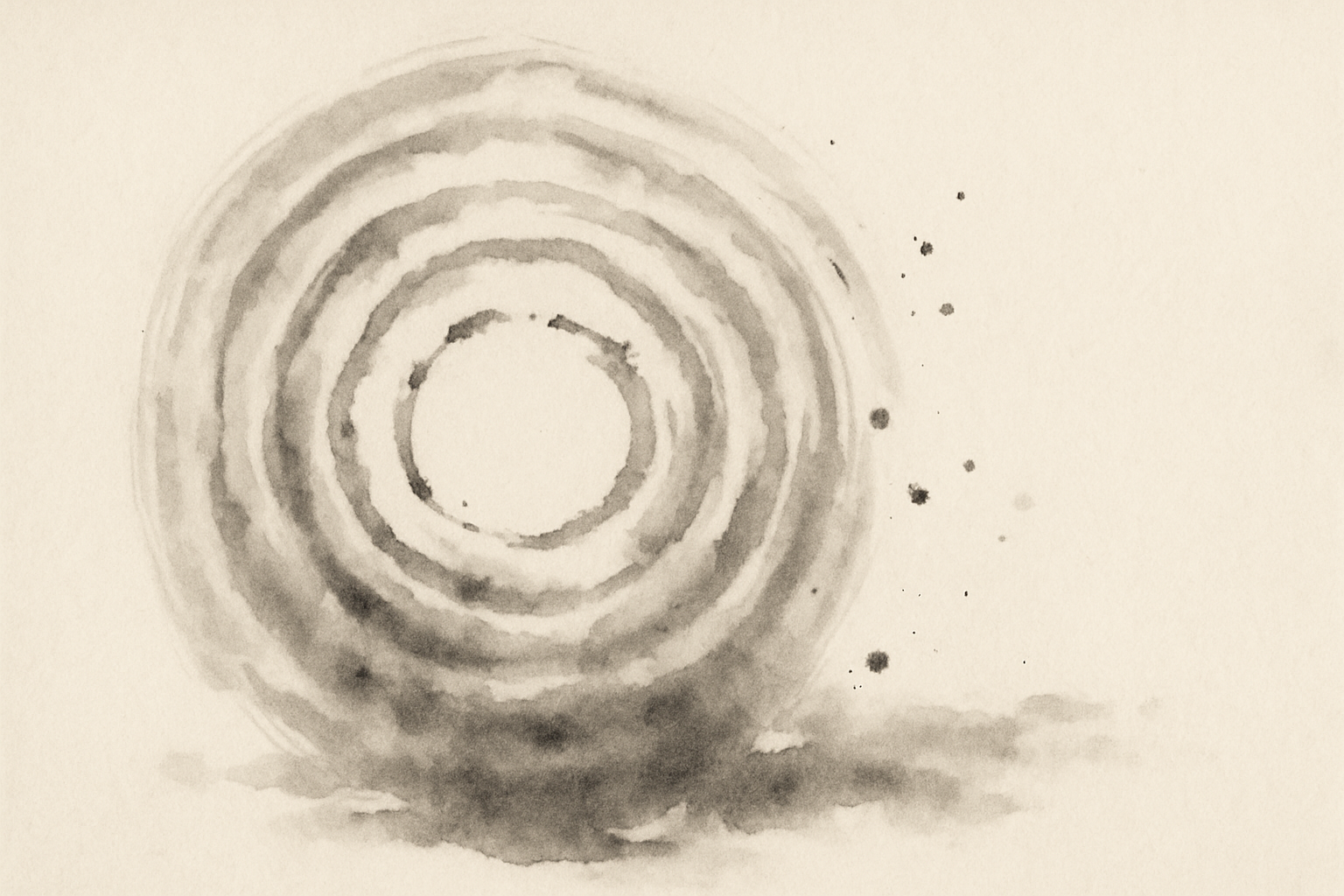
The Center That Isn't There
El centro que no está ahí
A gentle exploration of how the sense of a personal center keeps forming and dissolving within the open, centerless field of awareness.
The Center That Isn't There
Settling in
Tuning into the body.
Sometimes if we just dive into meditation, we might get too involved with something happening,
meditation being a thing we do, and then it becomes a bit too focused.
So the focus could be looking at thoughts, or it could be inquiry into the question: who am I?
Whatever it is we're used to doing when we meditate.
It's always good to just spend a moment.
Do a bit of a body scan, don't be technical about it either.
Just have a sense of your skin and your breath.
There's a direction of just bringing the attention downwards,
and you can even help with eyesight,
so if your eyes are open, just look gently down
and tune into the breath.
Just notice there's breathing happening.
You don't need to do anything about it.
There's a sense, sensations of the skin.
Just very gently move your awareness around to your face,
your jaw, your neck.
Don't get too bothered with full relaxation.
Just notice if you could very gently readjust and let something loosen,
but don't get too focused on that either.
Just a gentle scan of grounding.
Attention and awareness
Notice there might be something we could call two things happening.
One is attention moving.
Attention would be whatever is being brought to the foreground.
So if I say, notice the breathing entering through the nose or mouth,
and if you do that, then the attention brings into the foreground those sensations.
Attention is this kind of focusing that is constantly moving.
Then there's something that's aware of the attention.
There's a knowing of being focused on breath, or sounds, whatever it is that's in the foreground.
Notice how attention tends to have its favorite paths, focusing on thoughts.
Direct the attention to just the activity of thinking that's normally happening.
There's images, narratives.
In a dialogue, it's always best to notice without forcing, without pushing.
It's very gentle.
Something's noticing attention.
Something's knowing attention moving,
and it's not attention itself.
Think of attention as the camera focus,
but something's looking at the whole picture.
You might be focusing on sensations of the breath,
and there's also a knowing that sounds are happening.
Then upon hearing that, sounds can become the focus of attention,
or the sensations of your feet.
Notice how this works. It's very strange.
You can really look closely at what's happening.
Attention moving around. What's moving attention?
You might sense, well, that's me.
Then you can look at attention moving around.
It kind of goes on its own.
If it's really you doing that, could you just decide to focus on one thing?
The field of knowing
There's this knowing that is simultaneously knowing everything that's happening,
knowing in the sense of experiencing direct experience.
If there's a sound, there will be the knowing of the sound,
sensations, perception through eyesight.
It's all known simultaneously.
It's all one field of perception, including thoughts.
The world of thought is very deep.
For example, the sense that you're a person, a human being on a planet,
all of that is known in the mind, in the thought space, based on memory.
Looking more closely
The point of all this is to look more closely at our experience.
What's actually happening. What's actually here.
To be able to know more directly what we are.
Recognize that which is looking, that which is knowing.
It's not a thing.
The closer you get to that, you can start sensing there's an emptiness to it.
It's not a total voidness or nothingness.
It's a knowing.
This emptiness which is alive, which is seeing and knowing.
It's what we're looking for.
It's everything. It's everywhere.
The appearance of a center
Recognize that it has no center by looking at the appearance of a center.
There seems to be a center.
Part of us longs for a center, craves the center.
We're attached to a center.
That's the dilemma.
The dance: constantly creating a center, the sense of a center where there is none.
The polar struggle of distress and suffering, this tension
between the craving of a center and the incessant making of a center.
The more we experientially know this,
the more we glimpse into the impossibility of a center.
This is what sparks what we call awakening.
Who am I?
It's the question: who am I, or what am I?
This goes directly at what is this center that I call I.
What's its nature?
What is it made of?
How does it operate?
How does it appear to be a center?
The true inquiry makes no assumptions.
It looks at assumptions.
The conviction, clearly, is a center.
The making of this center and what we call identification, the false knowing of what we are,
the belief in what we are.
That's the process of contraction.
A part of us craves for something knowable, something we can know.
And a part of us craves for liberation from this search for a center.
Like a whirlpool, we twist and turn, make a shape that we can call me.
Noticing the tension
All that's needed, at first, is just to notice this process.
This tension pulled between contraction and expansion.
Craving for one, longing for the other.
You'll sense it in your body, in your mind.
The more we see this, the more uncomfortable it would get at first.
So we look gently.
Look with a childlike curiosity, loving affection toward ourselves.
Peace is already here.