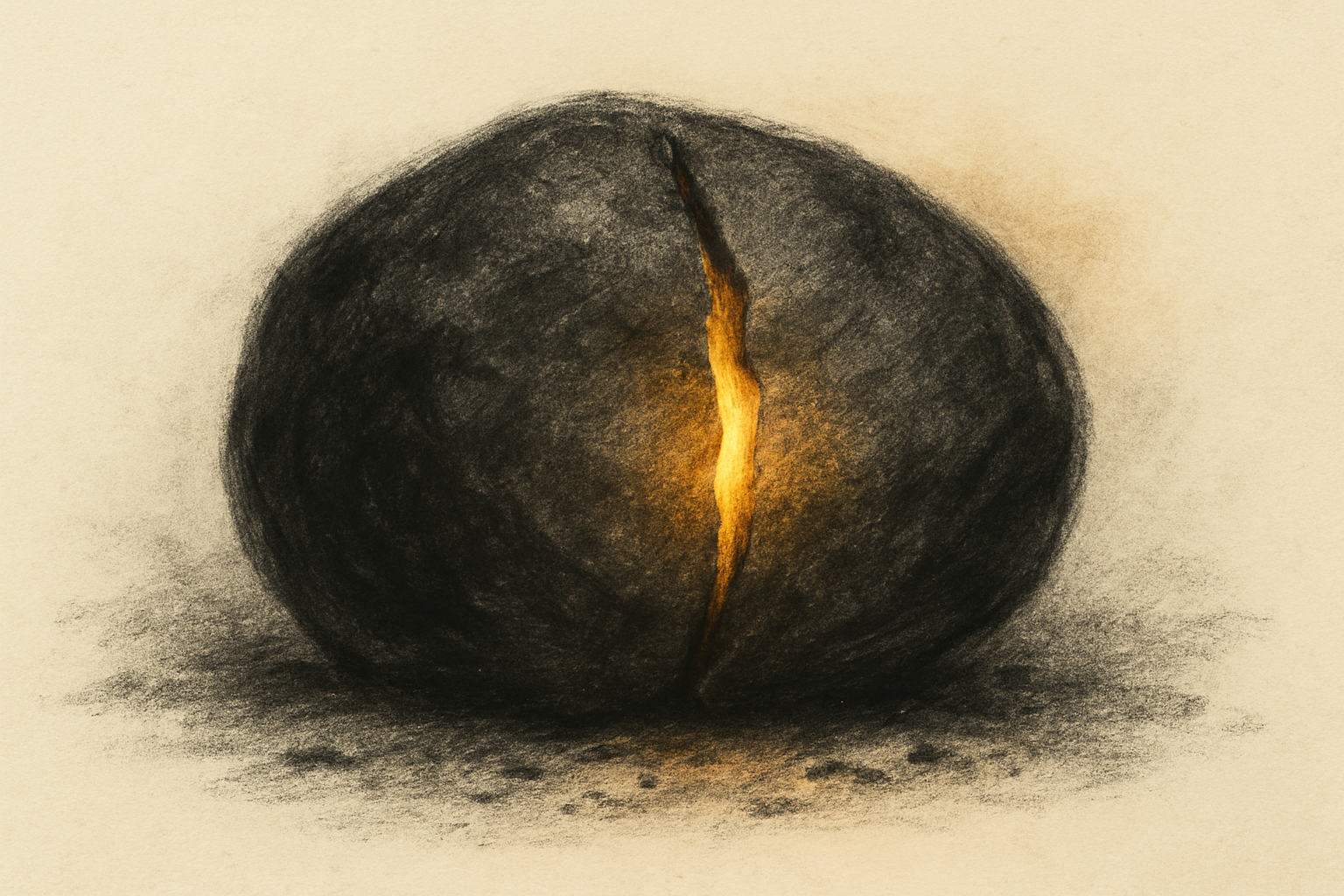
Making Fear Your Friend
Hacer de el miedo tu amigo
A student reports on the experience of sitting with uncomfortable fear, and the teacher explores how deep listening aligns us with a life force greater than our thoughts.
Making Fear Your Friend
A student reports on the experience of sitting with uncomfortable fear, and the teacher explores how deep listening aligns us with a life force greater than our thoughts.
I just wanted to report something. You said a couple of weeks ago about making fear your friend, and that really spoke to me. I've been sitting with some uncomfortable fear, and it is very uncomfortable. But as you say, it has come to something else. There's a relief, an openness, and a feeling of things shifting. I feel like I've been stuck for a very long time, not really looking at my desires, staying with things that are safe. Being with this fear seems like the only way. It's brought back some of that aliveness, and immediately in my life there are results. Things are happening. Life is reciprocating that aliveness.
And that is what validates that we are listening to a deep desire, because it is life's desire. There is a phrase, I believe from Osho, that the universe conspires in our favor. If we are listening to that deep desire, the plants and the trees and the ocean want the same thing as we do. If it is that deep, there is an alignment with the universe, with manifestation.
It doesn't mean you're going to get everything you want, everything you imagine. But it means that at a deep level it will be satisfying. There will be well-being. There will be a deep enjoyment.
The archetype of crucifixion and trust
The ultimate example of that is Christ, in the sense that the crucifixion, even if symbolic, is so powerful as a myth, as an archetype, because it speaks to this. He listened so deeply that he took the cross on his shoulder. What it represents is that deep trust, that deep surrender. The deepest desire in him called for him to be crucified, to allow the crucifixion, and in the crucifixion, resurrection.
That archetype is, in a sense, the proof, the evidence that even if we listen deeply, things that seem to not go well are in perfect alignment. Something has to end. Something in us cannot cross. It speaks to that crossing where the smallness is sacrificed. But it requires that deep trust, that deep listening, and the surrender to it.
Two pillars of spiritual work
Of course, the question then is: what do I really want, and how do I know? That is an ongoing process. In this work of spirituality, it helps to consider it as having two pillars. One is the work of self-inquiry and presence: distinguishing what is mine, what it's made of, and realizing more and more deeply that what we're looking for is here, not in thought. But if we only focus on that, there is a spiritual bypass, because there is also the need to attend to how we live and what we listen to in this movement of life.
These two work together. The more we understand our mind and the illusions we get trapped in, the more we can listen at a deeper level. It becomes a listening to, an allowing of, movement that is a life force rather than a thought force.
Yes, because I had this idea that my head had been trying to work out what it was that I wanted, and that was what was giving me the fear. I wasn't able to get to the heart, which is what knows what I want.
The heart's whisper
"Hear how the heart whispers," my teacher said. It's harder to listen to. It's harder to hear. That is why the work of looking at thought matters, so that we can recognize it as screaming noise, as howling. As we recognize that, we can start noticing the whisper. And eventually the whisper is a lot more powerful than the howling.