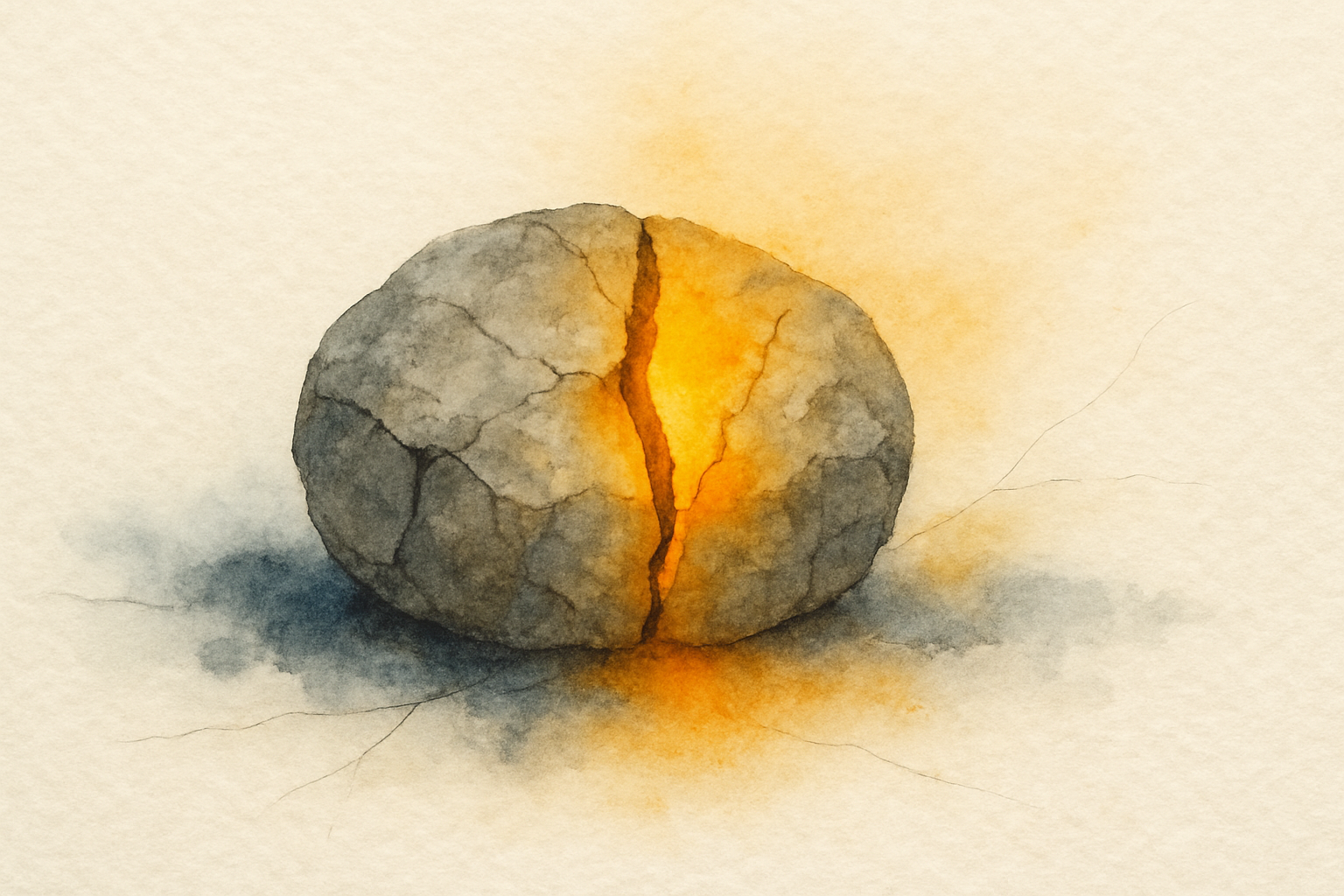
The Gold That Is Already Here
El Oro Que Ya Está Aquí
A series of exchanges exploring what happens when we discover what we truly want, how fear obscures our deepest passions, and why surrender is not something we can do but something that happens when we stop fighting reality.
The Gold That Is Already Here
A series of exchanges exploring what happens when we discover what we truly want, how fear obscures our deepest passions, and why surrender is not something we can do but something that happens when we stop fighting reality.
I'm fascinated lately with something I'm starting to see. In the self-inquiry meditation process, there seems to be a ceiling you reach. And from what I understand you to be saying, you can only go beyond that ceiling by following what you really want. I've been putting much more energy into my music, and I finish the day so much more vitalized, with so much more energy. It amazes me. At first I had doubts, wondering how it works. But it also amazes me how you can go such a long time without realizing what you truly want, even if you're doing years of inner work and self-inquiry. You can neglect something you're genuinely passionate about and tell yourself you don't want it. Is that just not wanting to face the fear it brings up?
The most important thing is to dance. To celebrate.
I am. And yes, it's huge.
The fear at the heart of desire
As to the "why," I can only speak generally. The simplest way to say it is: we are most afraid of what we want the most.
That makes sense.
You're talking about music, but you could define it even more broadly as self-realization. Can you be yourself? Can you truly be realized without doing what you love, without living what you want? And can you do what you love without knowing what you love? Not really. So in a sense, it has two sides. Usually, because we are in self-denial, we block that realization on one side or the other.
We could be doing what we love, but so confused about what we are that we live contracted, not really knowing ourselves, even though we might be doing what we love. So it happens in a very contracted way, without much deep vitality. On the other hand, we could not be doing what we love, and then there's just not enough energy in a different sense.
For example, we could love the process of spirituality and self-inquiry. That is a beautiful thing to be passionate about: meditation, practice. We could put a lot of energy there, but if we're not putting energy into what we want to do in life, what is all that spiritual work in service to? It becomes a form of what's been called spiritual bypass, driven by fear and self-denial.
I was having a lot of sensation today, and I just realized, with some help, that it has to do with fear. In a good way: I had an interview this morning for something I really, really want. So I recognize that this is fear, and I'm actually happy about it, because I wasn't knowing what I wanted for a long time. It seems so ironic that it's only by looking at the fear you're trying to run away from that you actually find out what you want.
That's beautiful. I hope you get it.
Thank you.
Knocking on doors
Knowing that is huge. Then the way it manifests requires you to keep knocking on different paths.
Paths within me or outside?
Both, really. There's always this attunement and refining: how we listen, how we move, how we flow. A beautiful metaphor for me is surfing. There's this interaction with reality that is a constant refinement. The more we are deeply aligned with the deepest want, the more there is a flow, and life responds appropriately. That might mean falling flat on your face; there's no guarantee of everything being rosy and pleasant. But at a deeper level, it is. So I really hope that works out, and if it's not this opportunity, it will come in some form.
It feels like an uncovering of something I hadn't thought of but that was quite obvious. A direction.
Yes.
It's a very short role, quite part-time, a contract until October. It's an assistant producer role on an arts project near where I live, with a really good arts company that does site-specific theatre. They don't have one fixed venue, and they have a great ethos that's very aligned with my own practice. Seeing myself outside of just my own art practice, as contributing to the whole picture, was a bit of a revelation: things I'm good at and things I love doing that were quite aligned.
Beautiful. It sounds amazing. Thank you for sharing it.
Surrender is not a doing
I was wondering if you could speak a little about surrender. It's been coming up very strongly for me over the past few months. For me, surrender is not really something you do; it's something that happens. Yet I feel really called to somehow do it as well. Every time I try consciously to surrender to something that's going on, whether it's fear or body sensations, I really have the feeling that it's the mind doing it.
Surrender ultimately is not something you can do, because all we can really do is fight and find ways to resist. Surrendering happens when our fighting and resisting fails.
Think of a battle. One side will only surrender when there's no other option. In a sense, it's just a plea for some kind of way out. Surrendering really is only the realization that fighting is useless. You can consecrate, you can pray, you can offer, you can invite, and you can try to act from that place. In a sense, it's a prayer. But the actual doing of it is not a doing. I think you said it yourself at the start: it's not something you can do.
Right. But it was happening, and what I'm sensing now through your answer is that because it started happening very naturally, the mind tries to grab it and make something of it, because it feels so good. It just happened on its own, really deeply, a few times. I was almost surprised that these words could come up: "Whatever happens, it's fine." And it felt so good. Then probably the mind just takes hold of it, thinking, "There's something here."
Exactly. We think, "This works. Let's do that again. Let's make it something we can control." But what's actually happening is related to what we can't control, which is pretty much everything.
That's very clear. I'm glad I asked, because there was a feeling that I could do something about it.
What we can do is not a doing
What we can do is not a doing. It has to do with observing, with seeing, with knowing. There is something in us that wants to know reality, and something in us that wants to veil it. To whatever degree we're knowing it or veiling it is a free choice we are making. I want to communicate that this is not something happening to us, that we are not powerless or victims. It's a very deep choice. What we can do is lean towards reality. As we choose that, as we fall in love with that more and more, the surrendering is just a side effect, a consequence.
Can you explain a little more about leaning towards reality?
To be honest with yourself about what is real and true for you. What are you actually feeling? What do you actually want? What is your actual deepest experience? That's reality.
The gold nugget and the present moment
There was a talk you gave that I found on YouTube, which actually brought me to you. You were speaking to someone who said that in the meditation you offered, truth was just the breath, and it was so simple. Then you were explaining to him exactly what you just said: that we're not powerless, that there's some kind of cramping happening. You said the mind was promising a really big gold nugget in the future, while the present moment was all gold, and in that moment you just couldn't see it.
What I felt when I listened was: yes, it's just constantly projecting something being better in the future. Even a tiny bit better in the future seems preferable to seeing that everything is here now. And since I watched that talk a few weeks ago, I keep seeing it everywhere. Every moment is this kind of hoping things will get better in one second. You also mentioned that it's not only about projecting into the far future; it's also about the next minute, the next cup of coffee being better than now. We move from instant to instant this way. The more I look at that, the more frustrating it becomes, because it's so obvious. And then you can't help but surrender to this.
Use that as an example. I spoke some words in relation to something that resonated with you, and it just became true. You saw it: "This is reality." You chose reality.
Yes, that's exactly what I wanted to say. It felt like, "This is so true. This is what I'm doing, and this is what is actually true." It's here and now. I feel it's here. But something is so used to just looking toward the future.
The house of cards
The mind is really good at creating a hypnotic world that seems real, which is the future. To the degree that we believe it's real, we will be tempted by the promise of golden nuggets. But if you really look at your experience, the future is always made of mind. And gold made of mind is imaginary gold. Everything else, all sensation, all vitality, is all now. Walking toward the coffee is just as precious as having the coffee and sipping it.
That's very helpful. I think it really answers my question about surrender. You answered by pointing to looking at reality, and that was the part I was missing.
When I say there's a part choosing reality and a part choosing illusion: when the part choosing illusion gets pierced, it starts to lose the battle. It's going to be hard for you to convince yourself there's gold in the future, because you've seen, even if for a second, that it's just not possible. To the degree that this becomes more and more obvious, more and more of the time, the part of you that's been chasing the goal in the future is going to start surrendering.
Yes, that's it.
It's a whole house of cards that will collapse slowly. I always recommend, if there's anything we can do, to be gentle and go slow, because I know how rough it can be if it's sudden. But for some people, it is sudden.
Thank you so much. Nice to meet you.
Very welcome. Nice to see you.