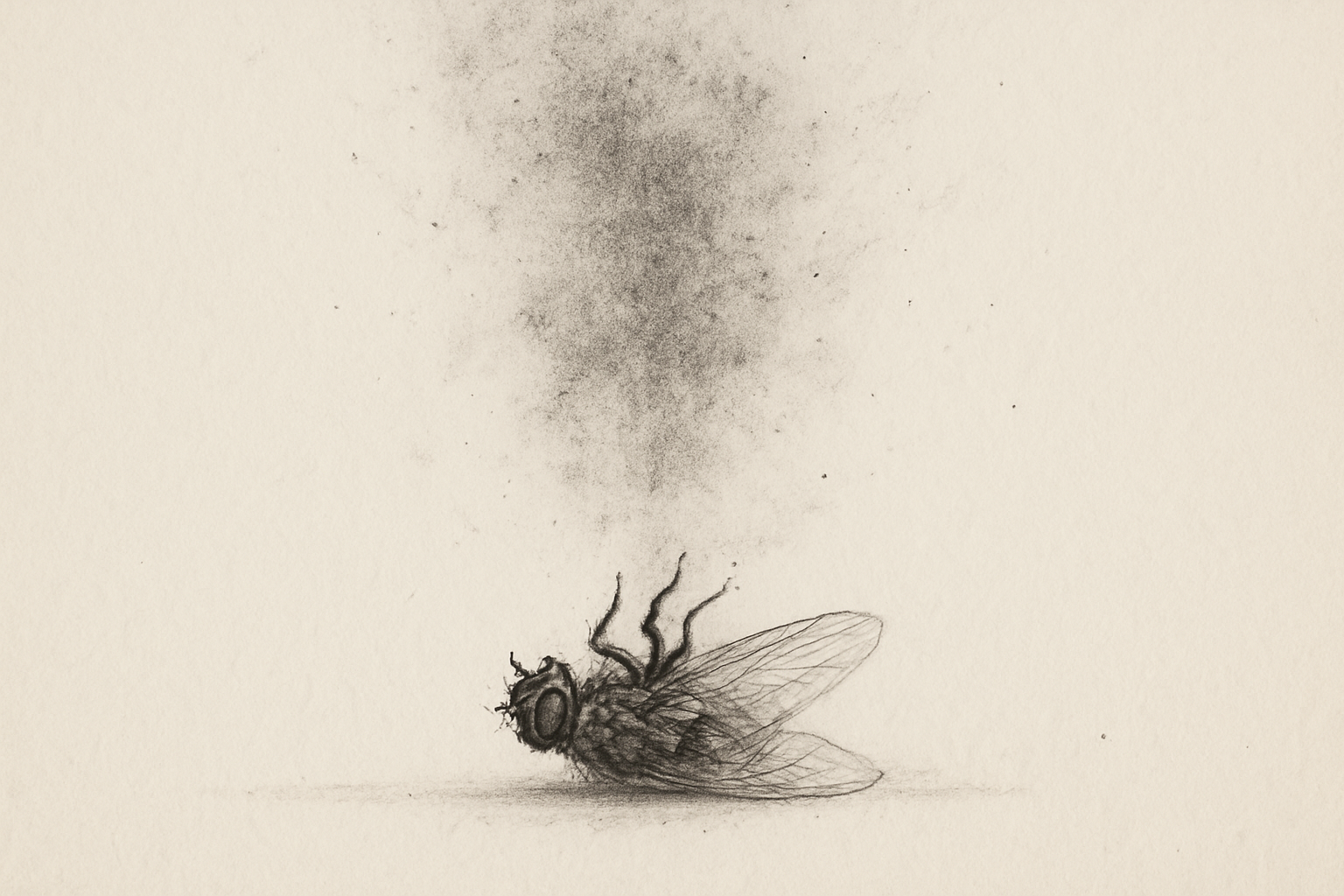
The Dead Fly and the Nature of Consciousness
La mosca muerta y la naturaleza de la consciencia
A question about whether a dead insect is still consciousness, and what non-duality says about the boundary between life, matter, and awareness.
The Dead Fly and the Nature of Consciousness
A question about whether a dead insect is still consciousness, and what non-duality says about the boundary between life, matter, and awareness.
I have a very weird question. There's a dead fly on my windowsill, and I'm looking at it thinking: how is that also consciousness? Because it's dead. Obviously, before it died it had a life force, and now it doesn't. But it's still part of consciousness, if that makes sense. There's been a change, but also somehow there isn't a change, because it's still part of consciousness. I suppose what I'm asking is, from a non-dual perspective, there's a change, but that change is actually an illusion?
What matters here is doing some work around semantics so that we're talking about the same things. When we say "consciousness" and "life," we need to be clear about what we mean.
Organic life and manifestation
If we're talking about an insect, "life" at the level of the insect being alive versus dead is one thing. But "life" as manifestation is another. You could say a rock is alive in the sense that it is manifestation, creation. It has a beginning and an end, even a rock. So now we're talking about organic life versus non-organic life, and the cycles of time. You could think of non-organic life as simply slower in its cycle. And within organic life there are also cycles: a tree versus an insect.
Point of view and the body-mind
Then there's another dimension, which is mind and perspective. A body-mind has a point of view, a perspective. It's fair to say that if the insect dies, the point of view from that insect ends. That's a guess, but a fair one. The same applies to the bodies we are experiencing as this body-mind. But that which we refer to when we say "I" carries no sense that it is limited to or tied to the body. And there's no sense that it is separate from manifestation. So the point of view can end, can change, but that doesn't mean what knows through that point of view also ends.
You could also argue, and I would argue in favor of this (knowing that we can't truly know), that a rock has a less sophisticated point of view, if any at all. I would argue that it probably does not have a point of view, that there is no mind, even a primitive one. But still, it is part of a vaster mind, which is manifestation. You could think of that as God's mind, God's dream.
No separation anywhere
But you asked about the perspective of non-duality. Put simply: if we look closely, there is no evidence of there being a separation anywhere. There is only seeing, or knowing. When there are appearances, those are known and seen, but not as separate.
Matter and consciousness are not two
The point about consciousness and matter, which I think your question was also touching on: we don't think of matter and consciousness as two things. In a sense, matter could have its independent reality from consciousness, but only at the level of mind, of perspective. What I'm trying to challenge is the notion that either matter or consciousness is primary. To me they are not two, so you can't have one as primary.
From that perspective, it's also hard to draw a line between what is alive and what is not. We'd have to specify organic life versus non-organic. And even then it becomes a gray zone. What is organic? And then the question of perspective, of point of view: does it have a nervous system? Does it have eyes? That probably allows for a point of view that is sophisticated enough, complex enough, for there to be a seeing through that point of view, which is what we are experiencing now. It's a knowing through the mind of this body-mind.
Something you said about neither consciousness nor matter being primary really struck me. I was ranking the deadness of the fly as "just matter," as somehow lesser than a fly that's alive. But what you're saying is that nothing is primary, so everything is equal?
Not necessarily equal. But it's not separate from anything else.
And you mentioned "knowing."
The knowing is consciousness.
The nature of consciousness
The real question is the nature of consciousness. What matters is not to believe anything about what consciousness is. All we can know is that it is. And it has certain flavors: a flavor of peace, of love. But that peace and that love have no color, no form.
When we say "consciousness," "knowing," "seeing," these are our words, the same as the word "I." "I am." They all point to the same thing. But if I say, "I am a woman, a man, a human, and that's all that I am," and I believe the consciousness that "I" points to belongs to, emerges from, and comes and goes with this body, then that's a belief about consciousness. And it's a problematic belief, because it's not reality.
Self-inquiry as the removal of assumptions
That's what we could call self-inquiry: the question, "What am I? Who am I?" It doesn't aim at finding an answer. It doesn't aim at arriving at a conclusion. It aims at removing the underlying beliefs, the assumptions that are already there, which we forget we have.