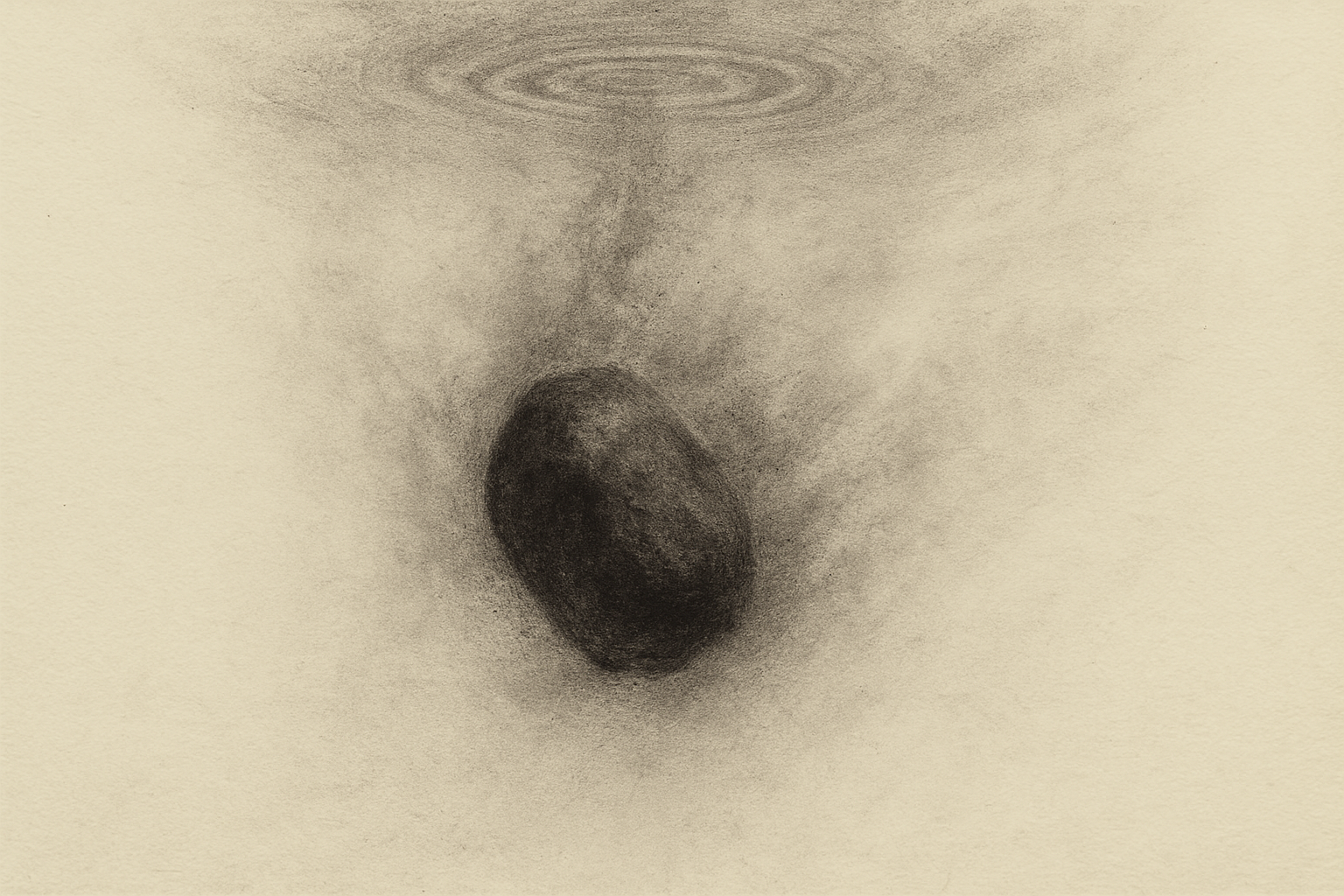
Sinking Into Sensation and the Sense of I
Sumergirse en la Sensación y el Sentido del Yo
A question about what the teacher means by "sinking in" to direct experience, leading to a broader exploration of how thought sustains our fixed sense of self.
Sinking Into Sensation and the Sense of I
A question about what the teacher means by "sinking in" to direct experience, leading to a broader exploration of how thought sustains our fixed sense of self.
I was trying to clarify what you mean by "sinking in," which you subsequently explained.
Yes, and it is a metaphor, a poetic direction. What I mean is that I am trying to refer to something I cannot describe. So I use more poetic language, because if I use language that is more specific, it will miss what I actually mean.
That said, there is a shift in attention and awareness that can happen, one that can be invited. It has a sense of sinking, of moving out of thought and into sensation. But nothing really moves. It is as if sensation and perception can be contacted more directly, instead of through thought.
The image versus the sensation
For example, if I say "bring attention to your feet," there are probably going to be two things happening. One is the sensation, and the other is the image of feet. This sinking is a movement, which isn't truly a movement, more towards the sensation and a letting go of the image. And also, the image becomes recognized as an image instead of being experienced as the foot itself. There is a moment where the image of the foot is experienced as the foot. But once we see it is the image of a foot, then it is just the image, just the thought.
Sometimes, upon hearing the instructions, say when you mention the foot, I would subconsciously, even with my eyes closed, try to look at my foot. That is a thought, right? But then the sensation that becomes amplified at the foot area, that is the part we are trying to attend to? So "sinking in" means sinking into the feeling, the sensations of that area, instead of trying to do an inner gaze, trying to see it. I also notice that my eyes may actually move, even with them closed. So that is part of thinking, whereas the sensation part is what we are trying to get into. Is that what you are saying?
Yes, exactly. And the same applies to the breath. The breath has sensations, and then we can have a thought that is "breathing." There is a whole series of images that can arise around the sensations of the breath. Sinking is, in a sense, letting go of those images. You will still experience them. They will still come and go. But as you sink into sensation and perception, the thinking activity will become known as thought. Whereas before, it is known as reality. The way we relate to thought has a kind of magic quality, a hypnotic quality, where we can forget that a thought is a thought. It becomes the reality of a thing.
Recognizing thought as thought
How would one differentiate whether something is actually a thought or not? Sensation is quite straightforward for me; I really do feel it. But when I want to be aware of my own thoughts, sometimes I genuinely do not know, because the narration seems almost perpetual to me. The differentiation between whether something is a thought or not is not that straightforward. Even when I think, "I'm quiet now," I realize, "Oh no, you're actually talking, so this is definitely a thought."
What you are describing is the human condition. It is not specific to you. You could say that the more we are aware of a thought being a thought, the moment it happens, the more awake we are. That is why so many meditation practices focus on observing the mind: so that we can recognize thought as thought. Then there is a whole process of understanding the mechanics of thought, of the mind. But first we need to notice what a thought is. Some thoughts are easier to notice than others.
The magic trick of the mind
The core of that kind of magic trick the mind performs is the sense of "I." It is all focused on preserving and maintaining a known sense of "I." In order for that to happen, we need to not know that a thought is a thought. To put it differently: we need to buy into the illusions of the mind. If we notice all thoughts to be thoughts, then that sense of "I" cannot remain as it is. It is the core, the anchor of all that cyclic mental activity.
So that is why you mentioned investigating the sense of "I," and the way to do it is to recognize a thought as a thought. Is that right?
That is one way to prepare for it. Then you can be more direct. But it is hard to do direct self-inquiry before there is much of a practice in observing thoughts. It can happen; there are no rules. And what I am referring to, that sense of "I," that known sense of "I," has to do with a deep belief in knowing what we are.
The beliefs that sustain the self
It has certain general qualities. A deep belief and a felt certainty about what I am. What I am, absolutely and undeniably, is, for example, this body: a body that was born and will die, and therefore I began and will end. I am located where this body is. There is a center, which I am, that chooses and controls. There is a sense of agency, of being the agent. All of that is sustained through thinking.
For example, thinking is going to name and map out our experience. Thinking is going to say, "That is over there, and I am over here. That is not me, and this is me." That is the way a sense of location is created.
I see. So when there is a gap, or when there is no thought or less thought, and I am aware that there is less thought, that is where that fixed notion of "I" becomes something I would be able to see through. Is that right?
Seeing through what you thought you were
Yes. What can happen is that you come to see that what you thought you were, the core of what you believe yourself to be, is a thought. It is one hundred percent made of thought. This is going to be hard to describe accurately, but something happens: something disappears, and yet something does not. Then that which disappears, which was created by thought, comes back, but you can no longer be convinced that that is where you are.
Do sensations still remain in that scenario?
Sensations can still come and go. It depends on how it happens, whether it is partial or full. What I am describing can happen while sensations remain, while perception, sound, and sight remain. And it can happen simultaneously with sensations and perceptions also stopping. That is what is called kensho in the Zen tradition.
Thank you.
You are welcome. And just to say something about that: the point of it is that we can, in a sense, wake up from a dream that is based on something which is not real. Being in that dream has, in a sense, some positive qualities, but it comes at a cost of suffering. What usually happens is that we are balancing benefits with a cost. At some point, the suffering becomes greater than the benefit, and so we start this kind of practice and exploration.