Boundaries and What Lies Beyond Them
Los límites y lo que hay más allá de ellos
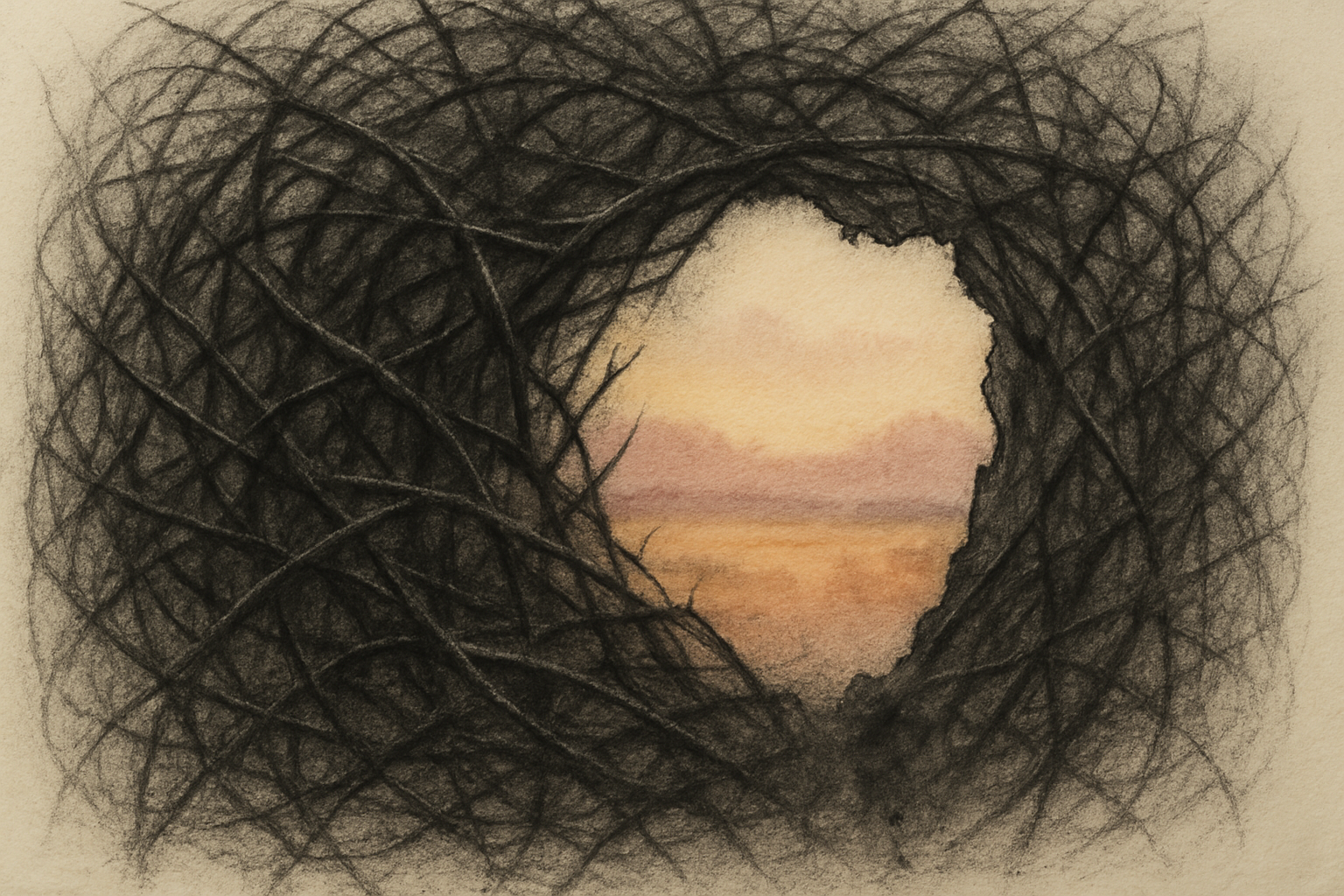
A conversation about the difference between setting boundaries as a management tool and developing a deeper, more creative way of relating to difficult dynamics in relationships.
Boundaries and What Lies Beyond Them
A conversation about the difference between setting boundaries as a management tool and developing a deeper, more creative way of relating to difficult dynamics in relationships.
So in a way, if you don't let yourself feel anxious, you won't be a match for the dynamic, and then it's more likely to shift quicker.
Well, you can't not let yourself be anxious. If you're anxious, you're anxious. If you're not, you're not. Don't try to control your emotional state. But notice: if your anxiety is activated, what's happening? What are you needing? In exchange for that need, where does it get you attached, if anywhere?
I suppose the need to help, like what you said about being responsible.
Yes, and that's where it gets deeper, more subtle. It's about developing a more intricate understanding of your emotional and mental structures. Then the creativity of what you truly, deeply want is informed by that understanding. For example, you might realize, "I do actually want to play with this and see how we could creatively change the dynamic of this relationship." Or you might find a way to disengage more creatively. For example, start dancing and walk away.
Thank you.
Boundaries as a tool
Listening to this, I got the idea that this is about setting boundaries. Knowing your boundary and living according to it is about the truth of you. Is that right?
The practice of setting boundaries is, to me, a tool for when you haven't yet been able to flow deeply with something. When we haven't learned to flow deeply, we need boundaries as a way to manage. For example, if I break a leg, I'm going to use a crutch until I can use my leg again. A boundary is a kind of crutch: useful, necessary, important to learn. But it's better to be able to go deeper, to relate more deeply. For example, in the situation just described, if there's a person who always engages with you in that way, and you always get stuck, and it's just not good for you, then the boundary would be, "I just don't see this person anymore," or "I walk away." Whatever the boundary is, it's a way to manage being stuck.
There's a deeper option, which is more creative. It depends on how problematic the relationship is. But for example, with someone I used to have to set a boundary with, it's no longer necessary, because what I want is just more naturally happening, and I don't end up in that situation anymore.
Boundaries are good practice to learn. But what I'm also pointing to is that there's something deeper. We can relate to that which the boundary says "no" to in a more creative way.
A shift that makes it funny
I'll give you a real example with my mother. There was a point in our relationship, and in my life, where there was something that was always very difficult for me. I learned to have a really strong boundary, to say an intense "no." I learned to bring anger to it when necessary: just a really strong "no."
That no longer happens. Now, when that dynamic arises, it almost ends up being funny. Something has shifted in me. What it used to bring up was too difficult, and I needed to stop it. But now it doesn't bring that up. When she goes to that place, I can talk to her in a way where it ends up being funny. It's not a big problem anymore. Sometimes I have to be a little emphatic, like, "We're not going there." But it's no longer the intense kind of boundary it once was.
I have the same thing. I'm fully aware that my mother has her way of living and tries to educate me to be like her, to live her life, when my situation is totally different. For quite a while I couldn't speak to her. We still have a good relationship despite not talking much. But I'm slowly realizing more of what I cannot accept from other people, and slowly getting to see more and more what I'm truly about. It's very slow.
It's slow, but it's deep, so it takes time. If our mother says, "Do this, do that," at some point you have to say, "No, I'm not going to do that. I'm not going to listen to you anymore. Don't tell me that." And maybe that's necessary. Then at some point, the response becomes more like, "Oh, here you are telling me what to do again." And if there isn't that charge of reaction, on the other side there's also going to be a deactivation of whatever pattern it's coming from.
Letting go of control over the outcome
Yes. There was anger first, and now it's a lot calmer, not so reactive. Because we cannot change people. They are the way they are. That's what I've come to realize. I can't change myself either. There's nothing there to fix on either side. So I feel like I'm simultaneously not accepting being forced into something, while also accepting that this is just the way it is. There's a lot less resistance. And there's also not knowing what the relationship will end up looking like. There's no controlling the consequences, no need to worry about the breaking up of a relationship. If it happens that we can't live with the situation, then we're separate.
Yes, and it might surprise you. You may end up having a better relationship than ever before. But it doesn't have to be that way.
It can be complicated.