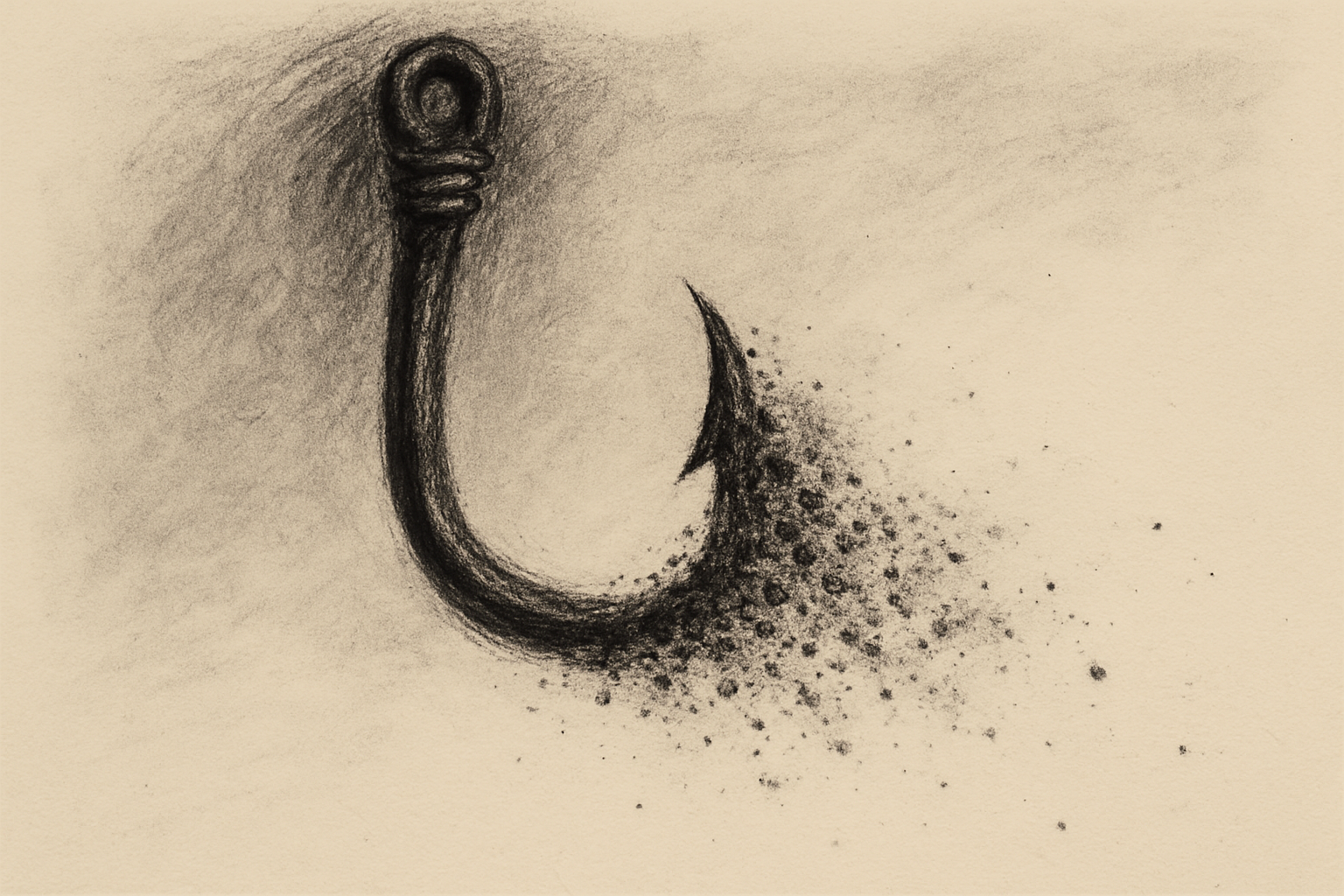
The Hook of Negativity
El Anzuelo de la Negatividad
A student explores why negative thought patterns persist despite awareness of them, and the teacher describes how to observe thought without collapsing into it, ultimately finding the absurdity that breaks the spell.
The Hook of Negativity
A student explores why negative thought patterns persist despite awareness of them, and the teacher describes how to observe thought without collapsing into it, ultimately finding the absurdity that breaks the spell.
I must be holding it as two, otherwise I wouldn't be fighting against it. I must be holding it without realizing. Some resistance to it must be held in order to fight against it, but that is what I haven't discovered.
Yes, and that's why it's harder to discover by bringing attention out of thought. It's easier to discover by letting the attention go into thought, but observing it. Recognize that it's a movie happening. It's not reality. It's thought. Then look at the movie. As you look, you can start to understand. For example, a certain kind of dark thought creates fear or anxiety, and there's a hook for you there. Unless we really see the deeper aspects of thought and how the mind works, we won't be able to see through it.
The anchor outside of thought
The practice of bringing attention to the breath and out of thought is necessary, because the moment thought gets intense, we're pulled in. Being able to get anchored in what is not thought gives us the ability to go into thought without being completely identified, immersed, and collapsed.
Yes, and when staying with thought and thought is so negative, I get to experience the negativity. And that's okay.
Yes, exactly. And more importantly, look at the temptation to believe that some of it is real or true.
Sometimes thoughts are so negative that it is perfectly clear they're not true. And when I stay with them, I get to experience the negativity.
Yes, and when you fully see through it, you could find it funny. The negativity will only remain fully negative when something is still believed, when there's some reality to it. When you fully see through it, it could be like a dark comedy.
So can I say it's like experiencing this negativity to a point that it doesn't feel real? Is that how it works?
It will be seen: if the negativity affects you in some form, if it feels negative, if some of it becomes real, then there's more to be seen.
I don't know if I'll be taken by belief, falling into the negative until I become so negative myself.
Finding the absurdity
Just keep looking at it and find the absurdity and the comedy in it, because that's going to break the spell of the negativity's purpose. There are emotional qualities that become addictive to the mind. A certain aspect of the negativity becomes addictive. But if you're no longer believing it, if it becomes funny, that will deactivate the power that creates the negativity, the power to which there is an addiction. This requires time, because it is actually changing biochemistry, changing hormones, changing the body-mind. It takes time to go through the withdrawal and stabilize. But first you need to see more deeply the hook of the negativity.
When thought captures you
So when I'm in these thoughts without realizing I'm in a thought, at that point there's nothing I can do. It's only when I realize, "Oh, I was in a thought." And at that point, I stay with the thought. But I also find that at that point, the thought just goes. I can't even hold it there and stay in it, because it's already dissolving.
Yes, you've seen that thought, and so it dissolves. That's what happens. For the time before you notice you're lost in thought, as you said, you can't do anything there. But that's where the practice of what you could call mindfulness, attention, breath, sensation, having a regular practice, is going to make it more recurrent that you snap out of the belief in the thought.
Yes. Thank you so much.
Prior to intention
There was a question: "Prior to attention, there is intention." Yes, but there's something prior to intention as well.
Awareness.
Yes. The noting practice is very, very powerful, but it has to be done in a very focused period, say five or ten minutes, and it has to be really intense and sharp. Really focused. It goes like this: thought, then name something that's not thought. Then thought again, and when you see it, name something that's not thought. Prior to intention, there is something prior to intention as well.