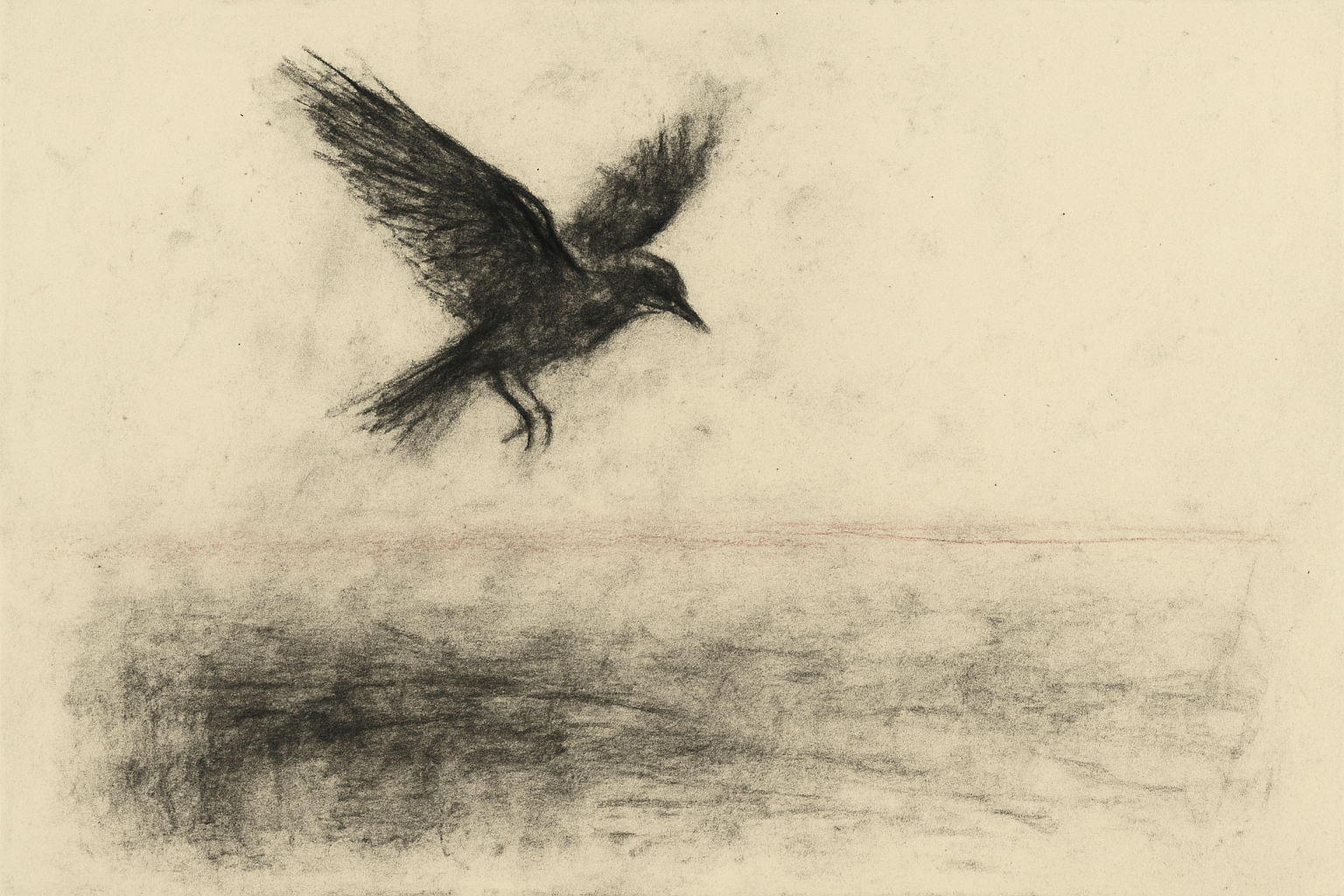
No Place to Land
Ningún lugar donde aterrizar
A student describes feeling upended by the recognition that the intellectual confidence and knowing she has relied on is only a substitute for true peace, and the teacher explores what lies beyond that collapse.
No Place to Land
A student describes feeling upended by the recognition that the intellectual confidence and knowing she has relied on is only a substitute for true peace, and the teacher explores what lies beyond that collapse.
I had an experience of seeing very scary thoughts and just sitting with them. They were just thoughts, really arising out of nothing, like weather, like a storm just passing through.
It was really moving, beautiful, intense too. What was mind-blowing for me was how you jump from one thing to the other. I'm not even sure what I need to say, but there's so much coming up all at once.
The idea you've repeated a few times this evening is so powerful to me I can't even express it. It's like it goes against my religion. If the door seems closed, I don't go there. If I feel stuck, I go somewhere else. If it's not working, then it's not working. That's the whole way I've lived my life.
I don't know how it's connected, but what comes up is this need to land: "I'm this, I'm that, I know this, I don't know that, I got it." Like I'm running after butterflies. Maybe it's overwhelming to see how flipped everything has been.
The need to land
It's very upending. At the same time there's so much gratitude, because that's it. There's no place not to go. It's just here. There's nothing to solve. I feel upended, all upside down. There's something exhilarating about it, and at the same time it goes against everything I've ever known. It's what I've always tried to avoid. The whole "smarty pants" approach, the sense of competence through knowing. It feels horrible. What's coming up is the horribleness of it: fighting, holding, believing things that aren't true.
On the one hand it feels so powerful, and on the other I feel completely like a dishrag. I can't even put two thoughts together. And there's this hopelessness that comes with it. There's no place to land, and that's very upsetting to what I'm used to.
If you could describe the experience of no place to land, what would you say?
It makes me feel so incompetent. I don't know what to say. I don't know where I am. I don't know what to do. There's just this very strong sense of being lost. I understand it's just an experience, maybe reliving something, conditioning of some kind. I guess what I'm trying to say is that this is a hard process.
What would you gain if you knew, if you weren't lost?
I would have a sense of competence. "Oh, I know how to talk about this. I know what to say. I know who I am."
And what does the sense of competence give you?
It feels peaceful. But that peace is extremely fleeting. I'm not investing in it these days as much as I used to.
Substitute peace
It's a substitute. It's a substitute peace. It's fleeting, it doesn't really work, but it's better than no peace. And what you're recognizing is that you still haven't recognized true peace.
I have felt deep peace in my life, but not lasting deep peace. It comes and goes. I could look back at some moments and say nothing was missing, or there was a complete forgetting of the persona, just gone. But I can't tell you for sure that that was it.
Those may well have been tastes of true peace. But something can be clarified: the cause, the source of that peace. We attribute it to something, and so it appears to come and go. In that attribution there is a misunderstanding. There is more that can be clarified and seen.
I see where you're going with this, and it makes complete sense. It's not an experience; it just is.
You're recognizing very intensely, and describing, the sense of trying to get this peace through knowing, through understanding, through a thought process. That confidence is equated to at least a taste, or a substitute, of peace.
What I'm saying is that right now it's so clear that it isn't real peace, and so I feel like I'm in free fall.
The garden and the fall
Right. You're caught in a deep, habitual mechanism. That's how it is for all of us in our upbringing. We lose that sense of peace and well-being very quickly, and there is a journey of rediscovery needed. But in the meantime, we find a substitute. We find it in the world of thought, the world of identity, the world of self. You could equate this to the Christian story of falling out of the garden: tasting the fruit of knowledge. It's what happens when the knowledge of thought is discovered and becomes the highest god. And when we see through that, it's very disturbing.
It's this loss of innocence, the loss of the most precious way of being in the world: just pure innocence. It's huge.
And the process is already underway. What I can say is: trust that you have tasted true peace. But you haven't tasted it in a way where its origin, its source, was known. And so it appeared as something that came and went, dependent on something in experience.
And you just realize how much energy that's been consuming. Before I even got on this path, I could spend hours lost in trains of thought and imagery, truly suffering, unknown suffering. Now I'm catching it almost within microseconds and stopping it. That's a blessing, a true blessing. Even if I were to never go any further, my life is 180 degrees from what it used to be.
But I think what's left, in a way, creates an emptiness and space, because I'm no longer living like that. And that's uncomfortable. Hacking away at your beliefs, tearing them apart. I was raised Catholic; I've got lots of beliefs. But I've also got plenty of other beliefs I subconsciously developed to cope, to survive. When you start taking them apart, it's uncomfortable. It's like living in the city, getting used to the sirens and all the noise, and then suddenly moving out to the country. It's uncomfortable living in all that quiet and peace.
I didn't really have a question. It just resonated with me as I listened to everyone share.
Toward fear and pain
I appreciate you sharing. I tend to emphasize this point a great deal: this work moves toward fear and pain. I don't want to diminish that in any way. Discomfort in all its forms. I summarize it simply as fear and pain.
And a sneaky one is doubt. My mind is always injecting doubt. I've only recently started picking up on it.
In what way? Doubt of what? What's the pattern?
Speaking from just these teachings: doubt about the teachings, doubt about whether this is the right path. But it could be doubt in any situation, given whatever the circumstances. I have a healthy distrust of my separate self, my mind, and I often have to stop and try to get myself into a state of pure awareness rather than following egoic thoughts. That's something new I'm struggling with, but I'm gradually starting to see it.
Fear is an easy one. Fear is something I can readily see now, and I can try to get at the underlying fears that are causing the thought patterns. And as I think I told you once, the realization that emotions are now, for me, just physical sensations in my body with a story attached. Whereas when I was really ignorant, a certain emotion could set me off: a tremendous fear of "I do not want to feel that." I'd be so afraid of it and do almost anything to avoid it. But now, if it surrounds grief, it's like a mild sensation in my throat, and something has triggered a story in my head that caused that physical sensation. When I start breaking it down, I start seeing it for what it really is. There's a lot of benefit in that.
Doubting doubt itself
That's great work. And from there you've built a foundation from which you can go deeper. Without that, it's often just too unstable.
If we look at doubt, there are different kinds. You could say: doubt every thought. Even a thought that takes the form of skepticism or doubt can itself be seen as a thought and questioned. By "doubt it" in that sense, I mean question its truth. That's a different kind of doubt. Then there's the doubt you're describing, the doubt around the teaching, around whether this is the right way. Well, why would you have any certainty that it is?
The only certainty is what's attained experientially.
Exactly. That's why I use words like "trust," "explore," "experiment." At some level I'm trying to generate a kind of inspiration, encouragement for one to even attempt this work. But ultimately it's as you said: you try something, something changes, something works. And then it becomes less about any particular teacher or teaching. You realize there's something here. Overall, yes, the process is difficult; there is fear and pain. But you are definitely having a better experience than you were.
That shows two things. There is something beneficial in this process, and also that reality, truth, nature, what is, isn't something inherently bad. To the mind it could seem that way, but it isn't. I speak from experience.
When there is enough trust and enough skill in this exchange, something can be explored on your end where you discover for yourself that your experience is better for having done this work. And what I'm here to say, again, is that there is more. Yes, there's going to be more fear and more pain, but it's worth it.
Agreed.
The end of suffering
The fear and the pain are going to be there no matter what. We could choose not to do this work, and more likely the fear and pain would get worse, because life goes on and things happen. If we don't get better at meeting fear and pain, it just gets worse.
What I can say is that there is an end, and it is absolutely shocking. I had heard about it. I had done a lot of this work. My teacher was very specific about not using certain terms; he didn't even use the word "happiness." He spoke about well-being and was very careful with words. So I spent a long time with a teacher who didn't point to the end of suffering directly the way Buddhism does. But when it happened, I was completely stunned. Nothing I had heard, imagined, or experienced had anything to do with it. It was completely shocking.
And that's me in the role of inspiration, sharing this with you.
The crucifixion as myth
In a sense, we come to a point where what is at stake is the sense of self. That's why I find the Christian narrative quite powerful, even just as a myth. Even after the forty days and nights in the desert, facing everything, there was still the crucifixion to face. Things were pretty good after he came out of the desert. He was feeling confident.
Are you still in the role of inspiration?
Yes, because that's part of it. Take it as a myth. There is the resurrection. The crucifixion is inevitable. Perhaps it could have been stopped or prevented, but that was not what was wanted.
What I would say is that, in a sense, it is the worst thing you can imagine. It is that which you fear the most, that which you're running away from the most. It feels like the worst thing you could have wanted. It feels like death. But what is death? It is whatever your body-mind conceives it to be, because you can't know it. It's the projection of the worst thing you could imagine. And it's the death not of the body, but of what I think I am, what I have believed myself to be. So it is felt like the hardest thing I could imagine going through.
And afterward it's known as: "That was a lot, but it wasn't death." Well, in a way it was. It's as bad as it can get, and it's okay. It doesn't go down without a fight. And ultimately, as you said, it's thoughts and sensations that are intense and uncomfortable. Then the seeing of reality, which can be very disturbing, but which, when seen fully, is freeing, beautiful, and loving. And you will never want to go back.