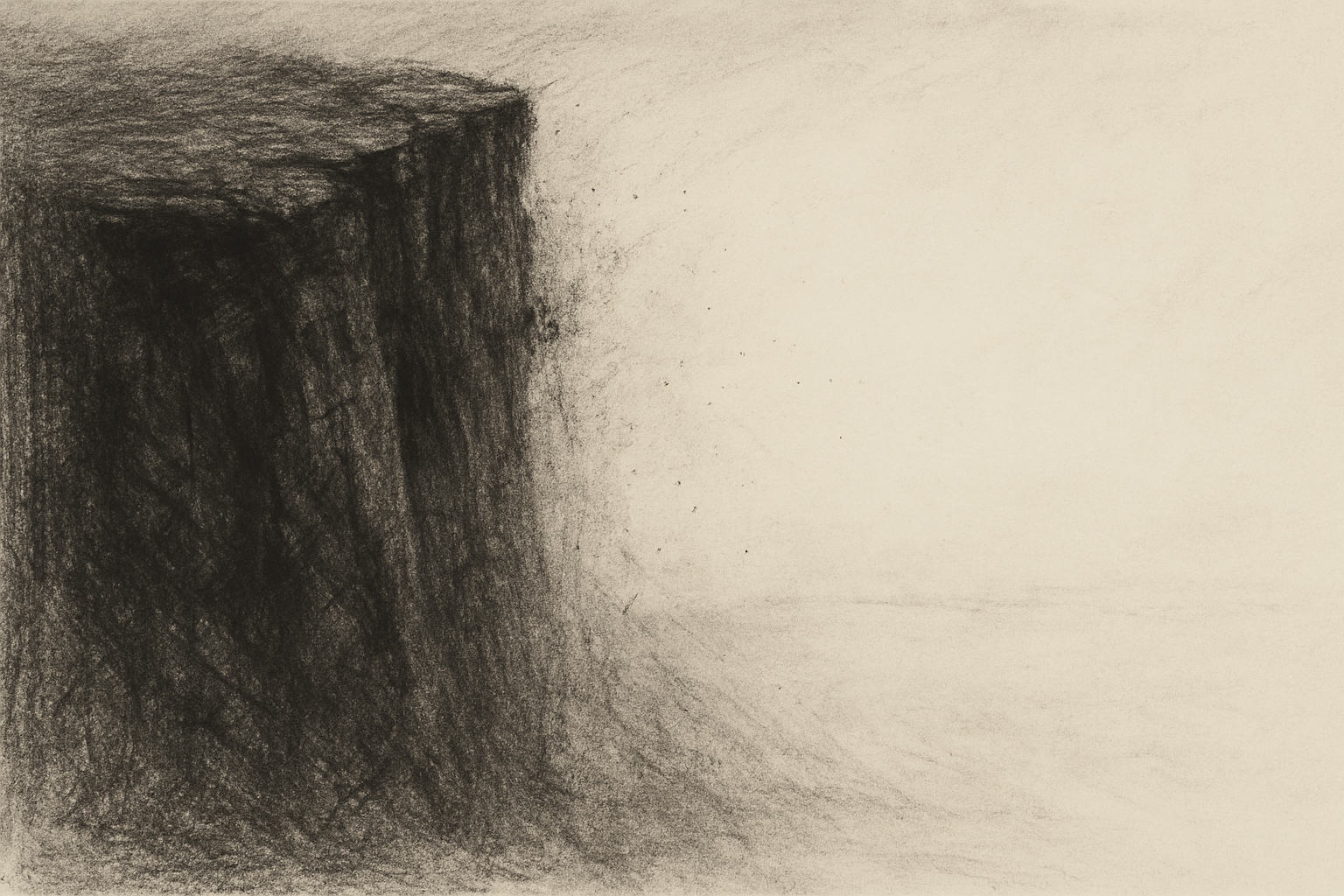
The Imaginary Edge
El Borde Imaginario
A student shares a recurring sense of dread rooted in the fear of death, and the teacher explores how the mind's habit of knowing and controlling creates a fictional boundary between safety and the unknown.
The Imaginary Edge
A student shares a recurring sense of dread rooted in the fear of death, and the teacher explores how the mind's habit of knowing and controlling creates a fictional boundary between safety and the unknown.
This has been amazing, really beautiful, really powerful. I don't know if I have a question. I was processing. It was absolutely breathtaking to listen to each person and each dialogue.
It's all about pushing the edge for me. How far, how far, how far? And I notice that for me, the question of what's missing or what's the problem always comes back to this constant sense of dread. It's not there all the time, but it feels very familiar. We're old companions. We've done a lot together. It's like an old friend that keeps coming back.
When I really investigated, I noticed that it's fear of death. It's just fear of death. It's very simple. We're all going to go, and I sense I'm going, or I notice symptoms and think that could be the end. It's not all the time, but it returns. It's always death.
What I feel I'm getting from this teaching, among many things, is that I truly feel like I'm more and more welcoming that fear. Bring it on. That's where it's at. And not seeing it as something that shouldn't be, because here it is. There's more and more of a sense that when I let it be as it is, even the worst of the worst, there's something beautiful about it. It absolutely is beautiful.
And then the mind says, "Yeah, but there's still dread." And I say, "I know, I know. It's okay. It's all right." There's this inner dialogue, and I'm able to watch it more. Maybe there's more space around it.
I like what you're saying about coming closer to that edge. How would you describe that sense of the edge?
It's not knowing, I guess. It's not being in control. And it's the melting of habits. Something that was so comfortable, and then all of a sudden I can't do it anymore, or it doesn't work, or I don't want to do it. To hell with that. And then maybe there's the fear. Then what am I? Then what are they? Then what? And then again, okay. Then what? Okay. Maybe there's a presence to it. I'm not even sure how to describe it, but maybe it's all of those things.
The promise of intellectual knowing
The intellectual knowing, the knowing through learning and habit and past understanding of this reality and how it works, has a certain kind of promise of control and safety. So the edge feels like the place beyond where you don't have knowing, you don't have control, you don't have safety.
This is now creating a world that is split in two. There's a world of the mind's knowing, of control and safety. Then there's a world beyond that. Now it's up to you to live on one side or the other, to make most of your world be the one of safe control.
The antidote isn't what we think it is, which is to know more, learn more, control more, make more safe. The antidote is to realize you don't know anything, you can't control anything, and you're already safe.
That blows my mind.
The fictional line
So look at the habit of intellectual knowing and controlling in order to get to safety or preserve it. Just notice that. You don't have to do much more than recognize that it's there.
And look at that line. It's a fictional line. The edge you come to is imaginary. It's an imaginary edge that divides these two worlds.
There's a fiction going on. It's just pure habit. And then the fear drives it.
The habit doesn't need to change or stop.
I think another piece that drives it is something like, "I was good. I didn't control. I felt the feelings. Now where's the reward?" There's that too, that seeking. Which is okay, I understand that, but I was noticing it also plays into it.
Where the habit was born
It plays into it because now you're talking about the traumatic experiences where these conditionings were chosen. "If I am right, if I know, if I do the right thing, I will be safe. I won't be punished." However that happened, that's how it became part of the mission, the survival mechanism.
That's why when we see this urge to control and realize we don't actually control, ultimately it's pain, and fear about the pain.