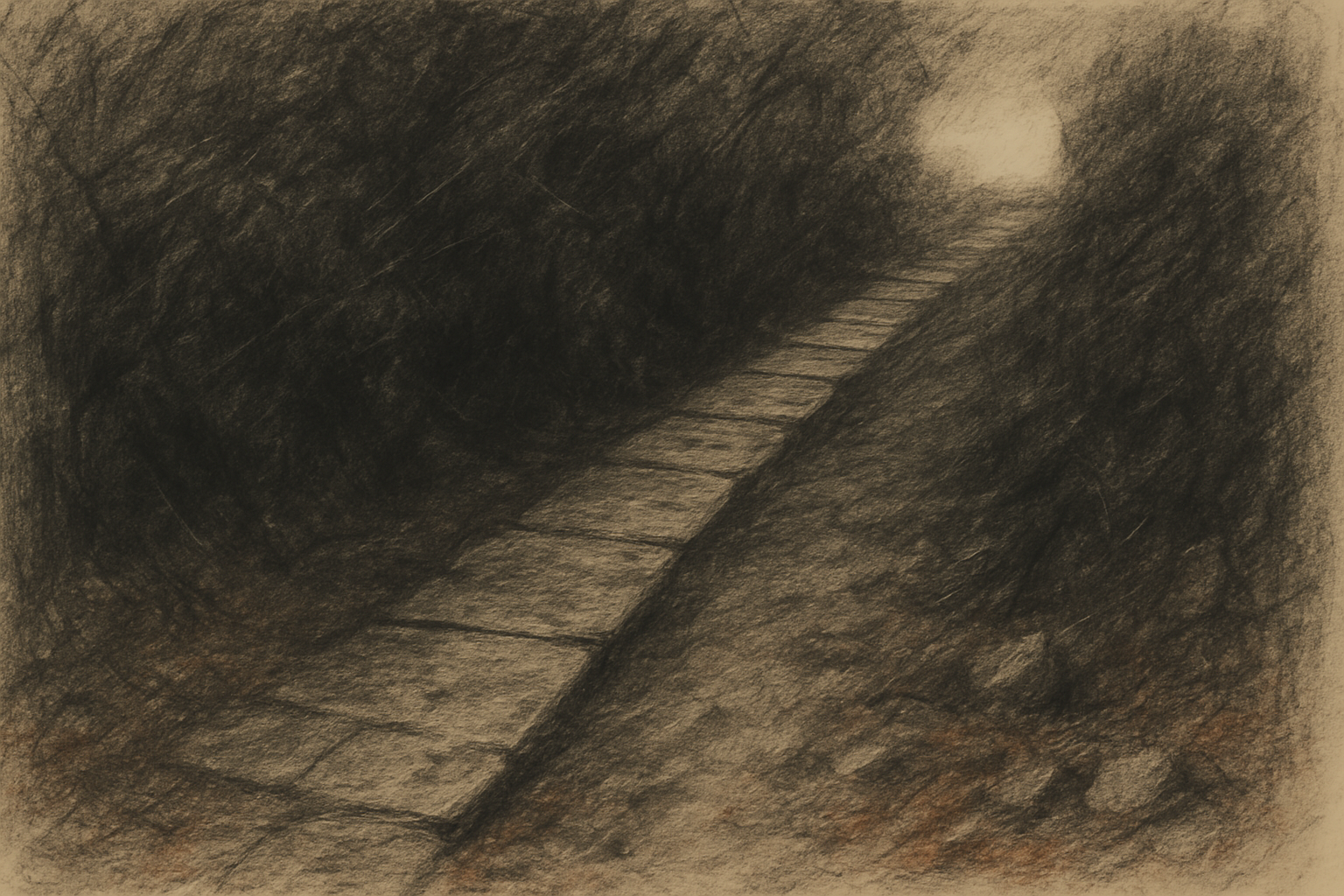
Living in the Outcome of a Previous Self
Viviendo en el Resultado de un Yo Anterior
A question about feeling stuck in circumstances shaped by past decisions, and the frustration of waiting to arrive somewhere new.
Living in the Outcome of a Previous Self
A question about feeling stuck in circumstances shaped by past decisions, and the frustration of waiting to arrive somewhere new.
I was wondering if you could say something about when you feel like you're in the wrong place, like you're living in the manifestation of a previous version of yourself, and the new one hasn't been created yet. You talk about doing what's true to you, and I feel like I'm doing that more now, but I'm still living in the outcome of previous decisions that probably weren't very good at the time. Those things take time to shift, so it requires patience. Maybe letting go of the idea that it's wrong in the first place would help, but this feeling that I'm in the wrong place is really frustrating. I feel grumpy and intolerant of the people around me, people I don't want to be around. Maybe that's okay too, I don't know. It's a weird soup. Any pearls of wisdom?
I think you gave them yourself: there's nothing wrong. And you're also expressing a lot of playfulness. Right now you're talking about being frustrated and angry, and it's quite delightful because there's a playfulness with it, there's humor. There's an aliveness here with us in this moment. Right now, you are expressing the answer.
You said two things. One is that it's not wrong. And then you brought an energy to it that is playful and humorous. That is the pearl of wisdom.
The illusion of arriving
Life doesn't really know where to get to. You're talking about a change in life and form, from previous decisions to something new, and it's going to take time to change. But that newness is never arriving. Things will shift to something closer to what you imagine, and then they'll keep changing, and then they'll keep changing again. What you know comes from change and goes toward change.
Yes, it's like I'm waiting to arrive somewhere, like a destination I'm not at that I need to be at.
That's the frustration, that sense of being in between.
But what you're saying is I'm never going to feel like I've arrived anyway.
You can, but only when you realize you're already there. You always have been, and always will be. That is what's here now. But at the level of the experience of life, the invitation is to truly see that there is nowhere to arrive to.
Even until that becomes obvious, the journey can be a little more pleasant if you bring the same energy you just brought now, which is humorous and playful. In the middle of the frustration and the anger, you can also have a laugh, because you tapped into it yourself right here as you shared. Something about this moment enabled you to bring that playfulness, and it's something you did on your own. Give yourself permission to have humor and playfulness about it. If you're around people you have frustrations with, you can find the comedy in it, in your own experience.
Yeah. I saw recently that any sense of restriction or compliance is made up. Something shifted around that. I think fear of consequences has stopped me from doing things. When that loosens, it's like, "Oh, right."
Yes. Most of the consequences we fear don't happen. And the ones we think would be horrible if they did happen, we get through the minutes. We're okay.
The only time I get really frustrated is when I feel stuck, when something doesn't feel funny anymore, when it feels like never-ending misery.
Tasting the experience of "never-ending"
This is a really important point. The experience of "never-ending" is not that something is actually never-ending; it feels like it's never-ending. "Never-ending misery" is an experience, and it involves thought as part of it. Sensations, thoughts.
You can go into that experience, because there's a very thin line between two things. One is the experience of "this is never-ending," where there's a felt reality to never-endingness combined with a projection in time that this is going to repeat or continue as it is for a long time. The other is to see it as an experience that is, in a sense, out of time. It's a flavor of experience that feels like it's never-ending, and that flavor itself comes and goes.
When whatever is getting activated brings up this contraction into never-ending time, never-ending discomfort, you can go more into it with a more subtle attention and really taste it. When I say "taste," I mean: what is this made of? Not as an intellectual exercise, but really savoring it. You see, "Oh, there's this sense of contraction, this sensation in the body, this narrative and belief that this is going to be like this for a long time," and that belief is made of thought.
As you taste it more directly, you can start to see that in a sense it's empty. It doesn't have any true nature or power over you. It's just a thing that's being created. And then you can actually see that you're creating it. There's a narrative you're choosing that produces the whole thing. But only through not fighting it and by tasting it can you see it all the way to its root.
That makes it feel richer. Something that superficially feels quite flat and stagnant is actually richer than that.
Yes. You can go deeper and deeper into that sense of richness, into that aliveness. The qualities that make it problematic start to become part of the richness, and then it all does change. In fact, it's impossible for something to be permanent. The experience of "this is going to be like this forever" is an experience that tastes like it's going to be forever, but it comes and goes. It's impossible to sustain that experience over time, even if you try. In fact, trying to sustain something over time is the struggle. Identification is these mechanisms that attempt to create something that sustains over time, and nothing does.
The paradox of change and stillness
It's interesting what might change. My parents used to live in the same house, and nothing really changed. They didn't like change. It's like wanting things to stay the same but also wanting to be free of that need for things not to change. And as you say, it's always changing anyway. But also, everything is still within that change, the paradox of it.
The only thing that doesn't change is what I often call beingness, what others call "I am-ness." It's all the same. That doesn't change. But what is experienced is always in motion, always changing, no matter what. The more you try to preserve something in time, the more it will become a struggle to keep something that inevitably will change. I'm not talking about practical things in life, like wanting to own an apartment for the rest of your life. I'm talking about experience. Even if you look at one object and the object is there, you look at it and the experience of it is going to be constantly in motion.
The whole root of this struggle is the issue of change and no change. Self-inquiry is to see that what we think we are is an attempt at keeping an image of ourselves constantly unchanged. The more we see that, the more we see that we are not that. What we think we are is constantly changing, so it's not us. That's not where we are.