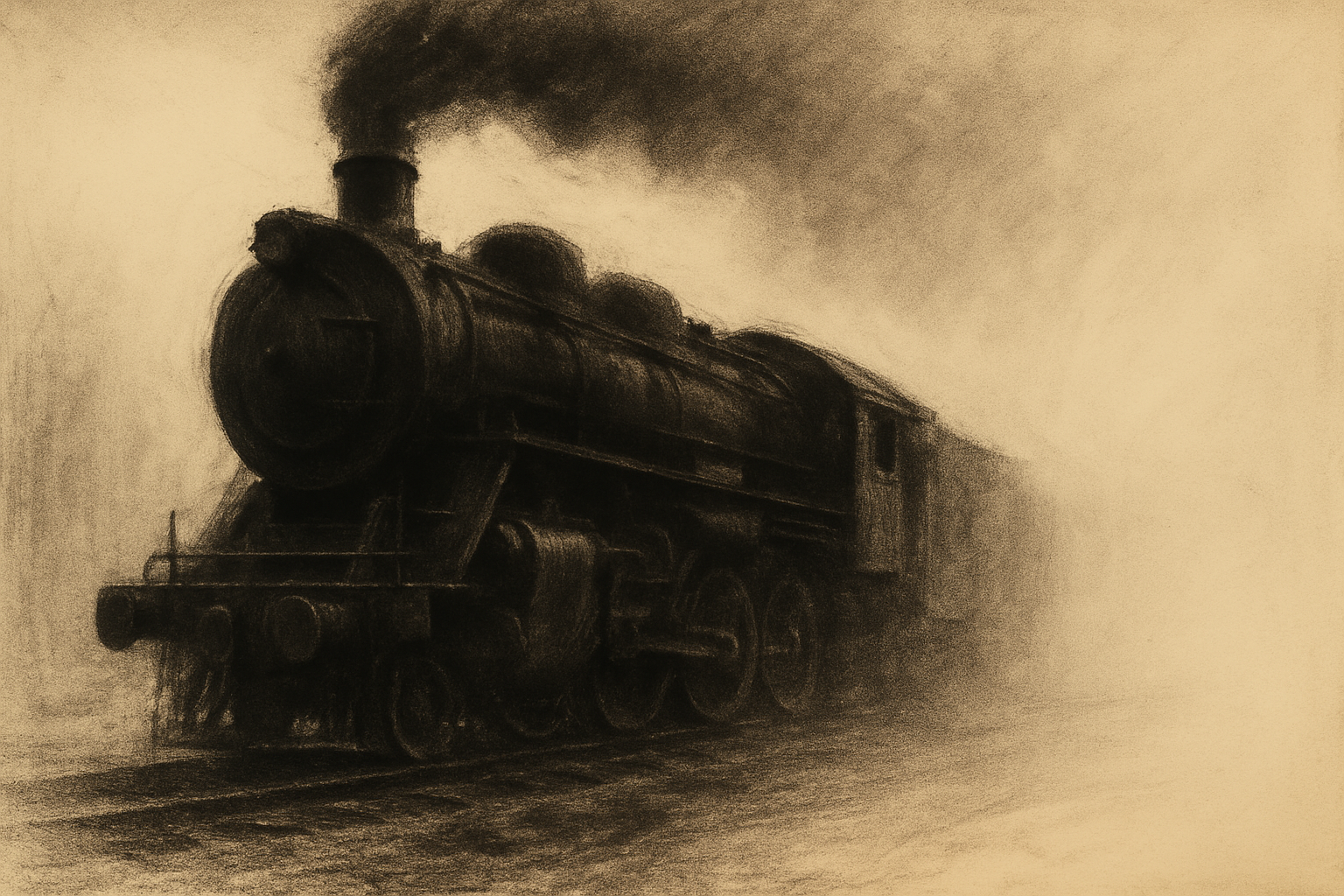
The Locomotive That Stops When It Stops
La locomotora que se detiene cuando se detiene
A student reflects on the experience of self-identification as an unstoppable force, and the teacher discusses the value of fully embracing the human experience, including suffering and contraction, as an expression of love rather than something to overcome.
The Locomotive That Stops When It Stops
A student reflects on the experience of self-identification as an unstoppable force, and the teacher discusses the value of fully embracing the human experience, including suffering and contraction, as an expression of love rather than something to overcome.
How tight things could get? How compressed?
Yes. I use compression as a way to describe the felt sense of identification. I really wanted to know it. I still feel I would do it again.
In which circumstance? Or do you mean if you had the life to live over, knowing what you know, you'd still go through that whole process?
I would actually probably dive deeper into it, knowing that it was playful, knowing how deeply I know it now. I would have more bravado to go further into it. Fully live everything: the suffering, the contraction, the identification, the illusion. Everything that seemed like the bad thing. Go right into it. Play with the sense that you're actually choosing this.
When you don't want it anymore, truly, you cannot not choose it. It's not masochism.
It's not original sin. I mean, it is. That is the original, in a way.
That is probably what they're originally referring to, but judged.
The value of forgetting
As a paradigm: a god wants to know what it is like to be human, to be in complete, absolute illusion. For that, you need to forget your godhood. If you can't forget, you can't know. How can you live the terror of being perishable flesh, and the thrill of that, such a vulnerable little bit of biological compound on a planet in the middle of space, knowing you're going to perish at any moment, at most a few decades? How could you know that experience if you don't forget what you are? So it is absolute love of being you, being human. I respect that.
So much of what you say, it's like drinking from the purest water. It's so cleansing. You're speaking, and I'm here on this call in this group, and it's like you're speaking directly to me. It's so personal.
I feel so strongly that you want us to realize the truth at least as much as every one of us does. It's so powerful. And then I think, well, how did I end up in this situation? I didn't make it happen. What's going on here? It's such a mystery. Part of me wants to say, well, it's because there's no separation, it's one mind. And then I think, I've heard that, but I don't really know it. It's such a mystery, how these things happen, how this manifests.
Missing the mark
I also want to mention the word "original sin." In Hebrew, the word for sin is chet, and the verb "to sin" is lahto. The original meaning of lahto is simply "to miss the mark." That's it. What seems to have happened over time is that people projected judgment onto it: "You missed the mark." But actually, the original meaning had nothing to do with sin as we think of it. It just fits into these conversations.
I also want to say, it's so great to hear the psychological side, because that's the world I live in. And I love the contributions of people who talk about the analytical or intellectual side, whatever it is, being precise about the truth. It rounds it all out for me, because I don't live there. I'm much more at home with the psychological. I realize it's all part of the whole. It seems like in these groups the psychological can get dismissed, as if I'm making something real that isn't. But what I experience is what I experience.
Watching the locomotive
I could so relate to what was shared earlier, that feeling of "I'll never make it, some people were born to make it, not me." It's so natural, so universal. It's the game we play of judging ourselves, defining ourselves.
What I want to say is this: as more time passes, the more I notice that this "I" that I experience is like a locomotive. It has a life of its own. I can't stop it. I'm not the driver. I'm not the one at the wheel or hitting the pedal. It's like a pendulum that will stop when it stops.
What I want to do more and more, and what I love doing more and more, is just watching. That is so cool, because the more I watch, the less I identify with it. It's an amazing process.
And what you said about suffering: yes, get into it, totally get into it. To me, it's the epitome of empathy. Why not experience everything that every other being experiences? I can't do it from a distance. I have to embrace it. I have so much going on in my mind, I don't know what to say first or last. But it's so rich, and I can't believe I'm here.
Thanks for sharing.