The Illusion of the One Who Knows
La ilusión del que sabe
A student asks about the common pointer that "there is no one," struggling to reconcile it with the felt sense of being someone who experiences. The teacher explores how the sense of a located, bounded self is a thought construct overlaid onto awareness.
The Illusion of the One Who Knows
A student asks about the common pointer that "there is no one," struggling to reconcile it with the felt sense of being someone who experiences. The teacher explores how the sense of a located, bounded self is a thought construct overlaid onto awareness.
I'm getting pretty clear about the recognition that I'm not my thoughts. I'm not judging myself for the thoughts that come up, and I'm seeing them clearly as a program. But this pointing that I keep hearing, that there is no one, I don't get it. I've been reflecting on it recently. It was always something I'd push aside, thinking I'd figure it out later and just focus on disidentifying from thoughts. But recently I've been sitting with it, asking: what does that mean, there is no one? Of course there is someone, because I notice that I'm having an experience. And then I go deeper into that, and I feel like there's something in that pointing that's calling me in. Do you have any pointers around this?
It has to do with a belief, and not just a one-line thought. It creates a perspective, a mental construct. You could reflect on it as someone, because "no one" is addressing the someone. If there wasn't a sense that there is a someone, the pointing of "there's no one" wouldn't make sense. It would actually be unnecessary.
So then, what is this someone? It has to do with what you said: you're experiencing. Right now you're hearing sounds, hearing words, seeing, having sensations and perceptions. But that which knows all this is being known through a kind of perspective, a filter that is interpreting that which knows. Does that make sense so far?
Yeah, I can sense the filter.
The image overlaid on sensation
That which knows right now, and by "knows" I mean you're aware: you're aware of sensations, sounds. But there is an assumption that there is something, an entity, that is separate from the sound, separate from the sensation. If you pay attention to, for example, a sensation in your hand, there could be an interpretation that there's something aware of the sensation at a distance from the hand. Usually that will have a location. It will be in the body somewhere, around the chest or in the head behind the eyes. The sensation of the hand, as you experience it, will come with a perspective: there's a location that is knowing the experience of the hand, and the hand is separate from the knower of the hand.
You could find this in your experience now. It might be a little blurry, not that clear, but it's actually a thought construct. The sensation of the hand is appearing, and this is where you could say it is known by no one. To be more precise: it is not known by that which you assume to be that location that knows it.
There's a thought construct placed in a location. Then there's a creation of a sense of distance. And then that becomes the "I" that knows, the someone who knows the hand, the sound, the computer. But that which occupies that position, that which seems to be doing the knowing: that is a thought, and it's not you.
When that is seen to be a thought, several things can happen. One of them is the recognition that there is no one. But it can be expressed in many ways, and that's just one way. It might not be the right way for you. It's addressing the sense that "I am that someone."
If you keep looking at that which is the knower of the sensation of the hand, you will notice that it's an image. It can also be attached to a sensation in the body. For example, some part of the body has a sensation that becomes the center of this "I." Now there are two sensations: one is the hand I'm paying attention to, and the other is a sensation where I'm anchoring the sense of "I am here." Because I have called this sensation "I" and that sensation "not I," I can create a sense of distance between them, a sense of a seer and a seen, a feeler and a felt.
But actually, if we look at this, it's just another sensation, just another thought. It's usually a combination of thoughts, which are images, and sensations.
Exploring the hand directly
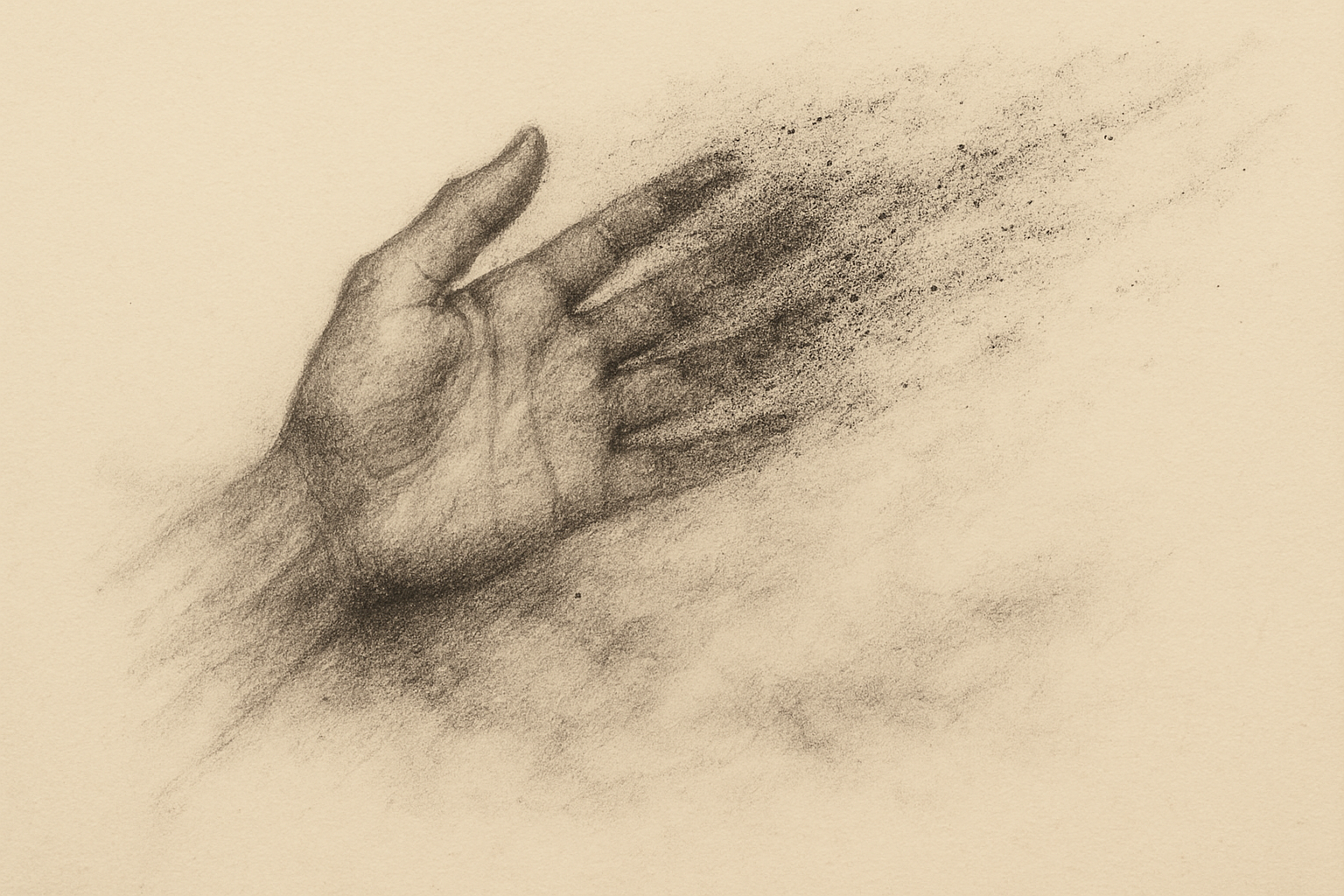
Let's explore this further. Go back to the hand. Pick a hand, say the right hand. If you're not looking at it, what is the experience of your hand? How could you describe it?
It feels kind of cold and tingly, more so at the fingertips. There's more sensation on the palm than the back of the hand.
What's the shape?
I know the fingers are there, and if I move them I can feel them. But it does feel like a blob of tingles.
Now, you know that it's a hand, so you know the shape. If you include the thought of the hand, then there are two things: the blob of sensation (tingly, cold) and the image of it. That image is, in a sense, overlaid onto those sensations. Do you recognize that?
Yeah, I can't help but imagine the hand in my head when you ask me that.
You say "in your head," but it's not really in your head, right? The image is appearing and the sensation is appearing. What happens is we overlay the image onto the sensation. We don't have the image of the hand over here and the sensation of the hand over there. It's like a glove fitting the hand.
The image and the sensation. Interesting. I've never thought about it like that.
That's something the brain does. It's called proprioception, a biological mechanism to align our image of the body with the actual sensation of the body. What I'm distinguishing now is that the image and the sensation, as you are aware of them, are not the same thing. Not many people are aware of that. The fact that you could describe the hand directly as a blob of sensation is actually unusual. That shows there is quite a bit of awareness, and you can refine and isolate the image, the thought, from the sensation.
From the image of the hand to the image of "I"
The image of the hand is a metaphor for the image of "I," that someone who is knowing all of this. If you now, instead of the hand (which is easier to isolate), look at that which is watching, that which is seeing, that which is knowing, you're going to encounter the same structure, but it's going to be trickier.
There will be the sense of "yes, there is something here." And then there will be that someone watching, that sense of a subject. But that sense of a subject is like the image of the hand: it is overlaying something, which is the knowing. The difference is that this knowing, unlike the sensation of the hand, doesn't have a location. The seeing doesn't have a location or a direction. What has a location is the image.
You can pay attention to that and start recognizing the image, the image "I": where it is, what it looks like. At times it could be related to a sensation in the body, in the chest, the breathing, something behind the eyes, a certain contraction that gets referred to as "I." There's an anchoring. But it's not like the hand, where there is a blob of sensation and then the image of a hand. Here, there is the anchoring of a whole idea of what I am onto a location in the body.
The question of choice
What about when I'm journaling, writing my thoughts and experiences on paper? I hear what you're saying about gross sensation, and I'll definitely practice that. But with something like writing, it still feels like there's someone in here choosing what words to use, what concepts to expand on, when to stop writing.
That's fine. There are subtle misinterpretations, which are fine unless you want to keep inquiring further. Since you're here, I'll suggest this: when you say "there is something choosing in here," the "in here" is the problem. If you look at what that means, at what the reality of it is, you won't find it. In where? Because everything you are knowing, you would have to refer to as "in here." There is nothing that's not "in here." The whole notion of "in here" makes no sense. If everything is "in here," what is this "here" that it's in?
Sure, choosing happens. It's totally fine to say "I am choosing." The problem is the misunderstanding about what the "I" is. It's making the "I" into something I know. The "in here" starts to create something bounded. This part is "in here," that is "out there," and now I start defining the boundaries of something that is the "I," where some things are appearing inside it and some are not. For example, if I touch a table, that which I label as "table" is "out there." The sound appearing through my voice is "out there." Inner dialogue is "in here." All of this, "out there" and "in here," is fiction.
Find the boundary of the "in here" and the "out there." Where does it end and begin? It's all "in here."
The more you start to look at this, you may come to something you might express as "there is no one." Others have expressed it that way. But it's also just a phrase that might be confusing. It's not an absolute truth; it's just words. What matters is that you start to recognize and clarify what it is that you are. A lot of that is seeing what you thought you were that you're not. You're not something that has an edge where things are outside and some are inside. You could say that about the body, but if you're convinced you are the body, we can work on that specifically.
As for choice: yes, you can say "I am choosing," but look at how the choosing happens. You don't have to throw out the choosing. Choice does happen, and you can say "I choose." The issue is: what's the nature of "I"?
Right. The choosing is more or less happening because of programs and intentions running from the past, and I'm just observing that.
Unconditioned choice
Not necessarily. That's a paradigm about choosing, conditioned choosing. What if a choice comes out of nowhere, unrelated to the past, unconditioned? Why is that not possible? Where does it come from?
Yes, some choice comes from conditioned mechanisms. But what is the nature of that which chooses? Assume a choice happens that is unconditioned, coming out of nowhere, without any relationship to any past or conditioning. What is the nature of that which chose? Is it a body? Is it a mind? Is it a thought process? Or does it start to look like something very mysterious?
The choice is known. Does it have a location where it happened, an origin, an entity where it came from? Not really. We then attach the entity we have constructed to the choosing and say, "I am this, and this is what I am choosing." You can then say, "That which I am is conditioned, so I can't truly choose, and therefore everything is deterministic. I have no free will," and so on. More belief systems.
Consider this example. If you had to choose between a glass of champagne or a glass of urine to drink, what would you choose? Most people would choose the champagne. Yes, you could say it's because of the body, the mind, the conditioning: one tastes better, one doesn't. But there are other choices that are less extreme, more neutral, and still there is something that appears as a preference. The experience is that a choice happens, and yet, if you look at it, it is appearing; it's inevitable.
We could be confused around a choice for a long time, pondering. But the moment the choice actually happens, it's really mysterious. The whole point I'm making is that the moment you start claiming to know, in the sense of something you could write down in a book, what it is that chooses and how the mechanism of choice works, that's when the problem starts. By "problem," I mean that which leads to suffering, because it's the construction of an entity whose nature is not what we then attribute it to be.
The unicorn and the someone
The entity we could call ego: we attribute to it a reality that it doesn't have. It has a function, a use, a value, but it's not the source of "I." The source of that which we call "I" isn't ego. I don't want you to then think ego doesn't exist, that it's not real, and therefore it has to be gotten rid of. Something appears. What's the reality of it?
For example: a unicorn. Would you say a unicorn is real?
Not technically.
Do we all know what we're referring to, if we understand enough English? We all know what a unicorn is. There is an intersubjective agreement about what it is. We could all draw one to some degree. So there's a certain reality to a unicorn. It's real as an imaginary animal. When you said "technically," you meant as a biological being roaming the planet. But that's just one condition. Is it real as a thought construct? Yes.
Now, what is its reality? It's real as thought. And it's intersubjective thought: not just my own private creation, but something shared through humanity, part of mythology and language. There's a lot of energy behind the unicorn, and it becomes a thing.
Now imagine we are on a planet where the most important thing is unicorns, to the point that it's all we think we are. We are taught from a very young age that that's what we are, and there's no doubt because we're all agreeing to it. Now replace "unicorn" with "someone," a thing that is born, that is the body, and that will die. A unicorn is very specific: it's a horse with a horn. That which we truly are isn't a body that is born and dies. Everything appears like that's what it is. But it appears that way from the perspective of having been raised to believe we're unicorns, in a world where everyone agrees we are.
Then at one point you can see: I'm not a unicorn. "I'm not someone. There is no one here." And then people will hang you, crucify you. Maybe a few thousand years later, some people start to agree.
But what happens when you see that? There's a big transformation, but it's a really subtle change. It's not "I'm not a unicorn, I'm a zebra." It's "I'm not someone, I'm not a person. I am." And I cannot say anything more than that. Anything to qualify that which I am is too much.
There is a certainty in "I am." And there is a certainty that "I am" cannot be qualified. But there is no certainty as to the nature of what I am. It's mystery. The certainty is that the nature of this "I am" cannot be qualified in any shape or form, and it is not bound in time or space. That can be known with certainty. Not because you know that you are timeless or eternal, but because you know that you are prior to time and space.
All of this, people teaching it, speaking it in different ways, different languages, can be very confusing. The point of speaking it is to see if it can point so that someone recognizes it on their own, rather than adopting a belief system around it, which is often very problematic. Sometimes a belief system is helpful as a way to move out of something. What matters is that you can recognize it directly.
I definitely practice being aware of the sense of "I," the sense of existing, and that feels expansive. But I guess the takeaway I'm getting from this conversation is to perhaps start to recognize, whether in my visual field or sensorial field, the oneness.
You don't need to merge
You don't have to do any merging. There are certain aspects of the illusion of knowing what we are. The core illusion is "I am a thing." A thing that is limited, that has a boundary, with things outside and things inside. So look for the boundary. There's a sense of location. Any practice aimed at merging is going to be going the wrong way. By looking at the suggestion that the sense of a boundary and a location is an illusion, by looking at the illusion and seeing through it, the reality will be recognized.
That reality is that there is no separation. But there is no separation right now. You are in unity right now. It's like saying that everything is Buddha nature: we are all Buddhas; some people just don't realize it. What exists is the belief that you are not in unity.
I'm really trying to recognize it. I guess the visual is not like coming back to something but more like expanding outwards.
Expansion and contraction
The experience of expansion will happen. There are a few things about that. Because there is a contraction, there is an experience of expansion when we have moments of disidentification. But what can be seen is that where you are is always expanded, and the contraction is an illusion.
If we believe we are a hand, and the hand is clenching, we feel contracted and uncomfortable. When we manage to open it, we feel good, expansive. Then we clench again and feel contracted. There's this movement: contraction, expansion, contraction, expansion. We need this movement in order to believe we are a hand, because if the hand remains still, after a while there will be no sensation, and then what we thought we were will disappear. But it's actually that what we thought we were will be seen as "I'm not that."
That which expands and contracts isn't what you are. What you truly are cannot expand.
But with my perception, instead of the location being somewhere "in here," could I start to see the visual field, for instance, as myself, as another expression of what I am?
There are many practices useful for undoing the habit of interpreting what we are as limited. For example, when you go for a walk, you can investigate: am I walking towards something, or is something moving towards me? Am I still and the world is moving? You can play with that. Depending on the person and their preference, whether one has more of a rational, scientific mind or not, different practices will be more useful.
There are certain core beliefs that we're very attached to, even if they're causing suffering. These core beliefs are what we hold on to no matter what, even when the consequence is suffering. Those are important to look at. It can happen that this comes up in relationships, or in consequences in the way we function, the work we do, in how we create disharmony, chaos, and struggle in our lives. All of that is also a way to look at and approach things.
Walking towards something and experiencing it as "outside of me, out there": how are you perceiving it if it's outside of you? The only way that is true is if you define yourself to be this body, if you define that what you are ends completely at the surface of the skin.
You can start to look at what appears first. Is the body the source of awareness, or is the body appearing within awareness? These can become philosophical questions, but they can also be very powerful. You can have a direct experience where the body is gone, the world is gone, perception, sensation, sound, sight, all of it is gone, and you are still here.
I'm saying this because it can be encouraging for exploration. But what matters is for you to know with inner integrity, with honesty: "I am fully convinced I am this body," for example. Or: "I really don't know. If this body were gone, would I remain?" We can ask those questions. There are different techniques: the Buddhist approach, the Advaita approach, and within each there are many branches.
Follow that which gives you the most curiosity, what feels most playfully attractive and not like an effort. It has to be that you're really curious to know. That way you can set aside approaches that don't resonate. It could be a path of fully feeling the experience of beauty and love, where you feel as if you merge with everything. Or it could be a more rational, philosophical approach. It could be that while you're journaling, you start to hold an open question, a genuine looking to recognize what's actually happening. Where is the choosing coming from? What is the writing? Where is it coming from? Where is the sense of inside and outside? Where are the edges?
If it's this kind of playful love of recognizing what you are, it will go far.
Thank you. Thank you so much. I appreciate it.