The Hidden Side of Irritation
El lado oculto de la irritación
A student describes a persistent, low-level restlessness and irritability, along with a vivid dream echoing the theme that "you are the cause." The teacher explores how thoughts and sensations form a loop, and how seeing the whole complex clearly is the key to recognizing what only appears to be real.
The Hidden Side of Irritation
A student describes a persistent, low-level restlessness and irritability, along with a vivid dream echoing the theme that "you are the cause." The teacher explores how thoughts and sensations form a loop, and how seeing the whole complex clearly is the key to recognizing what only appears to be real.
What you were saying to the previous student reminded me of the "something's wrong" theme. Recently I noticed that most of the time there is either irritability or restlessness. It's not very intense, but it's there almost all the time. And something you said about the problem being you, being the cause. I had a dream last night: at some point I was outside, somewhat naked, looking for my clothes. There were other people, and there was a dark hole in the ground where suddenly hundreds of thousands of black wasps started coming out. At some point I escaped by flying. And you were in the dream, and you said something like, "It's you. You are the cause." It was exactly what you were saying just now. Then at another point I was in a bar listening to some people talk, and I realized you were right. I called you and wanted to say, "How the hell did you know?" To me it had seemed like something totally external that couldn't possibly have me as the cause. The dream continues, but I found it interesting because it echoes the same theme. I'm not sure what the question is, but maybe the dream itself says something too.
To hear how you describe it, your experience has more to do with sensation. The previous student described it in a more narrative way. In your case, it is a sensation: irritation, restlessness, something in the body.
Exploring the loop of sensation and thought
There is a similar approach, and it has to do with looking at what the nature of that sensation is. You can look at what the thoughts might be that are happening around the irritation, around the restlessness. There is a side to it that is more thought-based.
And I will say something to the previous student as well, because it is so related and could be useful. For her, it would be the reverse: look at what the sensations are. It was clear to her what the thought process was, and maybe the sensations are clear too, but it is interesting that we tend to recognize one side more than the other.
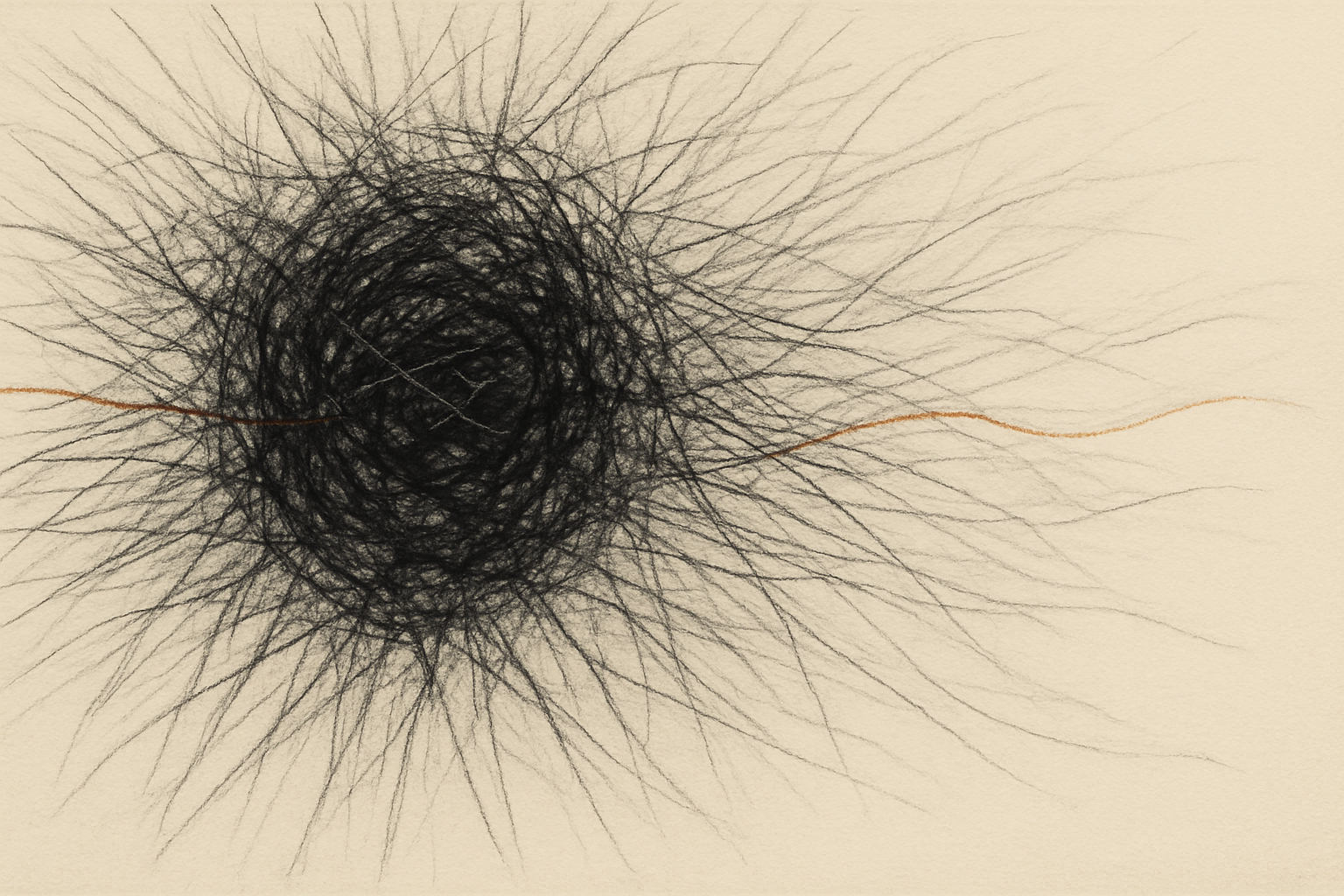
It is really a kind of vicious complex, a loop. Sensations and thoughts come together. But then we react more to one than the other, we pay attention more to one than the other, and the other one becomes hidden. So for you, the work is to look at what the thoughts, narratives, and beliefs are around the story of "you." That could unlock the sensations appearing in the emotional space. And vice versa when it is reversed. This can also shift depending on the moment. Sometimes I might get more involved with the thoughts and need to look at the sensations instead.
When the whole complex becomes transparent
Only when that whole sensation, thought, and emotion complex is transparent and clear can we start to look at what is really happening. What occurs is that something is assumed to be real, and it becomes the anchor of the issue. If the sensation is taken to be a real, solid thing, it becomes the anchor to the whole narrative. Or if something we believe in, an archetype, is taken to be a real thing, then it becomes the anchor to the emotional reaction. But by seeing the whole thing, we can start to look at what only appears to be real when it is not.
And I will say it this way: anything that appears to be real is not real.