Wonder and the Concrete Are Not Two Places
El asombro y lo concreto no son dos lugares
A student returning from retreat describes oscillating between states of wonder and ordinary life, and the teacher challenges the assumption that these are separate experiences requiring integration.
Wonder and the Concrete Are Not Two Places
A student returning from retreat describes oscillating between states of wonder and ordinary life, and the teacher challenges the assumption that these are separate experiences requiring integration.
It's like I got so much from the retreat, and now I get another chance to internalize it and give it more space for more life. I'm in a state of wonder, and I think that's a pattern in my life: wow, wow, wow, and then it's "come down to earth, come down to earth." It's a back and forth. There's something to hold on to, some real clear directives, and then there's nothing. And then it's back and forth again.
I was thinking about two friends in particular who will want to hear about the retreat. I've talked with both of them a lot in the past. But also, why do they want to hear it? Because they already know.
So it's the wonder and then the concrete. I guess I live between both worlds. Frankly, the first two days after I came back from the retreat, I thought I had Alzheimer's. I really did. I'm still not convinced I don't, but I was so discombobulated. I was worried. I'm not now, but still.
The expression "conscious suffering"
One thing you said today was about conscious suffering, and that gets to the heart of where I snag again and again. It's not about being brave or doing anything. It's just about being conscious. Maybe it's very deep in me, this sense of the light going out, this experience of nothing, no one. And then all of a sudden the light goes on. There's something about that expression that felt particularly valuable to hear at this moment in time. I don't know if you have anything more to say about it.
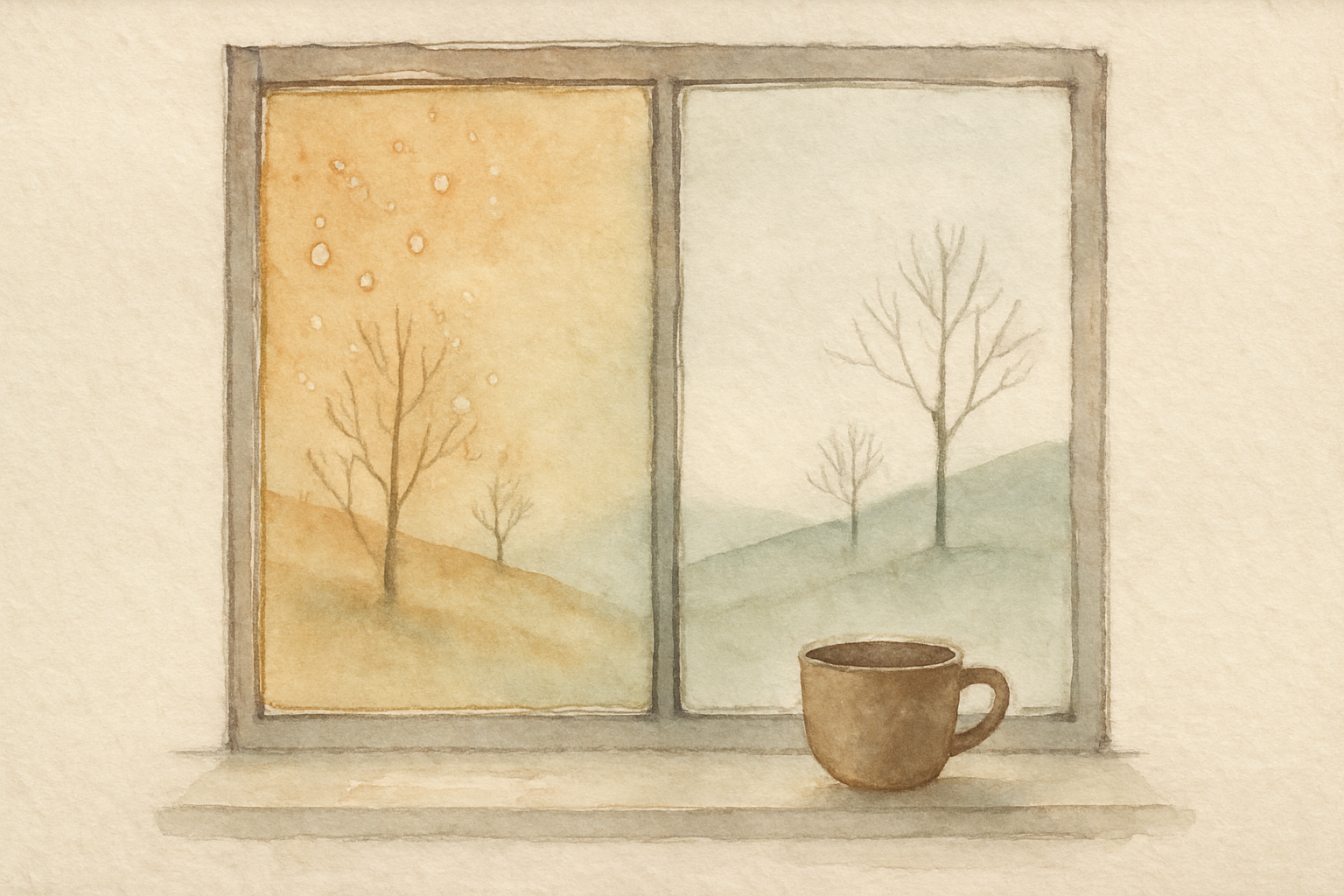
I have something I want to say about what you said a couple of minutes ago. You talked a lot about how you move between the wonder and the earth, the concrete and the wonder. I'd invite you to see how those aren't actually two states, or two places, or whatever you're referring to at the moment.
I get it. At a certain level, it's useful to see it that way for a while. But if I let you continue using that description, it could be a bit of a disservice, because I think it's no longer really valid.
The illusion of separation
What I mean is this: there is an illusion that in the world, in the concrete, in anything, there could be an absence of wonder, an absence of magic, an absence of whatever you might call sacred or spiritual.
I guess maybe I'm talking more about my experience. Maybe I have a hard time integrating the two. I think that's what happens. I sit with the practice, and then, where am I? That's what happens, I think.
I understand that. It's a very common thing, but it's a stage. I think you're at the place where that's no longer necessary. The sense that you can't integrate, or that it's hard to integrate, is actually what's reinforcing the attachment to those being separate.
That's the way you need to hear it.
"I can't" creates the difficulty
Yes, exactly. It comes back to that. The fundamental premise of "I can't" creates the sense that it's such a hard thing to do, that these two are so hard to integrate. But integration at that level is not a thing you can do.
Integration has to do with how you function. What I'm talking about is realization. There is no doing in realization. It's not a process. It's not in time. The realization is to see that the wonder, the sacred, the magical is in anything, is in what is concrete, what appears as concrete, what appears as worldly.
Realization first, then integration
The more that is realized (not integrated, realized), the more it can then be integrated, which means you will function more from that reality. In the sense of that contraction I was talking about earlier, it's the choosing and the attachment to "these must be two, and I will struggle between them." The interpretation of the absence of magic, the experience of tasting it and losing it, moving back and forth: all of that is a kind of choice. It's a settling into "that's where I'm at, what I'm dealing with, what I'm stuck with, what I'm playing with, integrating." Something does drop when that whole framework is dropped.
You mean dropping the idea that they're two?
Yes.