The Sound of a Bird Is Not the Bird
El sonido de un pájaro no es el pájaro
A student expresses deep frustration with the distinction between direct experience and interpretation, feeling that years of hearing about it have left them no closer to understanding. The teacher offers a simple, concrete reframing.
The Sound of a Bird Is Not the Bird
A student expresses deep frustration with the distinction between direct experience and interpretation, feeling that years of hearing about it have left them no closer to understanding. The teacher offers a simple, concrete reframing.
I was watching a video where you were talking with someone about direct experience versus interpretation. I've heard people talk about it for ten years, on and on: "This is direct experience, that is interpretation." And I just don't get it. Frankly, it's not the end of the world if I don't get it. But I do have curiosity about it, and I'll admit that, even though curiosity irritates me. It goes against my whole way of doing things.
Way back when I started on this path, I remember asking questions and finding it helpful. But now these discussions get on my nerves. Just get in there and do it. That's my way. And yet here I am, wanting to ask a question.
You're frustrated.
Very perceptive of you, doctor. A master teacher.
It's interesting that you're resisting the curiosity.
Don't accuse me of resistance. All right, maybe. I'll try to be open. I feel a resistance to it, I think. I'm trying to give you a hard time. I want to make you as frustrated as I am.
Naming things before we even notice
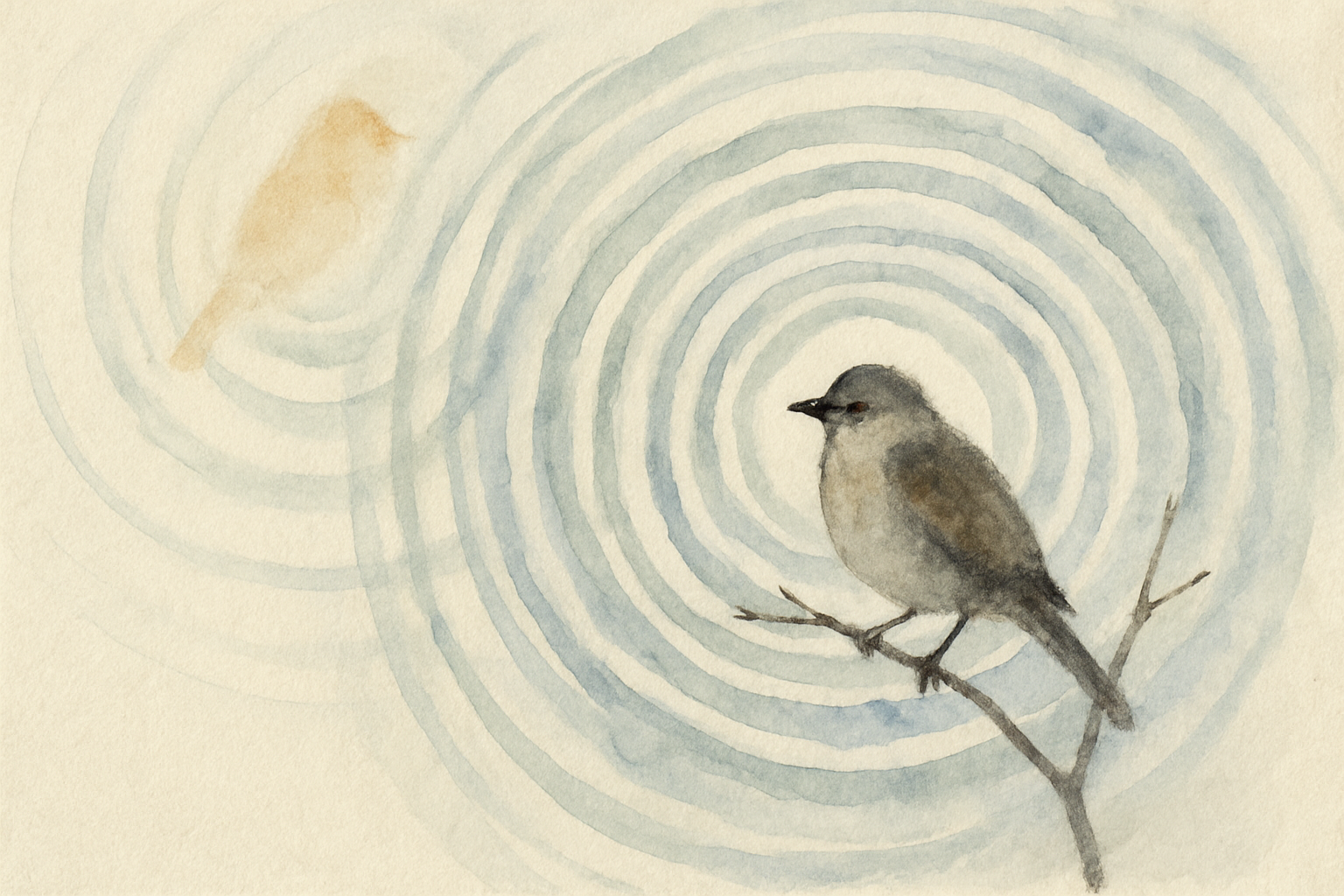
So the first question is really about the difference between direct experience and interpretation. It's very simple, but it's very elusive, because after so many decades of instantly naming things, you don't notice there's a gap. There is an experience, and then there is a thought. If you hear a bird sing, the sound happens, and instantly it's wrapped in the thought "bird singing." You recognize it as a bird singing. Or a car drives by, and the sound gets recognized as a vehicle, some form of engine. The direct experience is the sound itself.
I know the theory. I just have no idea how to detect the difference.
That's for you to explore. If you have curiosity for it, you could sit with the experience of sound, or even with sight. But sound is a better place to start, because with sight it's very hard to separate the interpretation from the perception. Both are abstract, but sound is easier to work with.
What you'll find is that instantly there's an interpretation. There's the sound of a car, the sound of a bird, the sound of whatever is happening, and right alongside it, the knowing that it's a bird, it's a car. All you need to recognize is that the "bird-like" nature of the sound of a bird singing is a thought.
The bird-like nature? What do you mean, "bird-like about a bird singing"?
It's just the sound. It's not the bird. Anything that's bird-like about it is a thought.
I see what you're saying. Like attributing something to the sound. I think I actually heard the penny drop.
Noticing, not stopping
Now, you could take that and struggle with it, trying not to interpret the bird sound as a bird. But that's not the point. The point is to notice the difference.
I notice that this is so deeply ingrained across the board that I don't even realize I'm interpreting. Maybe it's like so many other things that have helped me: just notice that I'm interpreting, instead of trying not to interpret.
Exactly.
I think that's where I've been tripped up. It's like, "Don't interpret." But how can I stop doing what I'm already doing?
That would be a never-ending struggle. The interpretation will dissipate on its own. The more you recognize the difference, the loosening is an aftereffect. So it's just about noticing the difference. Seeing what really is.
There's a texture of perception that we call sound. I'm using the word "texture" to point to the abstract nature of it. When a bird sings, there's a texture in the perception of sound, and then there is the imagined bird. Just notice both.
I'm actually glad I asked you this question.