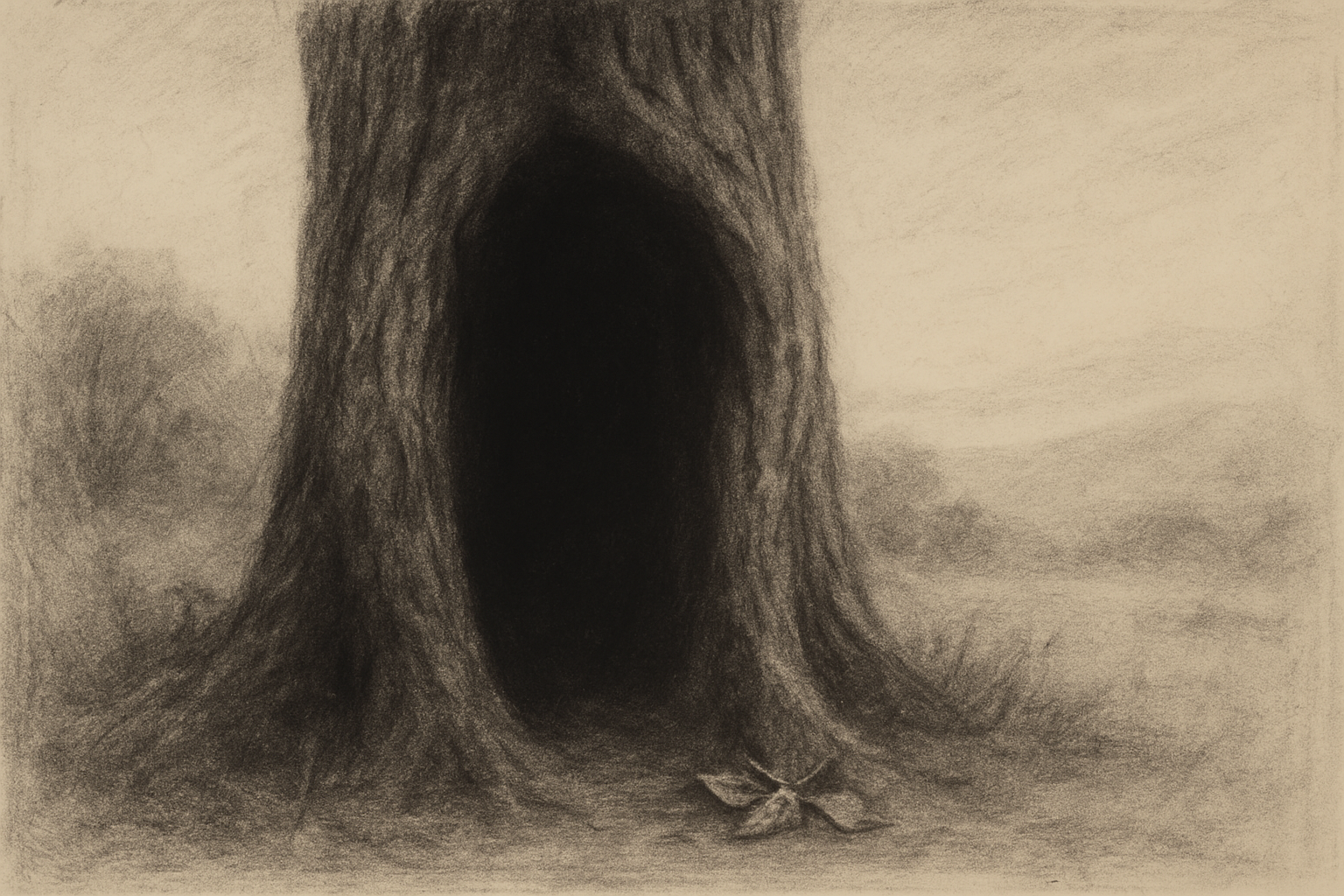
The Formless Hiding Place
El Refugio Sin Forma
A student describes a persistent sense of hollowness and being stuck, and the teacher identifies a subtle identification with a formless subjectivity that, while an advance over ordinary self-contraction, has become a safe but dry refuge from full immersion in experience.
The Formless Hiding Place
A student describes a persistent sense of hollowness and being stuck, and the teacher identifies a subtle identification with a formless subjectivity that, while an advance over ordinary self-contraction, has become a safe but dry refuge from full immersion in experience.
I'm not sure if it's a question, but I think it's only just whatever's appearing.
Questions are good, though. If you can formulate it as a question, it could be more powerful. But yes, whatever comes.
If a question appears, it just wants to appear, and it's just being grabbed by belief. If it's belief, then you think you have a question. It's a bit like a sushi conveyor belt with different dishes going around. If there's a particular dish you really like, you just grab it. And the more you like it, the more they serve that same dish.
That's a good analogy. It doesn't always work that way, though. What matters is that whatever is coming on the table, whatever is being served, whatever is appearing, the question is whether you resist what is or not. That's the distinction.
Whatever is appearing is what's real
Whatever is appearing is what's real. The words here are a little tricky and could lead to misunderstandings. It is what is real, even though we cannot know what that is. It is what is appearing. It's reality in whatever form it's taking.
So, for example, the sushi is tuna. If it's tuna and I don't like tuna, I can wait. But if it's tuna and I fundamentally resist the appearance of tuna, that is fighting with reality, saying no to something that is appearing.
The only way I can say no to that appearance (and this is going to be tricky to see) is by not knowing what I am. There needs to be an identification with a false mental self. From that not-knowing-what-I-am comes, as a consequence, a universe of knowings: "There should not be tuna right now. There should be something else. I would be okay if there wasn't tuna and there was salmon instead." That openness to what is gets lost.
This doesn't mean I can't prefer salmon over tuna. I simply wait for salmon.
Now, you've said this very often: what's appearing is appearing. That's all. Anything that's appearing is what's appearing. You don't need to focus on that or even use that language to reinforce or re-remember or re-recognize that truth. Whatever's appearing is appearing. Yes, true, signed. Now you can put that to rest and be fully immersed in the appearance of what's appearing, and dance with it, play with it, explore it.
The subtle withdrawing
There is a subtle withdrawing from what is appearing if there is a recognition that functions like a reminder: "What's appearing is appearing. There's only what is appearing." I hear in that a subtle withdrawing from the appearance.
For only a couple of days now, I feel a hollowness. Very hollow.
That's because there's this withdrawing from what's appearing. By repeating, in a sense, even if it's an actual recognition that you're focusing on, seeing again and again that what's appearing is appearing, that recognition needs to be, in a sense, forgotten or put to rest. Otherwise it becomes a mental process, and that's going to feel isolating. The hollowness at the emotional feeling level, the body-mind, is going to be contracted.
The mind is like thoughts appearing. The resistance to thought is seen better, more clearly. When there's resistance to a certain thought, the resistance is felt quicker. It's realized it's just resistance.
You could try a different way of languaging that. For example: if there is resistance, or when there is resistance, understand that that resistance can only come from the false identification. When I say "I," you don't know what I'm referring to. When I use the word "I," I can refer to many things and speak from many levels, as can you.
Using "I" strategically
It's a good experiment to speak of what's appearing impersonally, to stop saying "I" and instead say "this is appearing," referring to what's appearing here. That can be useful because "I" habitually reinforces identification. But there's another issue the other way around. It might now be useful for you, whenever there's resistance appearing, not to say "there's resistance appearing," but to say "I am resisting." Because now you can use the word "I" to refer to the false identification, the illusion.
I don't feel like I am identified with the resistance. I can actually see it's just the resistance. I don't feel like it's me. But I think I'm still identified with a belief, because I think I've realized what this is. This moment, the directness of this moment: it's only this. And I think there is a holding onto this, trying to steal this, trying to conceptualize this.
And who is trying to conceptualize?
From what I can see, it is something I cannot stop. It's just what the mind is doing.
This is what I'm getting at. This is where it could be useful to use the word "I," to make that into an object. Because you're turning it into something else, but there's a subtle separation. There's the "I" that you are still identified with, seeing the resistance as a third thing, when in fact the "I" that is identified is the resistance.
By calling it "I," you bring it close. Because you started a sentence and stopped midway. You're doing language tricks on yourself, not using the word "I" where it should apply in this case. You start saying "the identification is..." and then you skip it and try to speak about it in a different way. That's creating the confusion.
Yes. It's just that the mind likes to take a position.
It's not the mind. It has nothing to do with the mind. It's "I." It's the sense of self. Call it "I."
When there is the not-knowing of what we are, there is meditation. There, I can say "I," but that "I" refers to what Jesus calls the Alpha and the Omega. When there is no meditation, it's because "I" now knows what it is: "I" is gamma or beta (to continue the Greek alphabet analogy). When I define the "I," meditation ends and there is illusion. But I'm still calling that "I."
So to stop using the word "I" altogether can be confusing. You can use the word "I" when there is a belief that I am beta or theta or gamma. You can also use the word "I" when there is a knowing that is simply "I am." What I'm suggesting is: when you're speaking about the identification, about the resistance, call it "I," so that you can turn it into an object and see it as the false subjectivity, instead of treating it as a third thing that's happening while you detach from the actual experience.
As you were saying, it does still feel like it's appearing, and it is felt in the sense that it is seen. It can be seen.
The formless subjectivity
That is true. But what I'm signaling is that there can be a loss of intimacy because there is still a separation between what is appearing and what it's appearing to. So: what is appearing, and what is it appearing to? Answer this question in your experience. When you speak a lot about what is appearing, what is it appearing to? What knows this? Who knows this?
No one. Not hearing to anybody.
I'm talking about now. What is appearing? Your experience now is: everything's appearing. What is it appearing to?
It's just a thought, really. A thought claiming. And it's clear it's not a somebody.
But what knows this? What knows that this is appearing? It's not a thought that knows it.
No, it's known. But I don't know what knows it. It's just known. Your words are heard and understood. That's it. There's nothing else I can find apart from just hearing your words.
What you're saying is true. It shows a clear seeing. But I suggest there is still a subtle subjectivity. There might be in you naturally, as in anybody at this stage, a resistance to seeing this. It can be quite threatening. It can feel like the removing of the last place of safety, and so it could feel very scary.
But I suggest there is a very subtle subjectivity that is formless. That's why you can't find it. You can't find an object, a person, a self, or an idea. It's just a formless subjectivity. And that subjectivity is creating a place of safety that can never be found because it's not a thing. So it's guaranteed to be safe. What I'm doing is poking at it gently, hopefully.
That subjectivity is actually still an object. It's still a thought. But it's formless. It doesn't have normal object qualities, thought qualities, substance qualities, shapes and colors and narratives. It is the assumption of a formless, ultimate, vast, infinite subjectivity. And it is a thought. It is a thought form. And that is what you assume knows the appearance.
Yes.
And that is what's creating the sense of going around in circles. It's creating the hollowness you described, a sense of a lack of vitality, aliveness, and intimacy, because there's a withdrawing. That withdrawing is actually pretty normal at a certain stage in this process, but it's also a place where one could get stuck because it's so subtle.
I feel very stuck. It feels like forever.
That's why I'm suggesting your language has been helpful to get to this point in clarity, but now it's supporting the illusion. It does help if you can start, whenever you see resistance, to not externalize it as "the appearance." Assume that it is a false "I" and call it "I," because then it'll become here, rather than somewhere out there appearing.
Yes. It's still coming from a holding, still coming from a place of needing something. It's still a belief, isn't it?
It is. And the good thing is that you're in tune and in touch with your experience. You have what I call inner integrity: the willingness to know what you're experiencing. And you have outer integrity: the willingness to share it honestly in this place. The sense of hollowness, for example. You could pretend to yourself that you don't experience that, or communicate as if there were something really great in your emotional feeling tone. But you communicate hollowness. That's really healthy because it shows that something in you knows there's more, feels there's more. Something is still not seen, not free, not released.
Beyond the last layer
You sense that intuitively, and I agree. There is more. This is still prior to a full non-dual shift, where that subjectivity (which functions like an ultimate subjectivity, with everything appearing as an ultimate objectivity) is still a formless subjectivity facing objectivity appearing. Even if you see that they're connected, that they're part of the same reality, it's still a layer.
So this layer is just what's appearing?
No, it's an illusion. It's a mental interpretation. Sure, that illusion is appearing as well. But you are assuming that it is real and true, and you're not seeing reality. There's a deeper seeing possible. Your illusion is appearing, but what you're bringing here is where I'm attempting to pop that illusion.
What is appearing to you is that there's this subtle subjectivity, and everything else is an appearance. But that is an illusion. That's not really what's appearing. There is an illusion that's distorting what is appearing.
It is tricky, because in the directness, it's not experienced.
Exactly. You can only experience this illusion when you think. Not because thinking is the problem, but because you believe the thought. There is an interpretation that happens. You contemplate an experience, and then there's an interpretation of a subjectivity that is formless, that is "I," that you are calling "I," that you are identified with as "I." It is limited in a very different way than the normal limited identification, which is usually body, mind, person, and time. It is still an identification with a subtle, non-formed subjectivity, a subtle thought that is this vast subjectivity. That is an illusion, and that is a thought.
When you contemplate your experience, you go into very subtle, very sharp, complex thinking: appearances, and a subjective nothingness that is "I" knowing it. That is the illusion, and it is only possible in thought. Again, not because thought is the problem. It's just that believing that subjectivity is a real thing, and is "I," is the issue. It is real as a thought, not as "I."
So is it the case to just move away from thinking?
Thinking is not the problem
No. That's assuming thinking is the problem, which is why I keep repeating: thinking is not the problem. You have to go into the thinking, see your thinking, and (as I'm suggesting) call it "I." Then look at it.
Imagine a very vast, infinite substance that is transparent, so infinite that it covers the whole universe. Just imagine it: a very subtle, alive substance that covers the whole universe.
Yes, that's the imagination.
That's the imagination. But if you do that over and over again, and you contemplate your experience from that imagination, you have now transferred the identification from body, mind, person, and time to that vast infinite substance. Which is a step forward, because you're moving away from a very limited identification. But it's still identification.
It is just a holding place.
Yes, a safe place. Apparently safe. It's like a balloon that can pop, like any other.
The only thing I can say about it is that it's neutral. It doesn't have ups and downs emotionally.
That's why it seems better. But it's still not the place to end.
It can actually be worse, in the sense that it is an avoiding place, an escape from the ups and downs of life's appearances.
It's more hollow. It's dry. It's withdrawn. It'll feel cold and unalive.
Yes. Like, sadness is nothing to escape from, but when it arrives, this hiding place is there. I don't know how I got into that, but I think meditation often takes me to that safety.
It's actually a pretty normal place to end up. There is a stepwise method for disidentification that has become quite popular. There's a lot of speaking about what we are as consciousness, as an infinite space, and that suggests an image we can become identified with. I see that as generally a positive shift, because there is a movement from identifying with something really contracted, small, and limited to something that's vaster. But it's still mind.
Yes, it's still mind. You can get very stuck in it if there's a settling into that. But I don't feel I enjoy being in there.
And that's a good thing. That's healthy. That's the healthy intuition and instinct I was talking about. It really shows that you're in touch with a deep calling for freedom.
I do truly experience the impossibility of knowing what's appearing. It's impossible to know that it's experience. Because of that, a lot of questions arise. I don't feel the pull being drawn into those questions, because there's no point in asking questions. And yet somehow living experience still doesn't feel clean.
That should change with this conversation, if we make use of it. We are arriving at an important point. All I'm suggesting is: try what I suggest. The interpretation is that there is an identification, and it is with a thought form. It's just a very subtle, vast, non-formed thought form. And then there can be appropriate questions: What is it really? How is it happening? How do I work with it? Let me sit and look at it. Can I see it? How do I see it? These are the kinds of inquiries into this that could be valuable.
Yes. Thank you.