The Cliff and the Jump
El acantilado y el salto
A student recognizes a pattern of oscillating into suffering and guilt, and the teacher challenges the idea that one must wait to be "ready" before choosing differently.
The Cliff and the Jump
A student recognizes a pattern of oscillating into suffering and guilt, and the teacher challenges the idea that one must wait to be "ready" before choosing differently.
Now, with what you're saying, I see it as a natural process. There was a kind of guilt or blaming when I did that, as if I had a choice not to do it, or as if the choice was wrong. As if it was wrong because I was choosing it.
I speak to that quite a bit. You hear me say: you can choose to do that for many, many lives, and it's completely fine. Let yourself. No pressure. It's fully divine wisdom if that's what you choose.
It's great to hear you say that, and to see the oscillation now. I can see that there doesn't need to be any guilt. I can see that you can choose that. It happened to me many times that I would get fed up with escaping, and I would finally just let go and feel everything. I see it more clearly now, this oscillation. Everything is unfolding how it has to, in a way.
Guilt as identification
Guilt is a very deep form of identification. It's identifying with some entity in the past that did something so wrong, that you know was wrong, and that was you, and you deserve to be punished, you deserve to feel bad. It's all me, me, me. And there's no real responsibility in that either. There is no room for responsibility in guilt. There's too much struggle and emotion, and there's not going to be much clarity.
Whereas if one sees, "Oh, there's a tendency here in this life path to move in these directions," then the question becomes: what of that can I see now, that might be happening now, where I can invite a different form of creativity, a different way to manifest and create something different? Looking at the past, being informed by the past, seeing the tendency. That opens up the path for responsibility. It doesn't need to involve a sense of guilt or blaming oneself or having things be fundamentally wrong. It's just: there's a tendency to move in directions that I now don't see as the best way.
The real question
But the question is: it is dukkha. Do you still want to be oscillating into dukkha? Do you still want to be choosing that?
You're asking me?
Yes. And it's for you to ask yourself. It's not for you to answer right now here in this process; that's not relevant. But it's a question for you with yourself.
Now that you look back and you see: well, when I was there, I was feeling guilt, which is part of dukkha. But now you can see that pattern. You can see that oscillation, that tendency to prefer that, without any guilt or judgment. And you can look and ask yourself: is that what I prefer? Is that how I want to relate? And as the present moment moves forward, which is the best way to describe time, how do I want to support that movement? Do I want it to go back into dukkha over and over again, or do I prefer not to? But if I do, it's fine.
I interpret what you said as: you can't just choose to not go into dukkha anymore. It's as if you oscillate, maybe less and less, until suddenly you don't go into dukkha anymore.
You just stop choosing it
It is a choice. At the moment you're deciding to go into dukkha, you can decide not to. You just stop choosing it, if you're ready. And you don't have to be ready. That's just the mind, right? The mind objecting and resisting. "I'm not ready" is just a self-denial mental process supporting resistance, supporting dukkha.
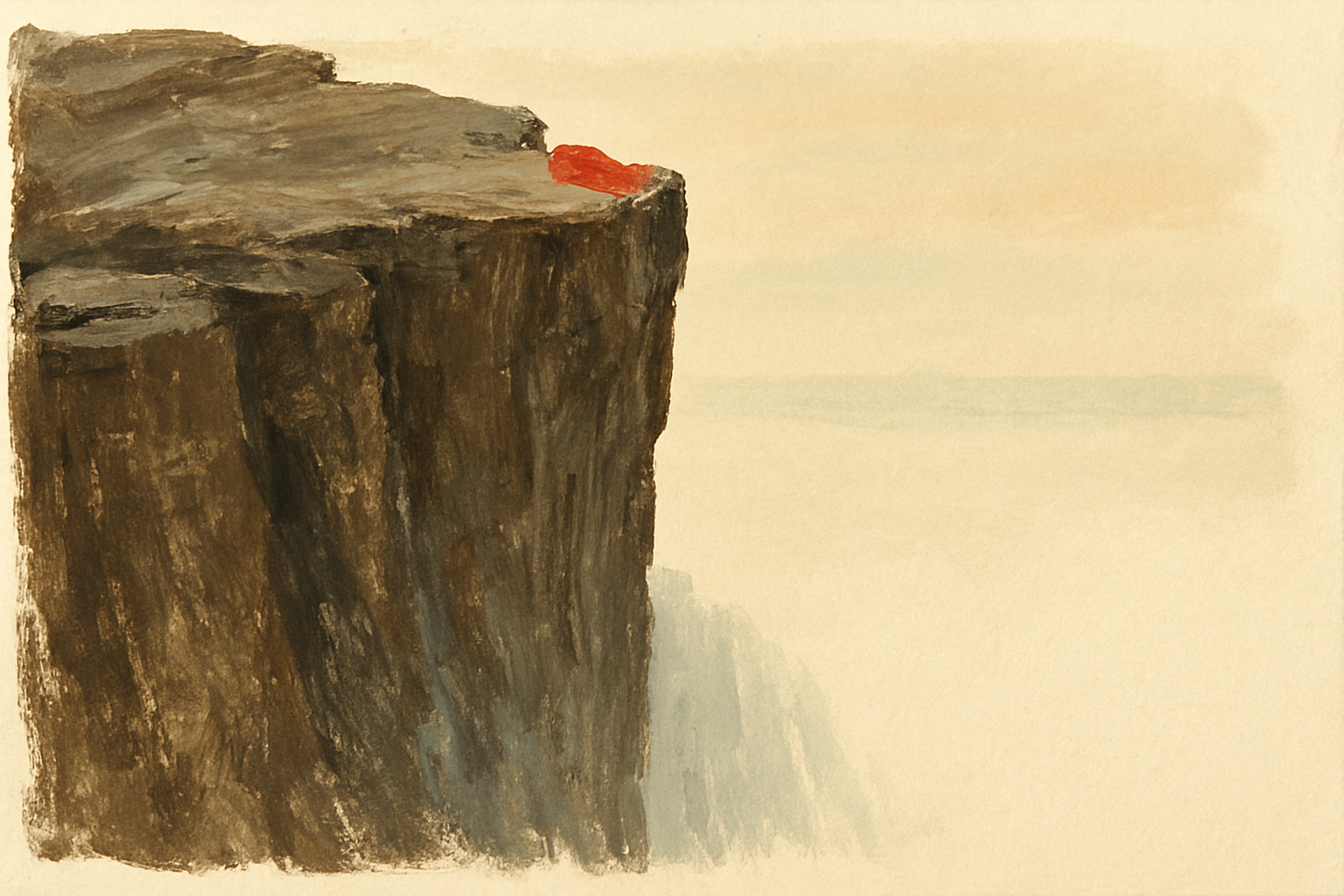
It's like standing at the edge of a cliff, about to jump into a lake. You're thirty meters up. It's scary. The option is to jump or not to jump. Do you jump when you're ready? If you do that, you never jump.
For those who have experienced this kind of situation: if you are waiting to be ready, you're going to stand there for hours. You're always going to feel unprepared and terrified. And then you just have to go for it in spite of not feeling ready, in spite of it feeling like a bad idea, in spite of your body and mind saying, "Don't do this, what are you thinking?" The choice can still happen in spite of all that.
But if you're listening to and believing your thoughts when they say, "Well, when you're ready," or, "There's a process, and it needs to oscillate more and more times, and only when it finishes oscillating on its own will I stop choosing it," then sure, you can keep doing that, believing that, for many, many lives. And I'm saying that's fine. You can still choose to do that for as long as you want.
When can you choose something different? Now. When can you choose to jump from that cliff? Now. If you're waiting for something to happen in order to be ready, that's just mind and time. You're waiting, waiting, waiting. Versus: now.
The trap of readiness
I get it now. You're ready when you decide you're ready.
Your mind is already trying to find a way to justify some form of readiness. You're giving your mind the power to determine when you're ready, and therefore the power to always keep waiting. You're delegating to your mind the opinion of you being ready. Because when you say, "You're ready when you decide that you're ready," how do you decide that you're ready? What is "ready"? Ready means something your mind has to be able to conceive.
I'm ready now. I stopped believing I'm not ready. I don't believe it anymore.
Sure. But then again, it's using thought to define readiness. What is this "ready" thing? Why is it important to be ready? Why are you focused on the sense of readiness or the narrative of readiness? Why does it have anything to do with this?
I guess my mind couldn't conceive that it was just a decision, in a sense.
Really look at why readiness has come into this matter and why it has anything to do with it. The whole concept of readiness is an excuse to wait.
Think of the metaphor of the baby learning to walk. If the baby is standing there waiting to feel ready, thinking, "I will stand when I'm ready," how long is that going to take? How is the baby ever going to feel ready or know that it's ready? There's no such thing.
But being ready in that metaphor doesn't mean not walking. It means continuing to stumble until you're ready to walk.
The baby stumbles and stumbles and stumbles until it learns, and it starts to walk, and walks better and better. There's no moment of before-and-after readiness. It's not related.
I'm a bit lost.
You're lost because you have a very big block around readiness. It's a thought process and mechanism you're using to wait and avoid. It's a reaction to fear.
Fear and the moment of decision
Think of when you're about to jump from a cliff into a lake. When you're waiting to feel ready, you don't feel anything. You're just waiting. But when you decide to jump, in spite of not feeling ready, you will feel a rush of fear and adrenaline in your body. The moment the decision happens, there's going to be a surge of fear and adrenaline. And the whole "being ready" thing, waiting for a certain condition, waiting to feel the right way so you can then call it "ready," is an avoidance of that fear.
So in my case, it would be a blockage against just feeling everything fully.
Life. It's an avoidance of life. The jump into the lake is a metaphor for life. Being ready is a metaphor for avoiding life, for living in your mind. And the barrier, in the metaphor, is the fear that comes with jumping and also the pain of hitting the water from thirty meters up. It's going to hurt a bit. But then it's going to be very exhilarating and fun, and once you do it, you're probably going to do it ten more times.
Because you've gone through it. You see you're okay. The fear is still there. The pain of hitting the water is still there. But, metaphorically, a movement into life means that in spite of the fear and the pain, you realize it's exhilarating. It's fun. It's a really enjoyable experience. And once you've gotten used to the fear and the pain, you do it again and again. This is often what happens with cliff jumping. It's scary at first, and then it's so much fun you end up going back, and in the next thirty minutes you jump ten more times. But that first one, especially if it's high, is a hard one. There are people who just stand on that cliff for thirty minutes, completely frozen, while their friends are calling them to jump.
But "life" sounds too abstract if you don't see the lake. You have to see where it's happening. Where in your life is it happening? Just catch yourself whenever you think you're waiting for, or working towards, or trying to be ready. That's where it's happening. Whenever you find yourself in some narrative about readiness, that's where it's happening. You just need to pay attention and then be honest with yourself. And I'm sure it's happening in many places.
Letting go of the separate chooser
That's such a beautiful metaphor, the jumping in the lake. Something just lit up inside; I definitely know that feeling. It came to me that it's really about a deep-seated trust. It's not the mind, not the readiness and analyzing and wondering whether this is the right moment. First there's an impulse, a movement that comes from that trust. It's basic. When the mind stops, it just happens. It's just the letting go part. And I can see how the mind can take ages and enjoy doing all of its analyzing. It's really just the control part. I remember it being described as a resistance to what is, like a fist in your gut, a "no" to life. It feels like this contraction in the body, probably in the gut, sometimes in the heart. I'm trying to feel into how this choice happens, because it's not a mental choice. It's the same as jumping in the lake. It's just that movement. You just let it go. You open it out.
Yes, and in a sense, there's a shift in the identification before and after the jump, metaphorically. Before, there is the contraction and the identification with thought. And then what you're describing, the mind stopping, is because in that jump, after the jump, we are also literally shifting out of thought, shifting out of the mind, shifting out of identification with mind. There is a trust there. And there is a choice that is happening, coming from a deeper place where it is no longer interpreted or perceived as a separate, independent chooser. It's life, but it's not life as an other.
Is that where the fear comes from? The fear that "I'm this separate thing that can be hurt"?
Yes.
And when that lets go, it's just what it is. There's an impulse, and you jump.
In spite of the fear. It doesn't mean there's no fear or pain.
And there's exhilaration in this.
The aliveness, yes.
True aliveness, not a mind-created narrative.