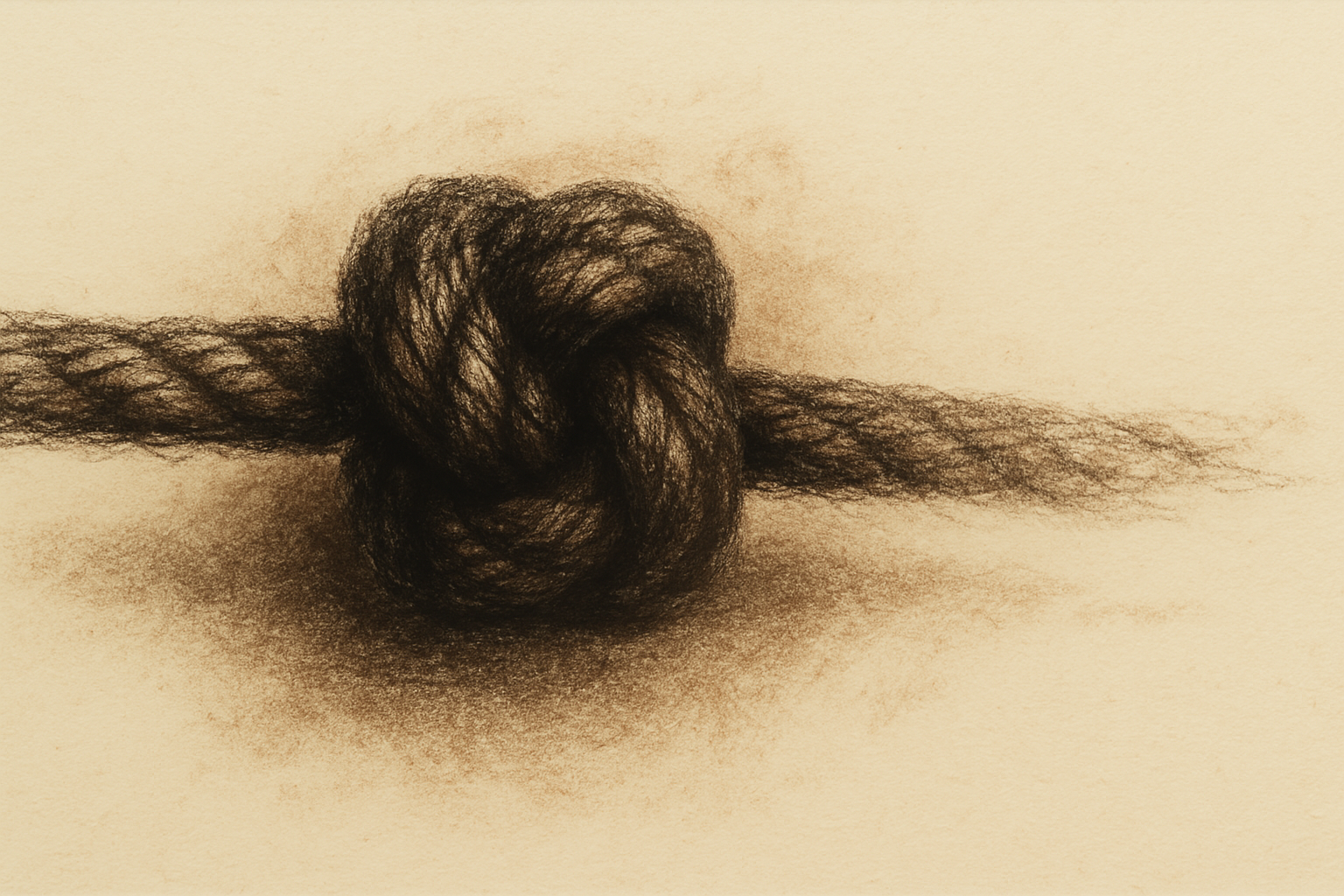
The Bird in the Cage
El pájaro en la jaula
A student describes the friction between moments of calm presence and the pull of old thought patterns, leading to an exploration of intimacy, paradox, and the taste of what is real.
The Bird in the Cage
A student describes the friction between moments of calm presence and the pull of old thought patterns, leading to an exploration of intimacy, paradox, and the taste of what is real.
I found the meditation very stimulating. I still feel the aftermath of it, as if it's vibrating through my whole body. At times when I meditate, I feel much more able to receive what is there, to allow myself to be with it and be present. I feel much calmer in my body. But other times the meditation brings up a lot of these minuscule thought patterns, these attachments that my mind hangs on to. In that in-between place, between believing what my mind is saying and just being here, there's a friction, and that friction is very felt. I'm trying not to give too much meaning to it. I'm seeing it for what it is. I'm seeing my own desire to give all this meaning to it. And I'm letting myself be here. But with that comes this friction, almost a battle between my body and my mind. I was just making an observation.
The bird that returns to its cage
I have some comments. There's a framing that might be helpful here. The image that comes to mind is a known metaphor: a bird born and raised in a cage. As soon as you open the cage, the bird, who probably had an instinct and an urge to leave from the beginning, will have this burst of aliveness and energy and fly out. Then four seconds later, it flies right back in.
There is a transition where the thing that is good doesn't feel good right away, and the thing that's not good feels better. What you're describing is this transition. You're aware of the goodness. You've recognized that it is much better to be free, much better to be out of the cage. But there's a phase in the experience where you need to adapt, where you need to allow your body and mind to adjust and get used to it. It's going to be a very intense and confusing transition.
This is what I was hearing as you were sharing. It's a natural response of the body and mind, which has been immersed in the belief in separation. This has happened to all of us. It's a natural process of the human being: how we become so immersed in a belief in what reality is, as seen and filtered through the mind.
Who is attached?
You said something like, "My mind is still attached to this and that." In that particular moment, I would recommend you change the way you interpret that. Because it's not the mind that is attached. I think it's more useful to say, "I'm still attached to this aspect of thought," because there's a stage where it seems valuable to see it all as the problem of mind, as if mind is the enemy, and then there's a kind of internal battling with the energies of emotion and thought.
I don't see it so much as the mind being the enemy. Maybe I just see it as my wholeness is attached to it.
When I say "enemy," I just mean seeing the mind as the problem. Sometimes it can be valuable and useful to see it that way. But at some point, that too is still an illusion. The freedom is always in you. The freedom and the choice are always here. The mind is just doing what it does, and you can choose to believe it or not. But you can still have a preference to choose the reality or the illusion of mind, and that's what we can call attachment.
It's important to see where you are in relation to that. Specifically, do not frame it as, "It's my mind that's attached, and I'm just here trying and waiting for it to unattach, doing what I can so it frees up." That interpretation leaves you in a victim position, where something is happening to you and you have no part in it. But what if you are the creator? What if you are the source of that, the source of everything?
What would that look like? It would look like: the mind is doing its thing, so what? Who cares? Nothing's happening. No problem. Emotions are doing their thing, so what? No problem. And really no problem. You're watching a movie. That's a fun movie, that's a scary movie, that's a sad movie. You could be loving the movie, but at your deep sense of being, there's no fear.
Right, it's really no problem. It's not just me telling myself "no problem."
Exactly. That second one is a belief you're trying to adopt, versus the reality. In the core of your experience, there's no problem. That experiential knowing doesn't have a thought, no belief attached to it.
Discovery beyond words
This is actually how it happened for me. It took me months to find words for what happened. It was a discovery of something that, when I discovered it, was like night and day. Everything changed. And then I also realized that what I discovered was always there. It wasn't something that appeared; it was always here.
It took me months to be able to put words to it. At first, I called it silence. Then after months I said, "Oh, I think it's peace." And I'm a smart guy. My point is that I wasn't telling myself, "Oh, there's peace and well-being," until finally it stabilized as peace and well-being. I discovered something, and it was so unlike anything I had ever experienced, because it's outside of thought, outside of the world of emotion. It was so innocent, so essential, that putting any word to it just takes away its purity and value.
Every emotion I had felt, every emotion I was used to experiencing constantly, even positive ones, had nothing to do with it. It was a completely different universe. Everything I had imagined about it, and I had done many years of meditation, had glimpses and energetic experiences, none of what I had experienced was like that. I couldn't imagine it, and that's why I couldn't put words to it. But then when I did, I could say "peace," "silence." I had never read Ramana Maharshi, and then I read him and he calls it silence, and I realized it's a universal word for it.
Seeing through illusion, not adopting belief
My point is: it's not something you can imagine and then talk yourself into, or have words that you try to repeat until you feel okay and at peace. It's more about seeing how the illusion and the attachment are happening, knowing that you are choosing that. This is a delicate pointer, because for somebody who is really stuck, telling them they are choosing it can amplify self-negativity and be unhelpful. But when you're at that edge, coming through, coming out, it's important.
When you said, "When I tell myself it's okay, it's not the same as the reality," that's exactly right. The reality might not come to you or be experienced as "okay." But it's here now.
In essence, the experience is here now, but the mind still has all this karma, different areas of life that it's busy with.
The mind has nothing to do with it. My mind is active. I can only speak to you because there are thoughts. My mind is not a problem. This is also part of the discovery: mind has nothing to do with it.
There are other experiences in life besides the experience of peace and presence, and it may be tempting to mix and match these things together and make a big salad out of all of it.
All struggle is made of peace
All struggle, all pain, all suffering is made of peace.
I spoke earlier about paradox. For the mind, paradox is an impossibility. It creates struggle and the attempt at resolving. But for the reality of what we are, paradox is contained. It does not need to be resolved, and the understanding is beyond words, before words.
What I just said is a response tailored to what you're saying. It's not an ultimate truth, but I think it's a reasonable approximation. So for your experience, it's probably a paradox: how can suffering, pain, and everything that's difficult and horrible be made of peace? That's like a koan. But I'm putting words to something that's true to my experience. I'm not intentionally creating a random tricky mind paradox.
This is what it was like for me. Seeing that, experiencing the truth and reality of it, gives me goosebumps to remember. That moment when all of this started to deepen and shift, it was from one instant to the next. Suddenly the veil was lifted. But the veil wasn't thoughts, because that was another thing that happened. I intentionally spent a day winding up my mind, having really busy thoughts, even stress and contraction in the body, and then realizing: it's totally unaffecting. The peace and well-being have nothing to do with whatever the mind is doing, whatever the body is doing.
It's a discovery of what reality is. And reality is real now. It's not tomorrow. It doesn't appear from somewhere. It's what is.
So it's not thoughts. It's an intuitive, heart thing?
No. It's prior to the heart as well. It's prior to the universe. It's prior, prior, prior, but not in time. Another word would be: more fundamental, more original. That's why in different traditions you would use different words. In Hinduism and Advaita, you talk about Brahman. You could talk about the Tao. You could talk about God.
So then how about nature?
In Taoism, nature is not it. Nature comes from the Tao. And "the Tao that is spoken is not the true Tao." If you call Tao "nature," that's not Tao. In fact, the first sentence of the Tao Te Ching, in my preferred translation, is: "Tao, called Tao, not Tao." It's practically a mathematical equation.
It's usually translated as "the Tao that is spoken." The reality, the truth that is put into words, is not the true Tao. You cannot put it into words. But I prefer the actual Chinese, which says: "The Tao that is called Tao is not Tao." Anything that is called the thing is not the thing.
So it's for awakening.
Defining the undefinable
When you said, "So it's a heart thing or an intuitive thing," your mind is trying to grasp it. We're talking about what we could call Tao, or God, or Brahman, or peace, or truth, or reality. But if you want to define it, I'm going to say: no, that's not it. Not because I enjoy the argument. This is just how it is.
One of my most favorite definitions actually comes from a teacher who says, "This is it." That's the most accurate definition. There's a philosophical definition, which "Tao, called Tao, not Tao" captures perfectly. And the practical definition is: what is it? This. If you say anything more, it's not it. Because it's not "not the computer," but it's not the computer. It's both and neither. It's not "not the heart," but it's not the heart. Is it intuition? No, but it's not "not intuition."
Mind paradox. I can see that. It's very relieving to know that there are people like yourself who can reassure me of that and who are not telling me, "Go believe in this, go believe in that."
Beliefs are no good. The way I recommend working with certain assertions in language is to say: what if?
What if, whenever you experienced the most difficult pain and suffering, peace was present, and even that was made of peace? Not telling you to believe it, because then it becomes a thought, and you try to believe it, and you imagine what it would be like, and that's a rabbit hole of misleading misunderstanding. But, what if? How could that be? Contemplate that. See the possibility and see if you can discover it in your experience. What if that were true? How would that be real and possible for you?
Intimacy with what is
During the meditation, when you talked about seeing things and being very intimate with them, it reminded me of what you're saying now. Looking at the things I may usually not want to look at, just seeing them, and seeing that as something very intimate. I'm getting closer to something real, something raw. It feels scary at times, and at times it feels very beautiful and very flowy.
Intimacy is a beautiful word for that. When we really recognize how intimate this is, that's where there is no separation. In a sense, we disappear, but we weren't really there. We weren't really here. It was an image of "I." And then intimacy is: it's this, it's here, it's all of this. And it's so beautiful.
A word that comes is "fragile," but it's not fragile. It's vulnerable, sensitive, alive, heartbreaking and beautiful. Everything is appearing and it will never be this way ever again. Like the sand mandalas of the Buddhists. Every moment is a sand mandala. The universe has never had this exact configuration, and it will never repeat in this way. It's so precious.
It's like seeing someone you love, and they fly away to a different country, and you might not see them again. But you just enjoy them while you're with them.
And even more so because they're flying away. You're really immersed in the intimacy of that. But now that person is this: you, and not you, and everything. The sounds and the bird, and the pain and the struggle of a friend, and your own struggle. But it's flying away in the next second. Then it's gone.
The only words I can put to it are: very raw, very spontaneous, very vulnerable, and just loving.
The taste of reality
Now you're putting words to your experience. And to me, it's: yes, yes, yes. That starts to resonate as a description of this directionality of presence, of what is.
In the meditation I spoke about breadcrumbs: how do you know you're attuning in the direction of what we try to communicate here, whether we call it freedom or being? One way to recognize the taste, to follow a bit of a trail, is a sense of expansion, a sense of artfulness. What you're describing now, those are the breadcrumbs. When you start to realize you're tasting what you just described, that's it. That's close to the reality of this.
Whereas when we get immersed in thoughts, and the problem is the mind, and the attachment is in the mind, and we're here trying to shift that, there's more and more tension and contraction and struggle. That's moving into the world of beliefs, identification, and the belief in separation.
But both are right here. The question is: do I immerse in the belief of interpretation of mind as real, or do I taste what is real? And what has the taste of the real is what you described. It's raw, vulnerable, artful, a bit scary, alive, precious, like a lover that's going to leave.
To me, that has exactly the flavor. Francis Lucille talks about the perfume of truth. I tend to talk about taste and savoring, because it has the directionality of something that is not thought. Perfume is like that as well. Something you can't see, not anywhere you can identify, but it's there. You taste it, you smell it.
Imperfection is perfect
Allowing reality to be imperfect, that's part of it too.
Imperfection is perfect. How could perfection be perfect without imperfection? It would be so limited, missing its other half, alone in the world of perfection. How boring. Eternity and perfection in the eternal universe of perfection, alone, longing for its other half, the imperfection. And vice versa.
This is really the best place to be imperfect.
I really appreciate that. I feel honored. What you shared was very moving for me.