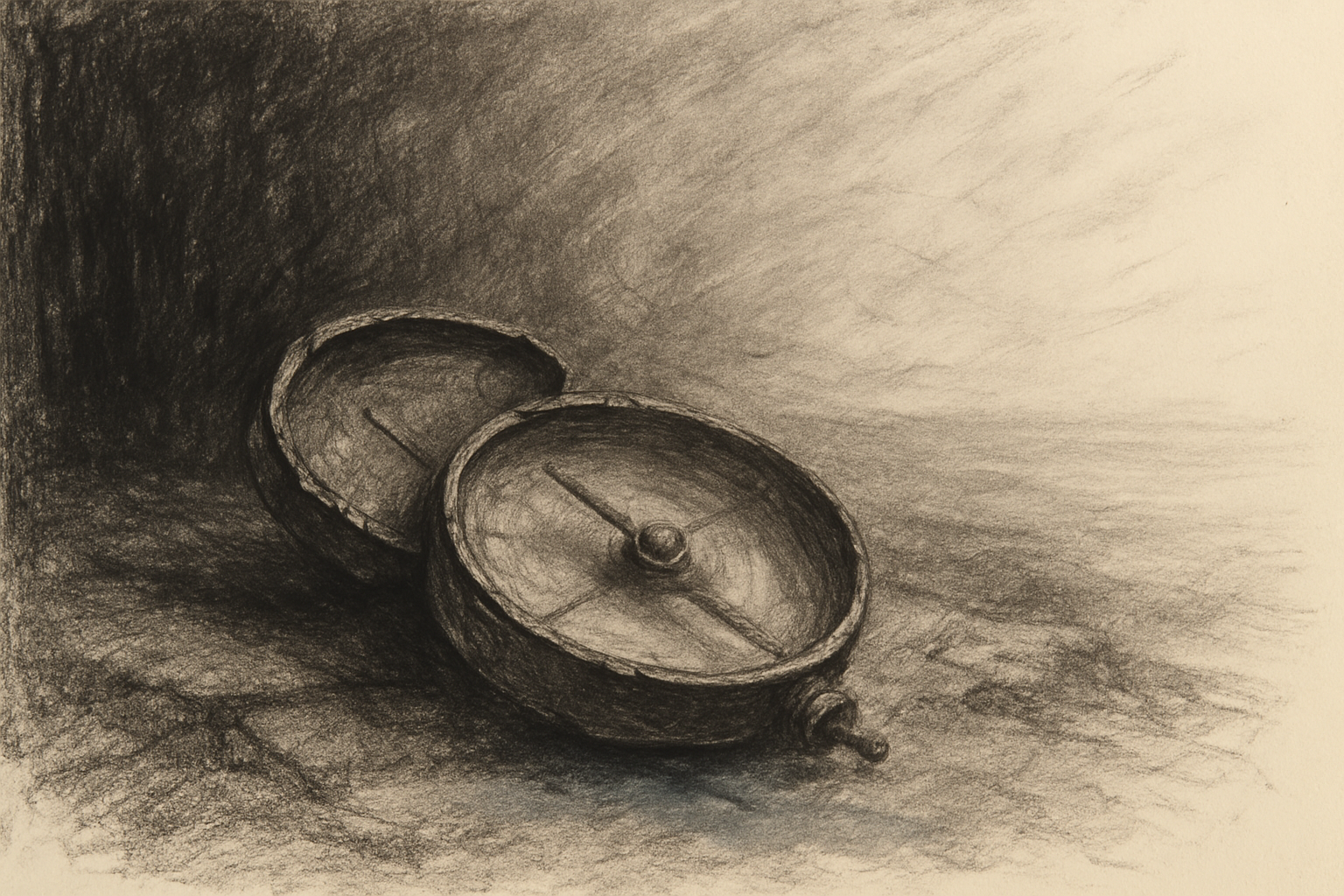
The Compass of Fear
La brújula del miedo
A student shares her struggle with setting boundaries and the confusion that arises when she begins opening up to life after a period of isolation. The teacher responds with guidance on moving toward fear with discernment, and on discovering the deeper stillness beneath the turbulence.
The Compass of Fear
A student shares her struggle with setting boundaries and the confusion that arises when she begins opening up to life after a period of isolation. The teacher responds with guidance on moving toward fear with discernment, and on discovering the deeper stillness beneath the turbulence.
I relate with everyone here. Having given it some thought, I realize I was choosing to be isolated because the world and everything seemed so delusional. When I found myself at that point, I was so afraid, and then I believe I was brave in choosing to start living again. I started to meet new people and participate in society, make an effort, and everything was feeling good. But the mind is the mind, so I find myself right now struggling a little bit. Not so much with my vulnerability, actually, because I just realized that I had built a kind of mask of vulnerability while at the same time having no real boundaries. I wasn't used to boundaries, and I've been reading a lot about that.
Apparently, setting boundaries when you're not used to them, or when you think you don't have the option, makes you feel uncomfortable. Sometimes I feel ashamed to set boundaries. Sometimes I feel guilt, or frustration, or I'm suddenly angry because I just set a good boundary that actually makes me feel good, but afterward I feel bad. It's really tricky. During the meditation, I felt that balance some of us were talking about, and it came to my mind like a compass that's always moving, always trying to find its center. I feel like that movement kind of numbs me sometimes. My waters feel mixed, and I don't like it, but at the same time there's a sense of wonder in it.
What do you mean, your waters are mixed?
I was afraid to connect with other people and make friends because I was afraid to be hurt, afraid to be rejected, afraid of not being enough. And then I took a leap of faith and connected with people, and it's a really nice experience. I'm enjoying it. But suddenly I'm facing scenarios where I question myself, and that's where my waters get mixed, because a lot of the narrative, the layers, the perspectives you were talking about: I have too many. It's overwhelming.
The mind resists the direction of freedom
This is very normal in this phase. As soon as we start moving in the direction of freedom, everything stirs up. My teacher used to talk about the compass. He described it as always pointing toward fear: wherever fear is, that's where you should go. But he always added, "with discernment."
You have to really recognize which fear is the one you're truly avoiding. I could be afraid of talking to my partner, or talking to my father, or approaching a person I want to be close with. And instead, I go climb a mountain because that's also scary. But that's not the real fear. He would joke, "Don't step in front of a bus just because it's scary." The point is that discernment means seeing what you deeply want and are afraid of. It could be to socialize, it could be to draw something and show it to a friend. It could be anything, whatever life brings to you.
But when we start doing that, the mind is going to go crazy. We've practiced and trained and built these patterns, and there are also parts of the psyche that are genetically programmed for survival. So all of that will activate. Even if it's a psychological fear, like being rejected or someone saying they don't like me, the body can interpret that as a lion about to bite my head off. There is a mechanism by which I become so identified with the idea of being liked that being told I'm not liked triggers the fear of death. If being liked is that important, if I'm that identified with it, then not being liked equals death. And if I approach a person who might say, "I don't like you," my body reacts as though I'm walking into the mouth of a lion.
This is very normal. This is very human. The mind, along with all its stories and narratives, is basically saying, "Don't go this way." So at first, there is a need for some effort and practice to make these explorations, which is exactly what you're talking about. It's going to be confusing. It's going to bring up everything that was being avoided. But that's perfect. That's the way.
What we most avoid can become what we most cherish
What can happen later is that everything we were ultimately avoiding does happen, and you realize it's totally fine. In fact, you can discover that the thing you were most afraid of is the most beautiful thing, and the pain you were most deeply avoiding is the biggest love you could have. You simply couldn't be with it before.
So you see fear and you run toward it, face it, go through it, and then freedom is right there?
It's mostly about doing the thing you want to do that happens to be scary, not pursuing fear for the sake of fear. But the fear can be the sign that tells you something is important to you.
I'll give you an example. I would go to my teacher's meetings, and I was a teenager, very afraid, very shy, introverted, with serious social anxiety. I was in this intimate group with an awakened master, and it was very intense. I wanted to speak to him in person, and I would sit there telling myself I wasn't interested, that I had no question. Then for a moment I'd have the impulse to simply say hello, and a wave of terror would hit me, literally heat and terror in my body.
That, to me, was the big sign: I really do want to talk. Instead of interpreting the fear as "don't do it, this is dangerous," I started recognizing it as confirmation. The fear was saying, "Shut your mouth, what are you thinking." But the teaching was: no, this is what you want. You're just very afraid of the outcome. It's like approaching someone you're attracted to at that age. Paralyzing. And then you realize, "Oh, there's fear here."
Some things are more obvious: "I want this, but I'm afraid." In the moment, though, that energy of fear can become a sign that you're going in the right direction. It's actually a vitality.
It feels like that sometimes, definitely. And sometimes it feels like a reward afterward.
You feel it after. And then it feels really good.
But I would like to hold that feeling for longer. Before I know it, reality kicks in and it's back in my head.
The ocean beneath the waves
It takes time. Whatever that movement is, something becomes deeper, where the movement is just like waves on the surface. Imagine we're a little boat in an ocean and there's a storm. Everything is really intense, then it gets a little better, then intense again, then better. The more we go in this direction, letting the life force move, the more we start to recognize that what we are is very profound and very deep. It's not just this body-mind.
In the metaphor, it's like you start to realize you are the ocean. The waves and the storm, the part of you on the surface, can still be intense, but now there's an excitement within that intensity. Something, a knowing of the ocean of beingness, is simply okay. And from there, you can fully savor all the intensity and aliveness of life happening on the surface.
Right now, everything happening in the body, the mind, this conversation, perception, sounds, colors, thoughts, all of the experience of the body, the past, the future, this world: all of that is the surface of the ocean. All of that is the movement. And then there is what cannot be named, though it has been called consciousness. It can be called beingness, or emptiness. It is simply this knowing. And that is really what we are.
Definitely. Thank you.
You're welcome.