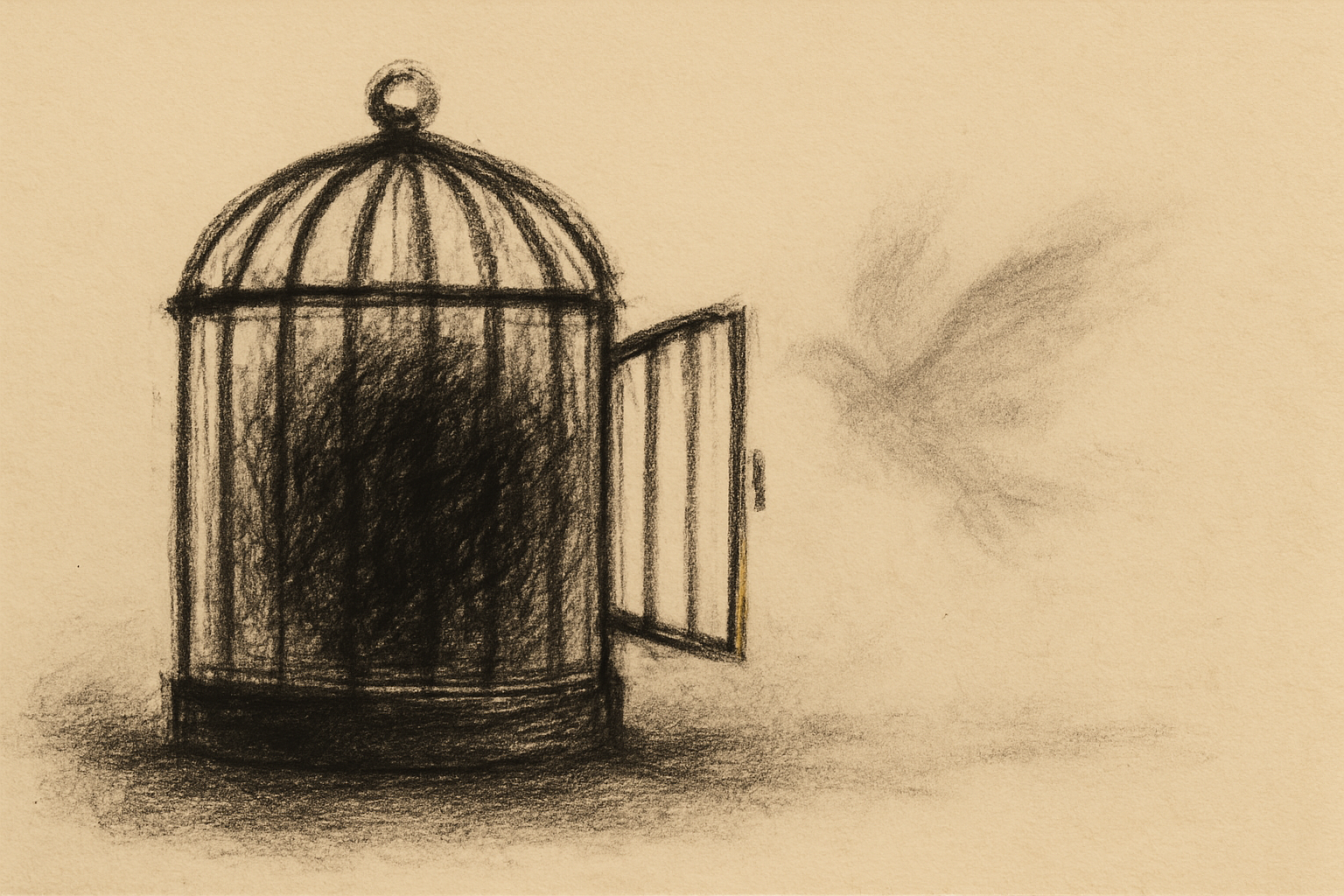
The Loyalty to Fear
La lealtad al miedo
A student shares about the suffering created by social alienation and the habit of suppressing self-expression, and the teacher speaks about the cost of choosing safety over aliveness, and how what appears to be pain can be known as love.
The Loyalty to Fear
A student shares about the suffering created by social alienation and the habit of suppressing self-expression, and the teacher speaks about the cost of choosing safety over aliveness, and how what appears to be pain can be known as love.
It's more of a share. I resonated very much with what was shared earlier, and just sitting here listening, I'm also feeling all these sensations in myself and believing that there's some kind of danger. My mind is creating so much suffering for me, and a lot of it has to do with social alienation: feeling like I'm different, feeling like I can't express myself, thinking I need to always be serious, feeling like I can't trust my own experience. If I stand by what I say, others might disagree or I might get alienated in some way, and I feel like I need to keep that in. But what you said earlier was very helpful. I give so much space to the seriousness in me that I don't notice the playful aspect, the peaceful aspect that is also present in other areas. I'm wanting to be more playful about life.
That's a very human experience. And you're right that you're different. The more you gravitate toward this kind of work and exploration, the more likely it is that you're different. That's just a fact. Different meaning not the average person. By definition, you're different, because otherwise everybody would be doing this. If the normal thing were these kinds of meetings and conversations, then you wouldn't be different.
You found me on some video on the internet and are joining this call from across the world. That's quite something. You're called by something quite bizarre, let's say. And that's not a bad thing. In fact, it might be a very good thing. It's not for me to say, but I have an opinion.
What I was saying earlier that you resonated with, I'm speaking from experience as well. I was a very self-controlled person, very much living in thought and afraid. Vulnerable and sensitive and afraid of everything, but so devoted to truth and life. When I encountered the first sign of anything that had to do with this kind of freedom, I was just hooked.
Breaking the pattern of control
I remember noticing this fear and wanting to control every moment and avoid any situation of pain, and then giving myself permission to just relax and do something without trying to control it. Then instantly I hit my head against the wall, quite literally.
You were speaking of a sense that there's danger. And there is danger. If danger means being hurt, it's a world full of dangers. But if we see being hurt as just part of life, part of the abundance of life, then we live so much more than just pain and avoiding pain. That's where it's really a choice. There's a huge spectrum of aliveness, and we sacrifice that aliveness and abundance because we prefer less pain. By choosing less pain, we avoid the abundance and aliveness that is possible.
This seems almost like I've been oscillating between the loyalty I have to the fear and the infinite potential of what's possible. Some days I don't want to get out of bed. I'm giving in to all these beliefs and creating so much suffering for myself. It seems like this loyalty keeps pulling me back.
It's a very oscillating attachment. What's a different word for loyalty? Fear has served you well, and so you're loyal. But maybe it's time to move on.
I think I'm about ready to move on. The oscillation is just, as you said, the pain is always going to be there.
The end of certain kinds of pain
The fear is always going to be there. It's always there, but perhaps it becomes less personal. Things change, and I should speak to this a little: things can really change. There are different kinds of pain, and some pains will simply end. They will never come back. Once a certain threshold is crossed, certain pains never return, because there are pains that exist only in the world of contraction, identification, and belief. They are triggered through that system. It's not the end of all pain, but it is the end of psychological pain that comes from beliefs and identification. Those can end, though they often get a little harder before they stop.
The pain that can remain is deeper, but it's also sweeter, more profound. Physical pain will come and go, but the pain that can remain is this heart opening. The image that always comes to me when we talk about this is the image of Christ with the bleeding heart, where he's brought his heart out and the organ is in his hand, exposed to the world, being hurt by the society of his time.
The symbology there is many things, but one of them is that the offering is total. No matter what, the heart is here. It is the offering and the risk. But what I've also discovered is that the metaphysical heart can never be fully damaged. The more pain it holds, the more love is known, the more love expands. At that level, there is no real danger. The danger is that there will be pain, but there is no danger in the sense that what we ultimately are will be overwhelmed. The fear says: if there is too much pain, I won't be okay, I will end in some form, there will be a deeper and deeper not-okayness. In fact, it's the other way around.
What appeared to be pain became known as love
If I can fully allow that deeper, true pain, it can be known differently. It's been talked about as transmutation. When I heard about transmutation, it gave me the impression that something is one way and then changes into something else: a deep pain that gets transmuted into love. For me, the experience was different. What appeared to be pain became known as love. It was only painful because of a veil of interpretation. It literally felt like pain and then felt like love, but it was the same thing. What changed was the veil through which it was being known. The veil was the mind, and specifically fear: the fear that this energy is too intense, that for it to be there and for me to exist simultaneously was not possible. For this energy to be present, that would be the end of me. Therefore the experience was "this is pain and I am in fear." That fear made the energy feel like pain. The instant the fear vanished, that same energy was known as love.
It seems almost like the bigger the veil is, the more of a homecoming it is when you realize that it was always love all along.
Yes. I don't always experience this, but in some ways I have. The potential future of humanity is for this to be known and to be normal, and that is extremely transformational. But it can only begin with a transformation of one's own relationship, one's own mind.
The moth to the flame
It comes from a choice. For me, the choice was: once I tasted that, I needed to know more. I needed to know it more deeply. I was like a moth to a flame. I needed to know that pain more deeply, not to create it, but to know it. It would come up spontaneously in different moments of my life, this really deep, unbearable pain, and the second it appeared I just ran toward it. It only started to appear once I was no longer going into psychological distractions, once I was going toward the real experiences, in the direction of the things I really wanted but was very afraid of. Going back to what's most fundamental.
The words that come more recently are: what do you want, but you as the universe? What does the universe as time want? What do you want as the universe? The answer can no longer come from thought, from the past, from beliefs. It has to come from life, from aliveness. And it is a big desire. That's not the desire that needs to be extinguished, as in more traditional interpretations of awakening where desire is a demon to be overcome. I'm talking about desire that is aliveness, that is vitality.
I realize more and more that I can't always convince myself or talk myself into that. Sometimes I have to act myself into it.
Exactly. Just get out of bed and go out. Walk, go climb a tree. Literally break out of the patterns of thought. Why did you stop climbing trees? It's random, but this kind of thing matters. Everyone should climb trees.
I'm trying to be more playful with it.
Choosing fear as a crutch
The key is to assume you're choosing this, and then try to see where the wisdom in that choice lies. Fear has served you well. It's a crutch, and it has brought you here. For all of us as children, we've lived through different levels of brutality just being in this world, which is chaotic and painful, filled with unconsciousness. Our parents and caretakers were dealing with their own messes. We came into a world with wars and so much fear in everybody around us, and we learned how to be guarded, how to contract, how to withdraw. In that sense, it was helpful. It has kept us somewhat sane and functional. But it is just a crutch.
Living in a way where you're not creating more suffering, but also allowing yourself to be as free as you can: you can be fully, totally free. You already are. It's simply recognizing that. The inner negotiation with the freedom that we are is always the same question: can I have that freedom and keep my conditions as well, please?