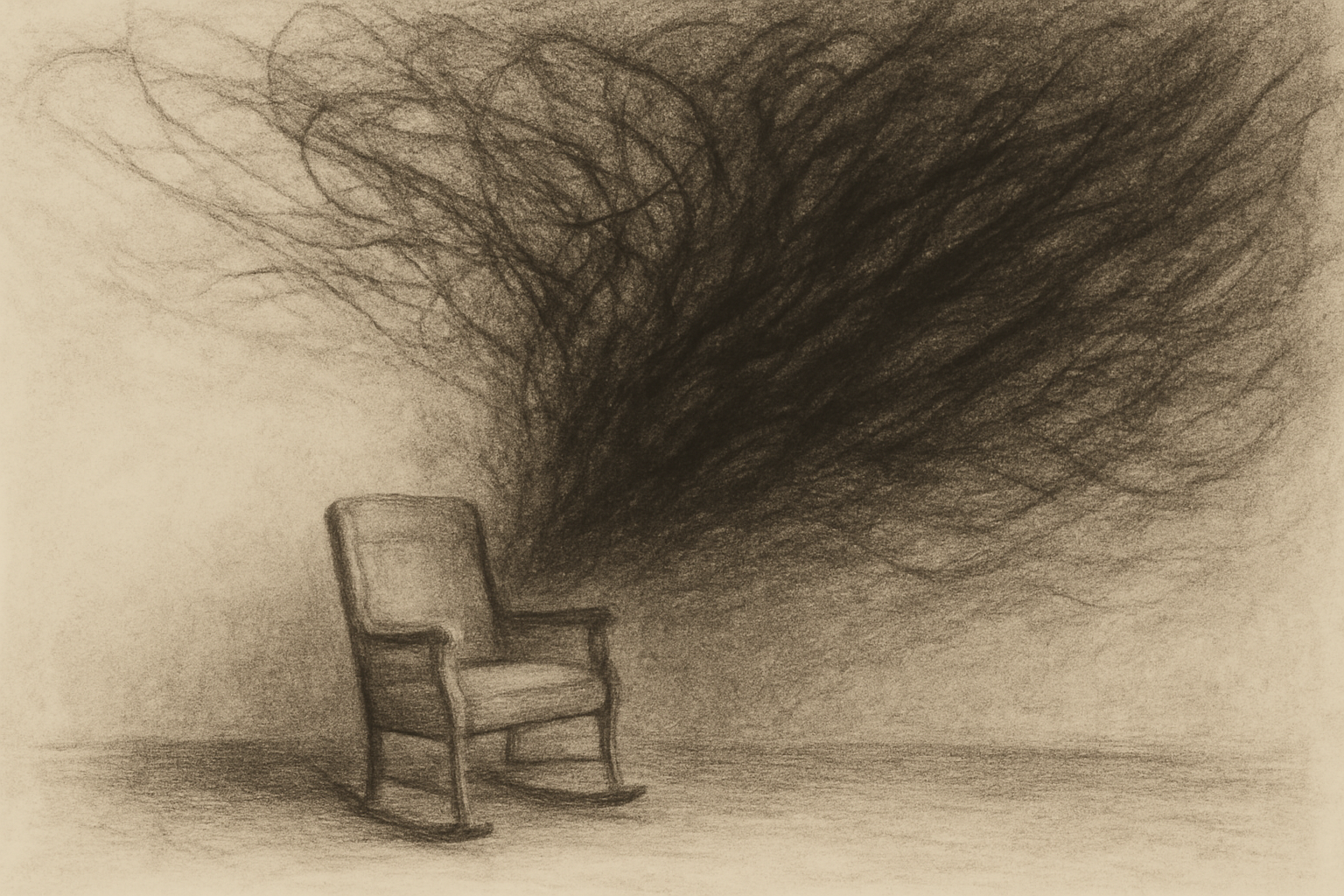
The Pull Away from Peace
El impulso de alejarse de la paz
A question about why the mind generates fearful narratives even in moments of peace, and what drives the urge to control and seek safety.
The Pull Away from Peace
A question about why the mind generates fearful narratives even in moments of peace, and what drives the urge to control and seek safety.
Something that comes up often in my experience: you say frequently that we go to the mind because there's something we don't want to feel. I have a question about that, because I notice it happens quite often that I'm totally fine, just feeling peaceful, and then the mind will throw something up. A thought will come, something like, "What about this thing? What if you're missing this?" Often it's around a pattern I notice in myself: fear of rejection, which goes right to fear of death. I'll be rejected, I won't be cared for in the body, and then I'll die.
It doesn't seem to me like this is happening from the body. It seems more like the mind is on the lookout for what could be a threat. Sometimes I can just see it for what it is, but I'm in a bit of a dance with it, because I can still give it power by thinking, "Well, what if there's something here I need to pay attention to?" And that is quite tempting.
And what's the temptation?
The temptation is: what if this is true, and I could die?
The temptation before the narrative
That's not a temptation. That's already in the narrative. The temptation is prior to that.
I guess it's something like "listen to this," or wanting to listen so I can control.
So the temptation is to control. What's the experience of the desire or need to control?
It's like I need to know, I need to control so I can hold on to something. I think it's a wanting to hold on to a sense of safety.
To control safety, to make safety more permanent or present as often as possible, something like that. And what is the sense of safety?
Knowing. It feels like knowing. Like, if I know what could happen, then I know.
But it's something more specific. Safety as knowing is something more specific. It's not just knowing, like "I can know what the birdsong is" or "I can know what's on the other side of that door." Safety is specific. It's a knowing of something particular.
Yeah. Knowing I will be okay and be loved.
What "not okay" really means
Just stay with the "okay" for now. What would be not okay?
Feeling fear. Feeling pain.
Are you saying that because that's what I say to you?
No, I feel that in my experience too. Especially where I have this pattern around rejection. It can come up in the mind as "what if something physically happens to me," but usually it's relational.
Which is why it's pain. If something bad physically happens, it's pain. If something bad happens in a relationship, it's pain. What fear is, is wanting to not have pain. It's the experience of not wanting pain to come.
This is why death is scary: the body-mind is programmed to anticipate it as a painful experience. Being hurt physically can lead to death in many ways, through illness or otherwise. But ultimately, it's the end of "I." It's the end of "me." And that is purely imaginary in the sense that we have no idea what happens in the death of the body. You have no idea if that's going to be painful. But the sense of "me" ending is anticipated as something that must be painful, something unwanted. This is deeply programmed. The body-mind is programmed this way.
The sense of safety you are talking about is literally what you described: "I want things to be okay, and I want them to be okay as much as possible, as long as possible, as permanently as possible." And the definition of this okayness, this safety, is no fear and no pain. Some kind of stable avoidance of fear and pain.
The avoidance beneath pleasure and pain
In other circles, more traditionally in spirituality, this is referred to as a cycle of pleasure and pain: attachment and the desire to be more in pleasure than in pain. But to me, it's not even about pleasure. It's literally just avoiding fear and pain. We can get addicted to anything that's not remotely pleasurable, so long as it's not fear and pain. We could be very distressed, not in pleasure, but still avoiding the particular fear and pain we're trying to avoid. I'd rather be suffering in the contraction of mind than feeling the fear and pain I'm running from. So it really isn't about pleasure. It's the hope and the dream of some future pleasure.
The mind as servant
Back to your question. You described being okay, and then the mind comes in. It seems like it's just the mind bringing that up on its own, but there's something prior to that which makes the thought appear. The thought is being created from the desire, because the mind really is a servant. We think the mind does things to us, that we get overwhelmed by the mind. But it's really just a servant. It's not "the mind did this to me." The mind is doing what you want it to do, in a deep sense.
If you want it to give you all the dreams of how you can avoid something, it's going to dream and dream. If you want to imagine something scary because it helps you avoid some other, real fear and pain, it'll do that by creating an imaginary fear.
Thought-based fear vs. prior fear
This is where it gets tricky, because there are experiences of deep sensation that are, in a sense, outside of the mind or prior to the mind. We can experience those without thought. And then there are experiences that are also at the level of sensation, but are what we could call emotion. It is like fear, like pain, but it's more imaginary. Through the chemistry and mechanisms of the body, it can produce sensations as well, and it can produce fear. But it's a kind of fear and a kind of pain that requires thought. It is thought-based, whereas the deeper fears, the deeper pains, are prior to thought.
So, for example (and this is not necessarily what happens for you specifically): you might be feeling fine, and then a fear comes up, or an emptiness comes up, a sense of something a little unsettling. Then the temptation, the reaction, is going to thought, going to the mind. And the mind is going to be ready. It's your servant. It already has the normal stories of safety lined up. Then you describe the narrative: "What if you need to do this and this in order to not be rejected? Then you're going to be loved. If you don't do this, you won't be loved." And that becomes, "Oh, I need to deal with this." That becomes the pull and the temptation. But it really is serving you to not be with what happened the instant before that thought came up, which was most likely some sense of emptiness, or some sensation that's uncomfortable. The emptiness is experienced as a sensation at first.
Not trusting peacefulness
I'll feel into that. It almost seems like a not trusting of the peacefulness. Because I can be peaceful, and then there is an energy of pulling back from it. I don't know why.
It's fear. That's all it is. And you can look at the narrative; it's going to be very clear when you see it as that. The mind is going to come with nonstop narratives of fear stories. For example: "If I'm just dissolving into this peace, it'll be taken away. I will lose it. Things will go to hell, and fear and pain will come back."
That's all narrative. But once you're in touch with that peace, once it's become somewhat known to you on a daily or weekly basis, then it's going to be this constant choosing. And this is a good thing. Now, are you choosing fear and control and illusion, or are you choosing that peace?
Choosing trust
It ultimately is just a choice, but it can be a practice of trust. The first part of this work is tasting that peace, discovering what you're describing. That's eighty percent of the work: to discover that there is this peace, and it's causeless, and it's here.
It is very clear, often. It is like that: "This is it, it doesn't matter so much." And that's becoming clear, like what layers of things are happening.
Except, right? Because if you absolutely knew from experience what you just said, totally, then you would know that peace is there even when you're in pain, even when there's fear, even when there's heartbreak, even when there's abandonment, even when all of the craziest thoughts and emotions happen. That peace is there.
Once that is seen, once you see that totally and fully, then nothing matters. That is freedom, because you no longer need to avoid pain. You no longer need to avoid fear. You don't need to create it. You don't need to go toward it. You're free. You can live. Then it's life abundant. You don't need to control. You can play with control. You can practice, you can have fun with it. It's all free. That peace and that well-being: there's nothing other than that. It's in the thoughts, it's in the pain.
But right now, you've known it somewhat conditionally. There still isn't the full clarity, and there still are some conditions. That deeper clarity can deepen.
Thank you so much. That's very helpful.
You're welcome.