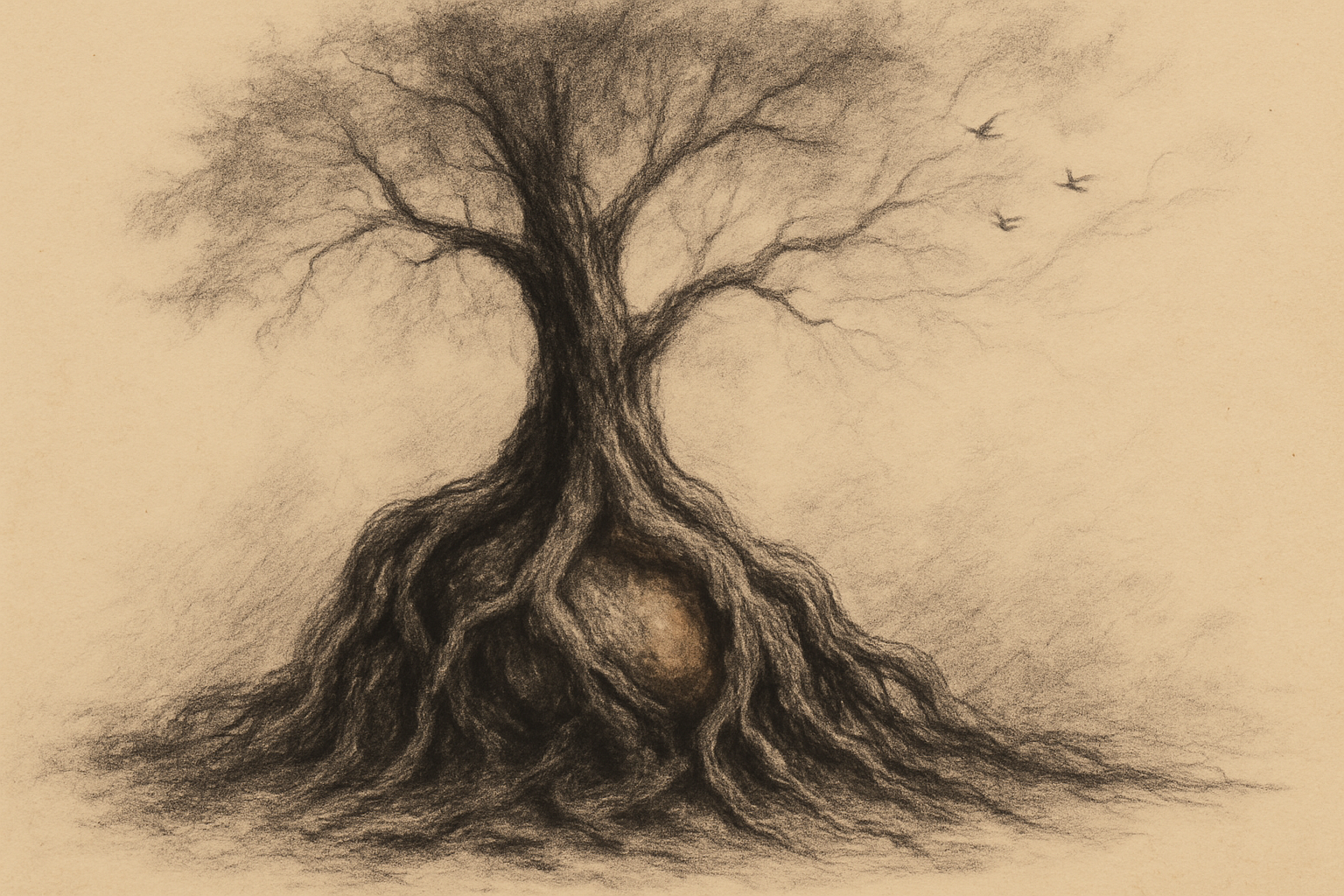
Trapped and Blessed
Atrapado y bendecido
A student caring for a seriously ill parent describes feeling simultaneously trapped by exhausting circumstances and grateful for the opportunity to feel deeply. The teacher explores the edge of "too much," the blessing of having no escape from feeling, and the balance between doing everything you can and accepting your powerlessness.
Trapped and Blessed
A student caring for a seriously ill parent describes feeling simultaneously trapped by exhausting circumstances and grateful for the opportunity to feel deeply. The teacher explores the edge of "too much," the blessing of having no escape from feeling, and the balance between doing everything you can and accepting your powerlessness.
It's really tricky here at the moment. I feel quite trapped, but also quite blessed at the same time, because it feels like I'm just being asked to feel a lot of difficult stuff and there's no way out. It's all to do with circumstance. I feel like I need to find some balance between getting away from the situation without escaping the situation. It almost feels like it's too much. I'm concerned I might be reaching a breaking point, a point where I really need to remove myself from the situation. But that would cause a lot of trouble for my parents, since I'm staying with them. My dad has very advanced Parkinson's and it's really not good for him at the moment. My mum is stuck in hospital.
I've been feeling really lucky to have this opportunity. I've learned to be so much more gentle with my dad, really opened my heart to him, learned to soothe him. But it's almost too much. The past two or three nights he's been waking me up in the middle of the night, basically in a state of panic or paranoia, and I've just had to sit with him and be with him. That's okay, but honestly, I'm just exhausted on top of everything. I don't know if I can take any more nights of not enough sleep. It's come to the point now where my dad can't even be left alone because he freaks out. I feel quite trapped in that way. But at the same time, it feels like a large blessing that I have this opportunity to really feel into all of this. I guess where I'm having trouble is with the balance and the boundaries.
The edge of "too much"
That feeling of "almost too much" is the edge. The edge of too much, and the limits, the sense of a limit where we can't go any further. This is really all about sensations. For the mind, sensations are too much, some sensations especially. And so we go to the mind as a refuge, to numb. I think that's what you're referring to as a blessing: this situation is, in a sense, bringing you to an edge where you have no other choice than to feel, because there's no way out. That is a blessing. That is life conspiring in your favor.
There's so much gratitude at the same time. I guess there's a shade of fear that I might be pushed over the edge into utter exhaustion, but I don't know if that's part of the thing anyway.
No, that's a very valid thing to be careful with and to be aware of. I'm sure you're trying to bring in all the resources that are available. Circumstantially, what is the health system like? Is nursing available? I'm not sure about the financial circumstances or the medical support and attention, but that's where you need to explore and exhaust all possibilities.
The line is: how much do you take on yourself, and how much do you leave to the universe to care for your dad? In the sense of the panic that he goes into, how much can you be of support, and how much is simply not in your hands? Be very attentive to that line. You can probably do more than you think, but not to a point where it hurts you. By "hurting," I mean if it exhausts you to a point where you get sick. But first, exhaust all possibilities of support that are available: the medical system, relationships, friendships, family. It sounds like an extreme situation. Extremely difficult. Extremely challenging.
I guess it's harder now that I'm really quite fatigued. There's the tetchiness from tiredness, and I just feel a lot more emotional. But that's not a bad thing.
Fatigue as a doorway
Watch the interpretation, because fatigue is not necessarily a bad thing. When we are driven to extreme circumstances by life, fatigue is also a way in which structures and identification get broken, because it is an effort to sustain an illusion. The storm of the mind, the sense of false safety of thought, is an effort. When we are fatigued, it brings up the opportunity to drop that, because it's an extra effort we simply cannot sustain.
Extreme circumstances are known to trigger shifts. But we don't create extreme circumstances in order to bring shifts. It's what life brings. And the wisdom lies in dealing with what is happening. If we are using all of our intelligence, all of our insight, to navigate that as best as possible, that itself is an opportunity: for example, to feel things you have been avoiding for a very long time.
The purpose of illusion
Ultimately, what this is all about is what I call, or the way I define, awakening: the ending of illusion. Illusion serves one purpose alone, which is to avoid sensations, to avoid feelings we cannot handle, feelings we just don't want. Ultimately they are related to death. What is death? It's the ending of something. What is the ending of something? It's a narrative. What can end? Everything that is, changes. Every change is the end of something and the beginning of something else. Everything is changing. So in a sense, there is always death and birth, every moment.
But if we believe we are something, something that begins with a concept of the body, an image of the body, and then a narrative of time, of past and future, there's an aspect where part of that is just normal functioning. But to believe that's what we are is what brings the imminent sense of danger: that something we are might come to an end. We are very attached to that narrative, very attached to what can be called the "I-fraud," because it helps us avoid sensation. There is a certain intensity, certain sensations and energies that happen in the body, that from very young we've just decided are too much. And so when we come close to these, it feels like what you're saying: it feels like it's maybe almost too much.
A really large part of it, on top of everything else, the tiredness and sadness, is my relationship with my dad.
The fear beneath the heartbreak
I think you might be heartbroken.
Really heartbroken. There's also something I've noticed more recently: I'm actually scared of him. I've been looking into that, just being with it. But it's still a thing, and it's kept me from really being close with anybody.
That might be something you felt since you were a very young child. And right now you're becoming aware of it to the depth that it actually exists. That is the circumstance bringing it into the light: this fear.
I struggle a bit with how much of it is that I have this fear of him and how much is that his energy is just very intense, especially at the moment. It's very chaotic and probably aggressive.
Finding a balance between feeling that fear and it being okay is the work.
I guess I'm worried about how much of his energy I take on and how much it affects me.
Clarity and energy
I wouldn't worry about that. I would look at how it is for you, but not by thinking about it. In the experience. Someone can be an absolute terror, expressing a lot of aggression, and that can be felt in an intense way. But if you're clear, if you're clean, if you're not confused, that energy will move through you and it will pass. It will not leave any remains. It won't hurt you.
I feel like that's what I'm learning. I do sense when his neediness is projected onto me. I can feel it pulling on me. Then I just walk away. But I don't know if that's running away or something else. It doesn't feel great. It feels like I'm being sucked in, in some way.
The wisdom of not knowing
The right thing, many of the time, is not something that feels good. And the fact that you don't know is a sign that you might be doing the right thing. If there's a sense of certainty ("This is what he needs," or "This is what I need to do," or "This is the right thing"), that's where we operate from beliefs and thoughts and mind, and it's not aligned with the moment. The moment is mystery. The flow that comes from wisdom is not knowing. The mind can offer insights and options, but any kind of certainty or knowing from thought is going to be false.
Faith and fear. That's what it feels like.
Exactly. When certainty comes, it comes from fear. That's where we get lost, operating from fear. Because not knowing how to act, that vulnerability, is very scary. The fear of doing the wrong thing, the vastness of how little we know, how painful things can be: there's such a temptation to figure out what to do, to have a certainty, to numb the pain and avoid all of the uncertainty. That's where we close off. That's where we surrender to the false.
The god of fear
It's the temptation of what I'd call the god of fear. As my teacher used to say, all it does is promise that fear will go away. The god of fear says, "Just do what I say and fear will go away, pain will go away, everything will be okay." That is ignorance itself. What I say is: be fully immersed in fear and pain. Go to the depths of it. Be okay in the fear and the pain. Then there will no longer be temptation. There will no longer be any problem with it. It can be uncomfortable, it can be difficult, but there will no longer be that really biting, really difficult thing that is suffering: this clenching of "no" to what life is, a "no" to this moment. That is only in service of avoiding fear, avoiding pain.
The trick is that when I speak of this, one might think, "Okay, let's go toward pain. Let's create pain. Let's create fear." And that is actually what a lot of people do. Take extreme sports, for example. That's one way in which you control the pain, you control the fear. It's a kind of bypass. It comes from an intuitive sense that "this is what I need to do, I need to go in, I'm avoiding fear," so you create the experience of fear. The intuition is real, but it's not the real fear. Skydiving versus going into intimacy with your father, for example, or the fear of pursuing something you want in life that is just too scary, too vulnerable. Extreme sports can become the way in which you face and deal with that fear, but it's not where the fear actually lives. It's not the appropriate place. There's nothing wrong with extreme sports. I'm just saying that when it becomes a bypass for the real thing, it's not helpful. It's not useful.
Checkmated by life
When you speak about the blessing you're in now, where life is giving you no option and you feel trapped in the sense that "I have no other option but to feel," that is a blessing. Your mind has been checkmated. You have no way to stay in thought and deal with the circumstance. You can't have both. Not anymore.
But also take care of yourself. Bring all the resources you can. Be very attentive to the line I was describing, where so much of this is not up to you. You can't know where that line is. If you knew exactly where the line was, you'd be back in thought. It's not fixed. It's like walking a tightrope. It has to do with how much is simply not up to you. The circumstances, your father, your mother: it's up to them and the universe. You do your part, but it's not all up to you.
Powerlessness as the way
That powerlessness, that vulnerability, that heartbreak, is your way. It is the way. To do everything you can and know you're powerless to make things better or fix things. That's heartbreaking. Not to do everything you can thinking you're going to fix it, because you're not. You can't. The circumstances only go the way they go. You will help them go in the best way possible, but it's not all up to you. And it's also going to show you that you can go way beyond your limits, way beyond what you thought you could.
So take care of your body and your mind. You need to find ways to rest, and that's your limit: not to go too far there. Stay with your heartbreak. Stay with your powerlessness. Let the sadness come. Let the fear of your father come, and notice how it's probably an imprint from a very young age. Your father is going to be making a lot of storm, and it can't hurt you. Not really. It's painful. It's scary. But he's in terror. He's in pain. And that's heartbreaking.