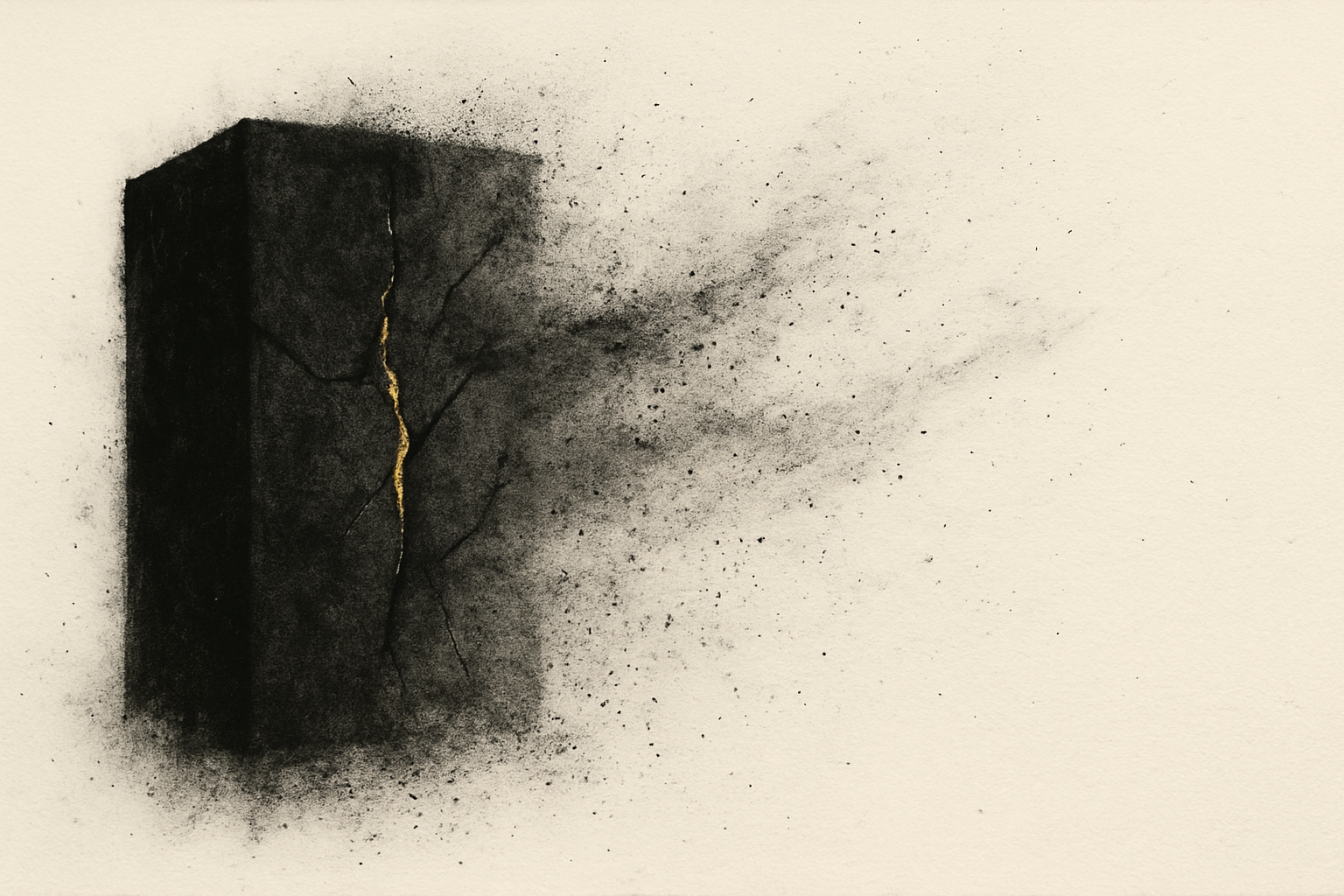
The Illusion of Certainty
La ilusión de la certeza
A student in a period of life upheaval asks how to cope with overwhelming uncertainty about work, home, and country. The teacher reframes the crisis, suggesting that what feels like "too much uncertainty" is actually the collapse of an illusion of certainty that was never real.
The Illusion of Certainty
A student in a period of life upheaval asks how to cope with overwhelming uncertainty about work, home, and country. The teacher reframes the crisis, suggesting that what feels like "too much uncertainty" is actually the collapse of an illusion of certainty that was never real.
You were talking about surrender. You can't force that in any way. I'm in a crisis right now. Everything is unstable: my work, where I'm going to live, even whether I'm going to stay in the same country. It's as if there's too much uncertainty, and there's fear. I notice there isn't surrender, there isn't trust, and that's probably causing the suffering. It's overwhelming. I don't know what to do, because many things compound each other into more uncertainty.
Something you said stands out to me: "too much uncertainty." Tell me about that.
I don't even know what I'll be working at in a few months. I don't know if I'll be kicked out of the country or not. I don't know if I'll be living in the house where I am now.
The illusion of knowing
And you have a sense that if you knew the answers to those questions, something would be different? Let's say I have some divine information and I give you answers to those questions, and you trust that it's true divine information. What changes?
I suppose I would suffer less. But I also know the suffering isn't really about knowing what's going to happen.
This is where you need to look at your experience and use memory in a practical sense. You can go back to a time when these matters were in question. Were you suffering less? Were things much better?
Not much better, but it wasn't so constantly intense.
Right. There was still suffering, but what there is now is a certain intensity. That intensity might not have anything to do with uncertainty. What else could it be? It could be that you're more naturally looking at reality directly.
You mean the process is in another phase?
Too much uncertainty as a belief
If you ask me what certainty I have, it's only one thing: that there is something rather than nothing. That's it. Everything else is extremely uncertain.
So my question isn't how to eliminate uncertainty. It's more how to be more okay with uncertainty.
You said there's "too much uncertainty." I highlighted that because it can turn into a belief, which it probably already is. It's a judgment on what has happened. It's a belief system about self: "There is too much uncertainty for me. Therefore, there needs to be less for me to be okay, or I need an increase in my capacity to be with uncertainty." But that narrative is built on the illusion that there's certainty in the first place, that you ever had any certainty about anything. You were just able to tell yourself better stories and believe them. It was still illusion, still no certainty. When you believed you were going to stay in Spain for five or ten years, that was a belief. That was not real. That was not knowing grounded in anything real.
Yes.
So you were better off inside the illusion. Now you're trying to go back to either more illusion or perhaps some other alternative. But when you say there's too much uncertainty, what I'm getting at is this: life is shaking you up. All of your illusions that you had any certainty about anything are starting to crumble. The intensity comes from reality, not from some issue with uncertainty.
When we wake up out of thought and into reality, it's intense. Not because we enter a world with more uncertainty. We enter reality where there is no uncertainty. We move out of the illusion of certainty, which is only possible in thought and beliefs. And when we're not used to dancing with that, it's a bit of a shock.
Surfing versus walking a straight line
Life isn't walking on a straight line along a well-built path, sorted out with indicators, where you step here and it's all laid out neatly. That's how we want it to be in thought. The reality is surfing, because what's happening is constantly moving. We are that movement, and the perspective we operate from is constantly moving with the reality that is constantly moving. There's something that's not moving as well, but at the level of life, it's an ocean and we're on that ocean, surfing.
If in your mind you're trying to walk on a straight line along a nicely built little road, with markings telling you where to step, where a bifurcation leads down one trail and then to another destination, that is how the mind plans and works with the future and the illusion of reality. Then you wake up from that and you realize you're on a wave. You're surfing, you're falling, and it's intense.
That's useful. There's also quite a lot of self-judgment. Like, "Come on, you're at a certain age, you've been through a process, and you're still so frightened of so many things." That also causes more suffering. The intensity increases, and then the judgment of the intensity increases on top of it.
Self-criticism as avoidance
You said that self-critical thoughts create more suffering. I'm not so sure. In fact, I'd say they probably don't. What if the self-critical thoughts are something you prefer, something you like more than something else that's happening? What if you prefer them more than facing a fear?
That could be true.
And if you prefer them, are you so sure it's more suffering? I wouldn't say it's more comfortable. But the narrative that you're doing this and it creates more suffering, and you shouldn't, and you should know better, and you should be past this (which is the self-critical thinking), all of that is helping you not look at something else.
I understand.
You're on the wave surfing. The wave is going this way, it's coming up that way, and it's scary. What are you going to do: jump off the board and think about yourself, or face the wave?
The waves are passing. They're coming, and you're not feeling ready. You're waiting for a better wave. In the meantime, you could be surfing and learning. Every moment is that option. The wave is reality. Waiting, contemplating, thinking, strategizing: that is self-involved thought. Versus flowing with what is and the vitality of aliveness.
I know you know both, but I'm highlighting this: you're in a moment where your life is pushing you to jump into the ocean and get on those waves, the ones you've been afraid of.
Bigger waves, more fun
So this is a moment of big waves.
They just keep getting bigger and bigger. And more fun. The more you wake up and grow, the bigger the waves get, the more fun and the more aliveness there is. It doesn't necessarily have to do with a certain intensity, but with a certain depth. Vaster ocean, vaster waves.
The fear is of drowning, but you can learn in the process that you can breathe underwater. That's where you're really free to take on any wave that comes.
It's just that sometimes my mind says I can't.
You realize you can breathe underwater when you take on the waves. You get pounded. It happens over and over and over again, until you cannot get your head out of the water, and then you realize you can breathe underwater. You don't realize this standing on the shore or waiting for the perfect wave and having them pass you by. You realize it once you think you're drowning, once you're underwater and can't get your head out. And then you go: "I'm okay."
Although this is a metaphor. Don't try it in the actual ocean.
Okay. Thanks.
There's nothing to lose. Just dive in and have fun. I think that's the bigger challenge for you: to realize you can have fun. Drop the pattern of complaining about what's happening, the rumination. Just have fun. Play. Discover that it's there. It's a part of you that you've forgotten. That's why I'm using the metaphor of surfing, because people travel the world to do it. It's challenging, but it's fun.